Front Trunklink
Last updated: December 20, 2023
Overviewlink
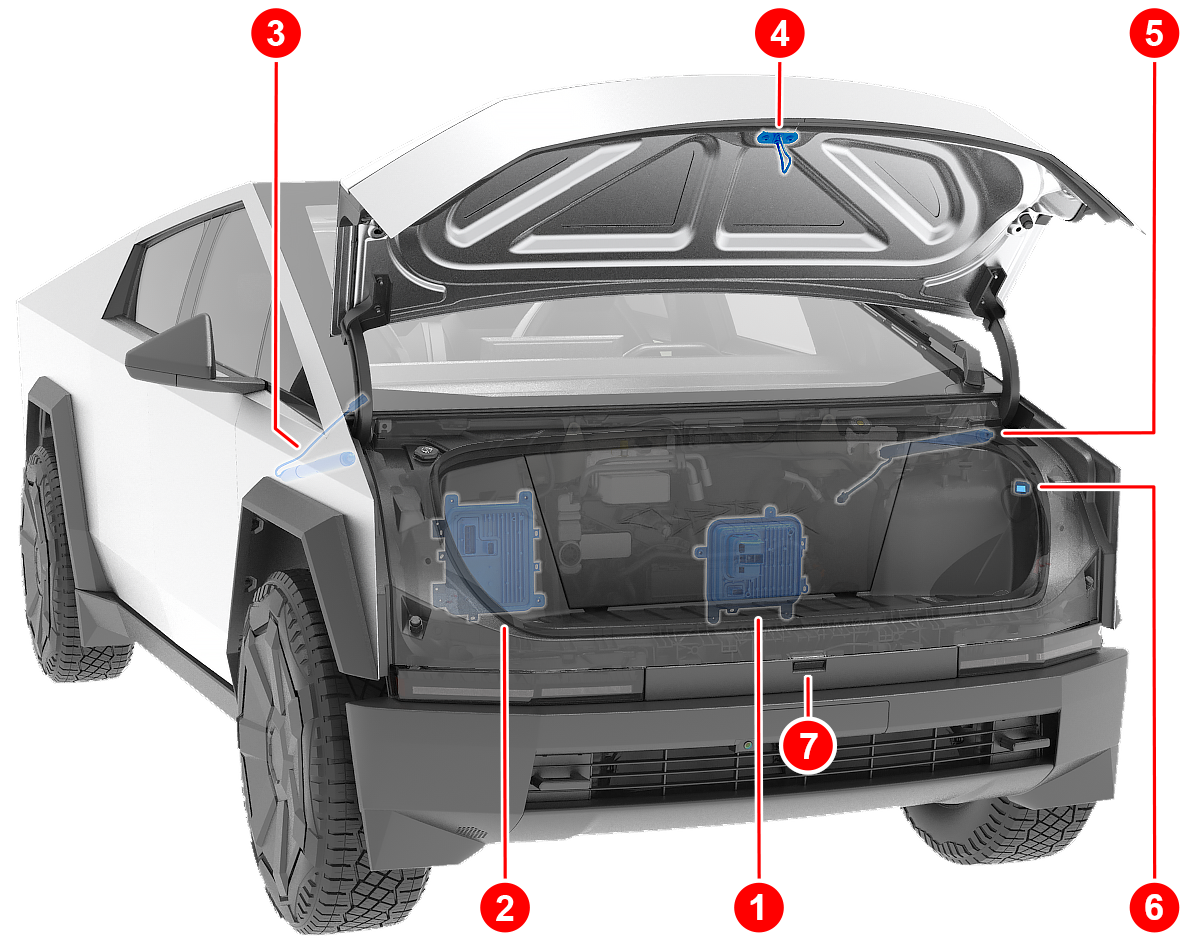
The Cybertruck front trunk, also called "frunk", is a storage compartment located at the front of the vehicle. The hood can be opened and closed from an exterior control switch, from the vehicle's User Interface (UI), or from the mobile app to access the cargo space. The hood is electrically operated by a double-pull cinching latch and two power struts.
Specificationslink
The main components are:
- Left vehicle controller (VCLEFT and EGGLEFTVC)
- Right vehicle controller (EGGRIGHT1)
- Two power struts
- Double-pull cinching latch
- Exterior control switch
- Interior release switch
- Hood striker
 |
|---|
| 1. Right power strut 2. Hood striker 3. Left power strut 4. Right vehicle controller 5. Latch cinching actuator 6. Left vehicle controller 7. Exterior control switch 8. Latch 9. Interior release switch |
| Front trunk - Overview |
When requested to open, the front trunk latch is first released by using a built-in electrical actuator. Once unlatched, the hood is then raised by two power struts located on the left and right sides of the hood.
Note
The struts are powered during the latch release to help the front trunk exit the latch secondary position.
When requested to close, the hood is lowered by the two power struts until the hood's striker is engaged in the latch. Once engaged in the secondary position, the latch actuator performs a cinching actuation to bring the latch in a fully closed position. During the cinching actuation, the power struts continue to actuate until the latch has finished cinching, to ensure that the cinch lever properly engages the ratchet. A single chime will play when the closing motion begins.
The front trunk can only be released if the vehicle is not in motion and unlocked. The power struts position and current are monitored to detect any obstacle or pinch events. If an obstacle or pinch event is detected, a double "harsh" chime will play and the frunk will reverse to either the angle where the front trunk began its closing motion or the angle where the frunk can support its own weight when unpowered, whichever angle is lower.
Info
Interior release switch requests while vehicle is in motion will not release the primary latch. Instead, they will be reported to the driver with an alert on the User Interface (UI).
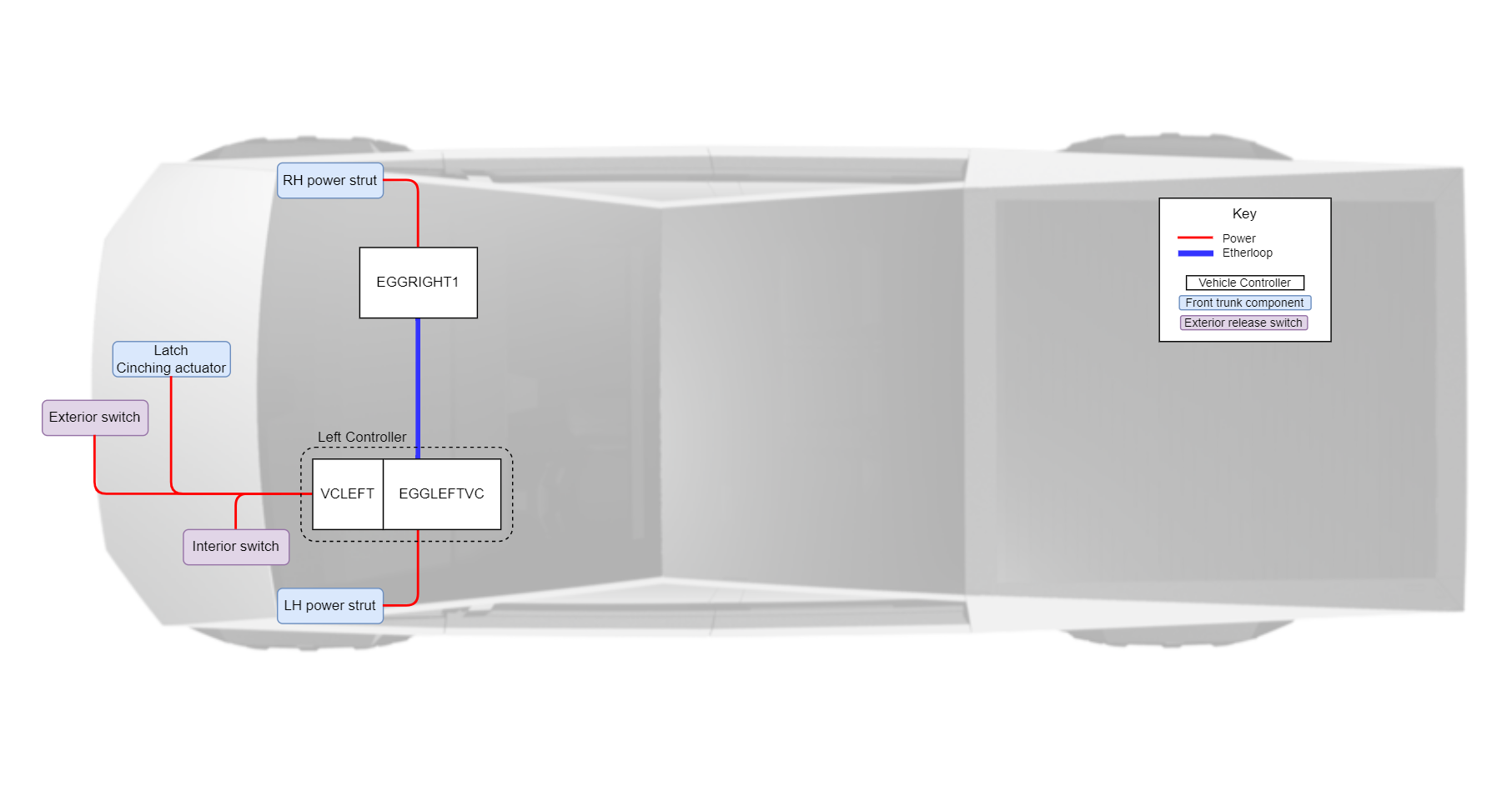
The left strut is controlled by EGGLEFTVC, the two frunk control switches and latch electrical actuator are controlled by the VCLEFT, and the right strut is controlled by EGGRIGHT1.
 |
|---|
| Overview of the front trunk communication and power architecture |
Operationlink
There are four methods to open the front trunk:
- By pressing the front trunk interior release switch, which is detected by VCLEFT directly.
- By pressing the front trunk exterior release switch, which is also detected by VCLEFT directly.
- By pressing the front trunk open button on vehicle UI, which is sent over the Etherloop from the UI to VCLEFT.
- By pressing the front trunk open button on the Tesla mobile app, which is either:
- If coming from an authenticated phone as key, it is sent over Bluetooth to VCSEC, which is then communicated to VCLEFT over an internal CAN bus.
- Otherwise, it is sent over Internet to the UI and then transmitted to VCLEFT over Etherloop.
Frunk Access Post
The front trunk can be released through the frunk access post in case of vehicle power loss. For additional information, refer to the Shutdown and Recovery document.
Note
VCSEC is integrated in the VCLEFT controller.
If the vehicle is unlocked and meets the criteria to release the latch, VCLEFT commands the hood latch to perform a full release actuation:
- The latch actuator performs a first actuation to release the latch out the fully closed (primary) position.
- Once the striker moves out of the primary position and the latch actuator returns to its home position, a second release actuation is performed to fully open the hood latch.
Pre-requisite
VCLEFT will only release the hood latch if the vehicle is not in motion.
If the vehicle speed is not available, VCLEFT will check that the vehicle is in the park gear and that the park brakes are engaged.
Once the hood latch is released, if the vehicle meets the criteria to perform a power open actuation:
- EGGLEFTVC sends a request to EGGRIGHT1 to extend the right strut.
- EGGLEFTVC and EGGRIGHT1 starts extending the left side and right side struts respectively.
- Both EGGLEFTVC and EGGRIGHT1 monitor their strut current and position to detect any potential obstacles.
- If any obstacles are detected, the actuation stops immediately.
- The power struts actuation will slow down as they approach the target position and stop once reached.
Pre-requisite
The front trunk will only perform a power opening actuation if the struts position is calibrated.
The front trunk opening height is adjustable and can be set by following these three steps:
- Open the hood and manually adjust it to the desired opening height.
- Press the exterior control switch for a few seconds until two confirmation chimes are heard.
- Confirm the hood opens to the desired height by closing and reopening it.
When opened, the front trunk can be closed from the interior release switch, exterior release switch, vehicle UI, and Tesla mobile app. If a closing request is received, VCLEFT performs a power close actuation:
- EGGLEFTVC sends a request to EGGRIGHT1 to retract the right strut.
- EGGLEFTVC and EGGRIGHT1 start retracting the left side and right side struts respectively.
- Both EGGLEFTVC and EGGRIGHT1 monitor their strut current and position to detect any potential obstacle.
- If any condition is detected, the actuation stops immediately and the front trunk will back off.
- When backing off, the front trunk will return to either the angle where the front trunk began its closing motion or the angle where the frunk can support its own weight when unpowered, whichever angle is lower.
- Once the latch detects the hood striker is engaged in the secondary position, the latch actuator performs a cinching actuation to secure the hood striker in the fully closed position.
- The power struts actuation only stops after the latch is engaged in the primary (fully closed) position.
Info
The front trunk will always power close if opened even if the struts position is not calibrated.
Power Strutslink
 |
|---|
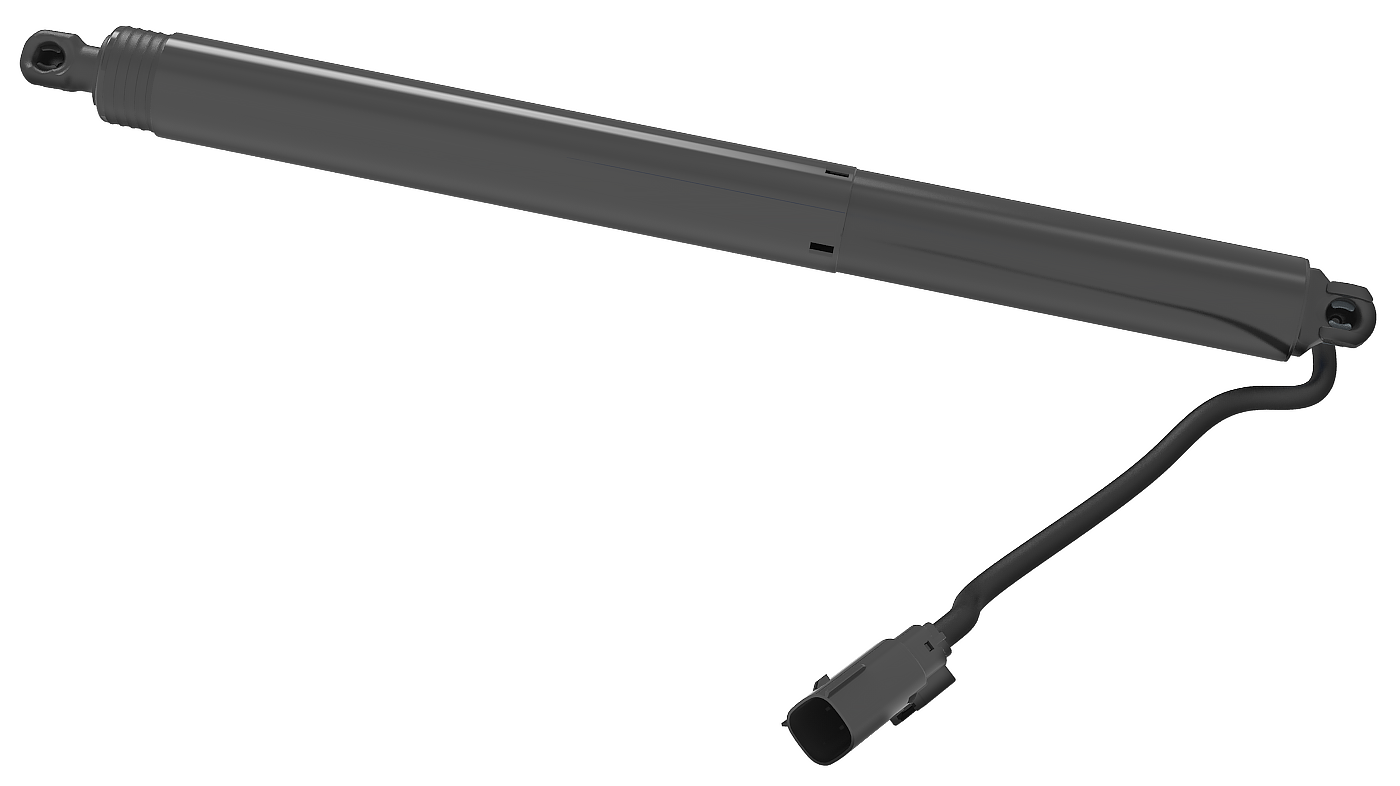
| Front trunk power strut |
The front trunk raises and lowers automatically using two power struts located on the left and right side of the hood, controlled by EGGLEFTVC and EGGRIGHT1.
The power strut includes a Direct Current (DC) motor connected to a gear mechanism, which transfers the motor rotational motion to a spindle that extends and retracts the strut assembly. The power strut position is sensed by two hall sensors for full quadrature encoding.
The power struts are calibrated when their zero (fully retracted) position is known. The struts zero position is re-learned every time the latch enters and leaves the closed state to compensate for potential drift in the hall sensor encoder count and travel in the struts. If uncalibrated, the front trunk will not fully open automatically, but can close using conservative speed and obstacle detection settings.
The power strut can lose its calibration if during an actuation, one of the following conditions is detected:
- Strut current is below a pre-defined value while exiting the latch area.
- Strut hall sensor encoder count did not change since it entered the latch exit state.
- Struts position is higher than a threshold angle when the front trunk latch is closed.
Note
Both struts are uncalibrated when one of the two struts meets one of the above criteria.
If the position of the two struts differ by a pre-determined amount, front trunk movement will be restricted. Additionally, the power strut current and position are monitored by their corresponding vehicle controller.
- If the current spikes above a pre-defined value (in amps per second) or the absolute current is above a pre-defined threshold value (in amps) while...
- ...opening, then an obstacle detection event is triggered and the front trunk actuation stops.
- ...closing, then a pinch detection event is triggered, and the front trunk opens up to free any potential pinched object.
Double-pull cinching latchlink
 |
|---|
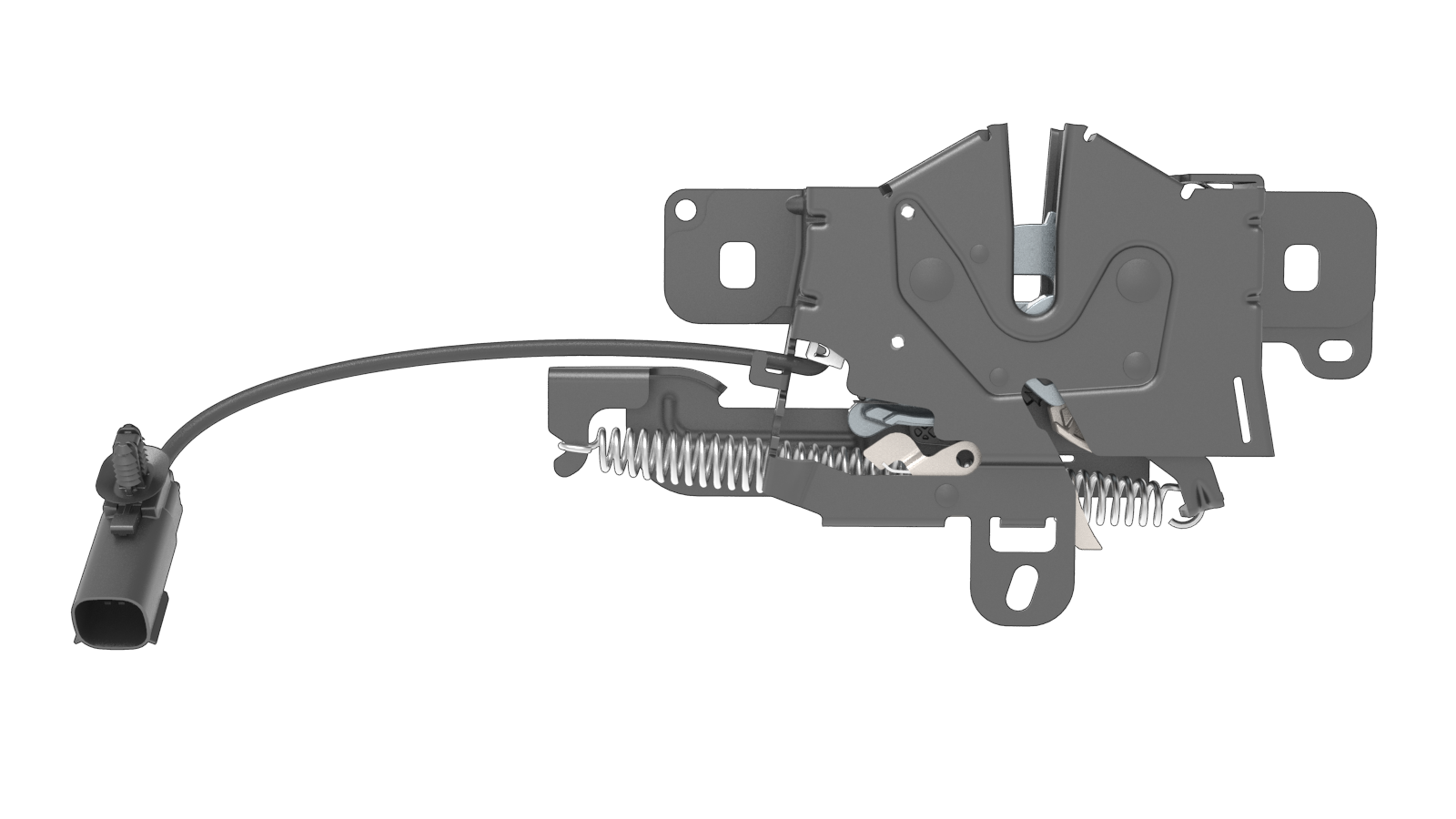
| Double-pull cinching latch |
The front trunk latch is a double-pull cinching latch, capable of releasing and cinching.
The latch is called a "double-pull cinching latch" because the release actuation is in two phases:
- On the first pull, the latch is released from fully closed (primary) to AJAR (secondary) position.
- On the second pull, the latch is fully released from AJAR (secondary) to fully open position.
The release and cinching of the latch is performed by an external electrical actuator. It contains DC motor and a switch reporting whether the cinch motor is at its home position.
There are four switches sensing the position of the latch
- Two AJAR switches, one Normally Open (NO) and one Normally Closed (NC), reporting whether the striker is engaged in the primary position (fully closed).
- One pawl fully open switch, NO, reporting whether the latch is in secondary or fully open position.
- One pawl switch, NO, reporting when a release actuation has completed, and is used to inform certain latch states (see table below).
The table below summarizes the mechanical and electrical states of each switch and the corresponding latch state.
| Latch State | AJAR switch #1 (NO) | AJAR switch #2 (NC) | Pawl fully open switch | Pawl switch |
|---|---|---|---|---|
| Fully closed | Not pressed / Open circuit | Not pressed / Closed circuit | Not pressed / Open circuit | Not pressed / Open circuit |
| AJAR (secondary position) | Pressed / Closed circuit | Pressed / Open circuit | Not pressed / Open circuit | Pressed / Closed circuit |
| Open | Pressed / Closed circuit | Pressed / Open circuit | Pressed / Closed circuit | Pressed / Closed circuit |
In the event where one of the switch voltage values is outside the open or closed state ranges or is implausible (AJAR switches reporting contradicting positions), the hood latch will become faulted.
When no actuation is taking place, the frunk latch actuator rests at its home position, which is detected by a dedicated switch.
When commanded to release, it will actuate in the release direction until the pawl switch is pressed. When commanded to cinch, it will actuate in the cinch direction until the striker is engaged in the primary position.
After a cinch or release actuation, the actuator will then actuate in the opposite direction until the actuator home position switch is no longer pressed, indicating that the actuator is in the home position.
If the appropriate switch transitions are not seen to signal the end of an actuation, the actuation will stop after a predefined time period.
Serviceabilitylink
In the event the front trunk is not functioning as expected, the first step is to understand which functionality is impacted.
- Front trunk latch does not function as expected.
- Front trunk power struts do not function as expected.
Overviewlink
EGGLEFTVC reports the main state of the front trunk with a dedicated CAN signal.
| CAN signal name | CAN signal values | Description |
|---|---|---|
EGGLEFTVC_liftgateState |
12 PLG_STATE_LATCH_ENTRY 11 PLG_STATE_END_OF_TRAVEL 10 PLG_STATE_LATCH_EXIT 9 PLG_STATE_UNKNOWN 8 PLG_STATE_NOT_INSTALLED 7 PLG_STATE_LATCH_CLOSING 6 PLG_STATE_LATCH_OPENING 5 PLG_STATE_CLOSED 4 PLG_STATE_CLOSING 3 PLG_STATE_OPENING 2 PLG_STATE_BACKOFF 1 PLG_STATE_OFF 0 PLG_STATE_INIT |
Front trunk main state |
EGGLEFTVC also logs the source of the front trunk movement.
| CAN signal name | CAN signal values | Description |
|---|---|---|
EGGLEFTVC_liftgateRequestSource |
8 PLG_REQUEST_SOURCE_EMERG_RELEASE 7 PLG_REQUEST_SOURCE_UDS 6 PLG_REQUEST_SOURCE_PARTY 5 PLG_REQUEST_SOURCE_VCSEC_COMMAND 4 PLG_REQUEST_SOURCE_KEY_TRUNK_BUTTON 3 PLG_REQUEST_SOURCE_SHUTFACE 2 PLG_REQUEST_SOURCE_EXTERIOR 1 PLG_REQUEST_SOURCE_MCU_SWITCH 0 PLG_REQUEST_SOURCE_NONE |
Front trunk actuation request source |
Additionally, the following CAN signals can be used to monitor the requests received from the interior, exterior, and User Interface (UI) switches.
| CAN Signal name | CAN Signal value | Description |
|---|---|---|
VCLEFT_frunkExteriorSwitchStatus |
0 or 1 |
Frunk exterior switch state (pressed when equal to 1) |
VCLEFT_frunkEmergReleaseButtonPressed |
0 or 1 |
Frunk interior release switch state (pressed when equal to 1) |
UI_frunkRequest |
0 or 1 |
User Interface (UI) frunk release switch state (pressed when equal to 1) |
Latchlink
Diagnosticlink
If the front trunk latch does not function as expected, it may cause the front trunk to not open or close as expected. Before diagnosing a front trunk latch issue, always confirm whether the latch status is correct.
If incorrect, there might be an issue with one or more of the latch switches or with the wiring between the latch and VCLEFT.
If correct, understand which latch functionality is impacted.
- If the latch does not release as expected, confirm from which source this happened.
- If the issue only happens when using the interior or exterior release switch, there might be an issue with the switch or its wiring.
- If the issue happens from all sources, there might be an issue with the latch electrical actuator or with the latch mechanical assembly.
- If the latch releases unexpectedly, confirm from which source this happened.
- If latch release requests are received from the interior switch while driving, confirm whether there was any object in the front trunk at that time.
- If latch releases from the interior or exterior release switch without the user physically pressing the switch, there might be an issue with the switch or its wiring.
- If the latch releases from the User Interface (UI) or Vehicle Controller Security (VCSEC), someone may have accidentally requested the front trunk to open.
- If the latch does not close as expected.
- If the front trunk latch does not close at all, there might be an issue with the latch mechanical assembly or with the electrical actuator being stuck in the release position.
- If the front trunk latch closes manually but not automatically, there might be an issue with the electrical actuator.
VCLEFT monitors the state of the front trunk latch at all times and may trigger alerts when specific conditions are detected.
| Alert name | Description | Impact |
|---|---|---|
VCLEFT_a394_frunkLatchHighCurrent |
Frunk latch actuator stalled due to high current. | Cinching actuator stalled unexpectedly, so latch may fail to cinch or release as expected. |
VCLEFT_a395_frunkLatchUnexpectedSwitchStates |
Frunk latch home position switch, pawl, or pawl fully open switches are in unexpected states. | Latch state is unknown, so latch may fail to cinch or release as expected. |
VCLEFT_a396_frunkLatchRehomeTimedOut |
Frunk latch actuator failed to return to its home position within allowed time frame. | Release actuator might be stuck in the cinch or release position, causing the latch to not open or close as expected. |
In addition, VCLEFT reports the latch status with dedicated CAN messages.
| CAN signal name | CAN signal values | Description |
|---|---|---|
VCLEFT_frunkLatchStatus |
8 "LATCH_FAULT" 7 "LATCH_DEFAULT" 6 "LATCH_TIMEOUT" 5 "LATCH_AJAR" 4 "LATCH_OPENING" 3 "LATCH_CLOSING" 2 "LATCH_CLOSED" 1 "LATCH_OPENED" 0 "LATCH_SNA" |
Front trunk latch state |
VCLEFT_frunkLatchSwitchHome |
0 or 1 | Front trunk latch actuator switch state |
Repairlink
The latch, latch striker, and its electrical actuator are serviceable components. No ODIN routine needs to be run after replacing either component.
Warning
The striker uses stainless steel fasteners to attach to the stainless steel hood and cannot handle the use of power tools with high RPM as it may cause thread galling.
Make sure to always use manual torque wrench to secure the striker fasteners.
In the event the latch release actuator is stuck outside of its home position, it is possible to force a re-home actuation by running ODIN routine PROC_VCLEFT_X_FORCE-FRUNK-LATCH-RESET.
Power strutslink
Diagnosislink
If the front trunk power struts do not function as expected, it may cause the front trunk to not raise or lower as expected.
EGGLEFTVC and EGGRIGHT1 post multiple CAN signals to report their respective strut status.
| CAN signal name | CAN signal values | Description |
|---|---|---|
EGGLEFTVC_liftgatePosition |
-5 to 95 |
Left strut position (in degrees) |
EGGLEFTVC_liftgatePositionCalibrated |
0 or 1 |
Left strut position calibration status |
EGGLEFTVC_liftgateStrutCurrent |
-30 to -30 |
Left strut current (in amps) |
EGGLEFTVC_liftgateSpeed |
-30 to 30 |
Left strut speed (in deg/s) |
EGGRIGHT1_liftgatePosition |
-5 to 95 |
Right strut position (in degrees) |
EGGRIGHT1_liftgatePositionCalibrated |
0 or 1 |
Right strut position calibration status |
EGGRIGHT1_liftgateStrutCurrent |
-30 to -30 |
Left strut current (in amps) |
EGGRIGHT1_liftgateSpeed |
-30 to 30 |
Left strut speed (in deg/s) |
Additionally, EGGLEFTVC and EGGRIGHT1 report the front trunk stopping condition, if any.
| CAN signal name | CAN signal values | Description |
|---|---|---|
EGGLEFTVC_liftgateStoppingCondition |
12 PLG_STOPPING_CONDITION_FOLLOWER_REQUEST11 PLG_STOPPING_CONDITION_OBSTACLE_CURRENT_SPIKE 10 PLG_STOPPING_CONDITION_LATCH_FAULT 9 PLG_STOPPING_CONDITION_UNCALIBRATED 8 PLG_STOPPING_CONDITION_OBSTACLE_TRAJ_VEL 7 PLG_STOPPING_CONDITION_OBSTACLE_TRAJ_POS 6 PLG_STOPPING_CONDITION_OBSTACLE_CURRENT 5 PLG_STOPPING_CONDITION_VEHICLE_AT_SPEED 4 PLG_STOPPING_CONDITION_STATE_TIMEOUT 3 PLG_STOPPING_CONDITION_LOW_12V 2 PLG_STOPPING_CONDITION_OBSTACLE_STALL 1 PLG_STOPPING_CONDITION_PINCH 0 PLG_STOPPING_CONDITION_NONE |
Front trunk main stopping condition |
EGGRIGHT1_liftgateFollowerStopReason |
2 PLG_FOLLOWER_STOPPING_CONDITION_OBSTACLE_CURRENT_SPIKE 1 PLG_FOLLOWER_STOPPING_CONDITION_OBSTACLE_CURRENT 0 PLG_FOLLOWER_STOPPING_CONDITION_NONE |
Front trunk follower stopping condition reason |
EGGLEFTVC and EGGRIGHT1 monitors the state of their respective power strut at all time and may trigger alerts when specific conditions are detected.
| Alert name | Description | Impact |
|---|---|---|
EGGLEFTVC_a352_frunkClosingLatchEntryFailed |
Front trunk is not detected to have engaged the secondary latch position while closing. | Front trunk may not close automatically. |
EGGLEFTVC_a354_frunkUncalibrated |
Front trunk struts are not calibrated. | Front trunk may not open automatically. |
EGGLEFTVC_a355_frunkUnexpectedStop |
Front trunk movement stopped unexpectedly due to a condition detected on the left strut. See payload signal that reports the stopping condition for details. | Front trunk opening or closing actuation did not succeed. |
EGGLEFTVC_a359_frunkLatchExitNoPositionChange |
Front trunk left strut encoder count did not change while the current flowing to the strut was nominal. | Strut position will be uncalibrated |
EGGRIGHT1_a579_frunkFollowerUnexpectedStop |
Front trunk movement stopped unexpectedly due to a condition detected on the right strut. See payload signal that reports the stopping condition for details. | Front trunk opening or closing actuation did not succeed. |
Repairlink
Both power struts are serviceable components. No ODIN routine is required to be run after replacing either strut.
Note
After replacing a power strut, the first closing actuation may fail due to the new strut position not aligning with the saved position on the vehicle controller. A subsequent closing actuation should be successful and will re-calibrate the struts position.