Front Trunklink
Last updated: October 20, 2023
Overviewlink
The front trunk, also called "frunk", is a storage compartment located at the front of the vehicle. The cargo space can be accessed by lifting the hood, which is held closed by the gas struts and the electrically operated latch system.
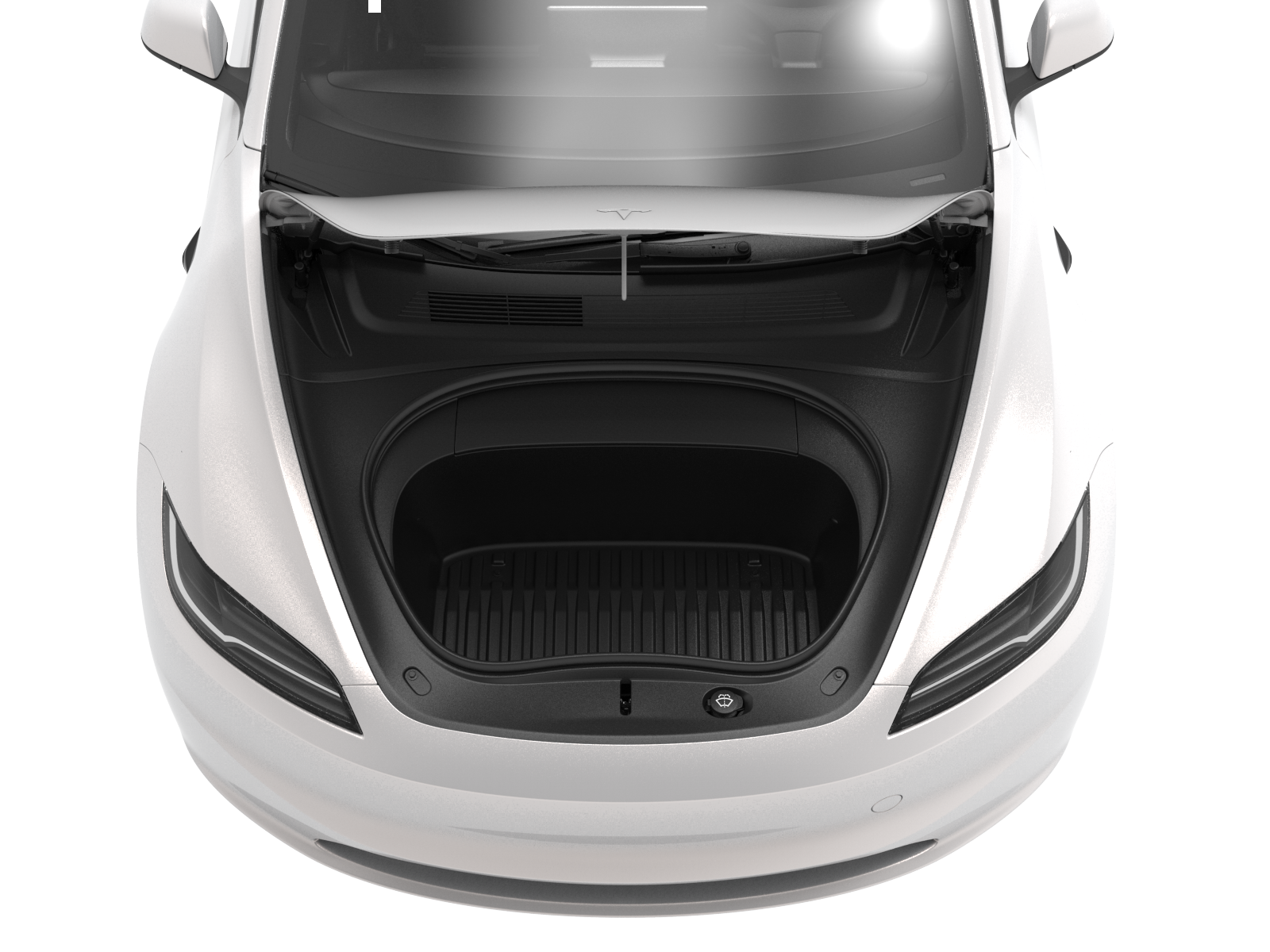 |
|---|
| Front Trunk Overview |
Specificationslink
The hood latch is a double pull frunk latch composed of a metallic latch mechanism connected by a cable to a pull-actuator. There is a single actuator that can pull the latch into three states:
- Primary latched (fully closed)
- Secondary latched (ajar, half-way open)
- Fully released (able to be lifted open)
The hood latch and release actuator(s) are controlled by the front vehicle controller (VCFRONT). The hood latch has various states in order to ensure the hood is securely latched.
| State | Function |
|---|---|
| Primary | The hood is closed and the striker is fully in the latch. The firmware reads this position as closed. |
| Secondary | The hood is still in the closed position, although the latch has moved from fully closed to partially closed. Secondary is a redundant feature to ensure that the latch does not open unexpectedly. The vehicle reads this position as open. |
| Open | The striker is no longer engaged by the claw and is free to allow the hood to fully open. The vehicle reads this position as open. |
The hood is held closed by a striker located on its underside. When closed, the striker is engaged inside the latch primary and secondary mechanisms.
When the front trunk is opened from the touchscreen or mobile application, the latch actuator pulls the latch pawl which rotates the claw from the primary position to the secondary position. The actuator then pulls again on the pawl to rotate the claw to open allowing the striker to move freely out of the latch.
Electrical release of the hood latch is blocked when the vehicle is in drive, and would require two separate false electrical signals to fully release. If the latch is open during drive, both the force of the gas strut and airflow pushes the hood in the closed direction. Both features are intended to prevent loss of visibility when driving.
There is an emergency release button located inside the frunk which will be illuminated for a certain duration post frunk closure.
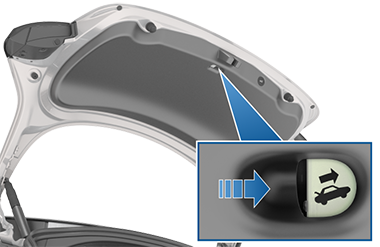 |
|---|
| Front Trunk Emergency Release Button |
The front trunk can also be opened by the frunk access post if the vehicle 12V battery is discharged.
 |
|---|
| Front Trunk Access Post |
Component Operationlink
User Interactionlink
There are 4 methods of opening the front trunk:
- Touch Controls > Front Trunk on the touchscreen.
- Use mobile app and touch Controls > Open on frunk
- Press the interior emergency release button.
- If pressed while the vehicle is driving, only the primary latch is released to allow air to pass through.
- If pressed when not driving, both primary and secondary latches are released.
- Apply 12V to the frunk access post (refer to the Frunk Access Post section for further details on the release conditions).
Note
If frunk access post is used to open the front trunk when the vehicle is locked and the alarm active, the alarm will sound.
To close the front trunk, lower the hood to the closed position and then push down gently on both sides of the hood to engage the primary and secondary latches. Do not push at the very edge or very center of the hood. The hood is aluminum and can be damaged if too much force is applied on one small spot.
Warning
Do not drive the Model 3 with the hood retained by the secondary catch alone. Lift the front edge of the hood to ensure that it is correctly closed.
Hood Latchlink
The front hood latch has built-in primary and secondary latches that can be released by a single release actuator, which is controlled by the front vehicle controller.
 |
|---|
|
| Front Trunk Release Actuators |
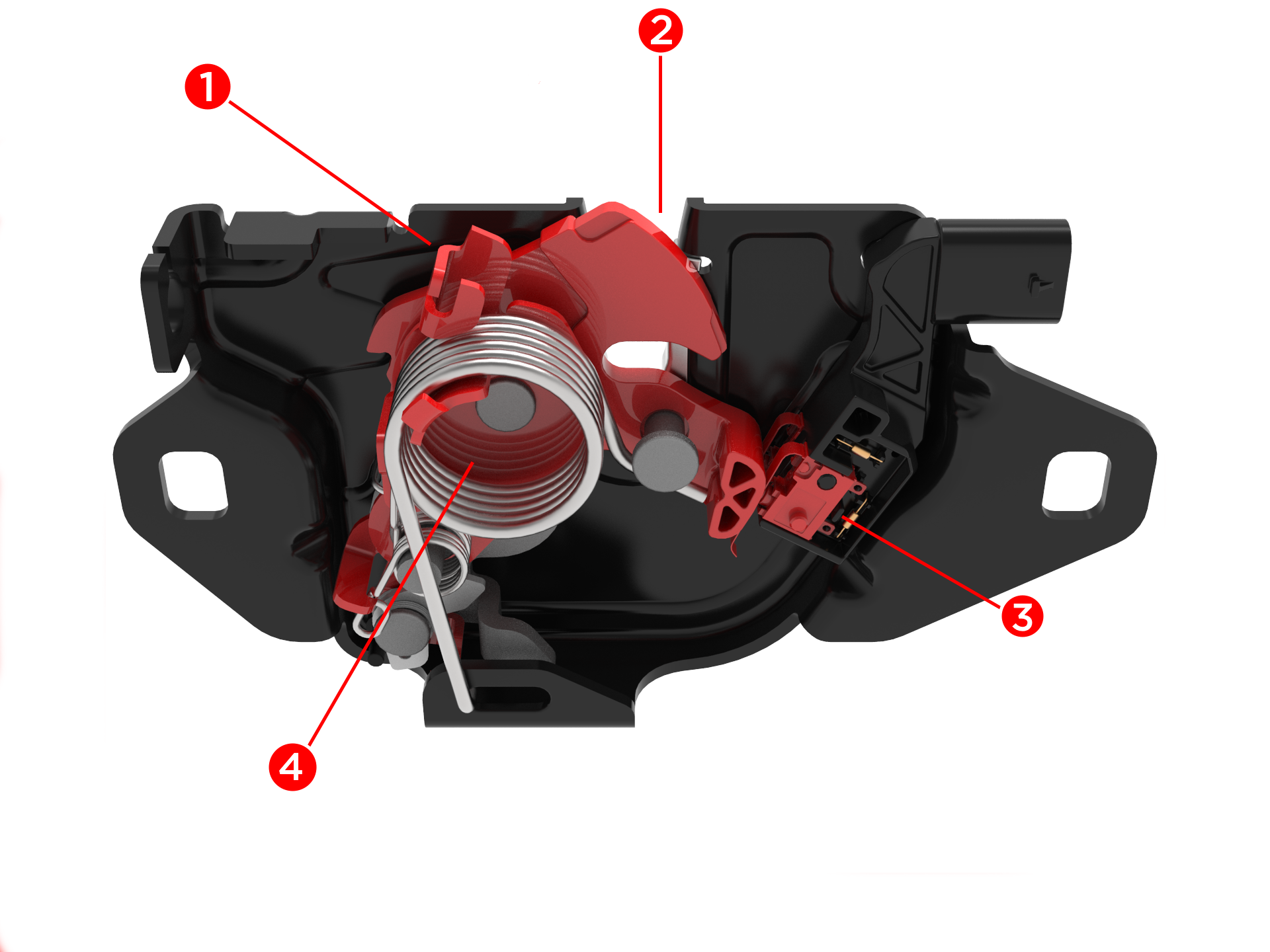 |
|---|
|
| Front Trunk Latch Components |
As the primary and secondary latches share the same release actuator, the front vehicle controller can issue two types of release command:
- half release to only unlatch the primary
- full release to unlatch both primary and secondary latches
If commanded to perform a half release, the single release actuator will:
- Pull in the release direction for 120ms.
- Pull in the opposite direction for 110ms.
If commanded to perform a full release, the single release actuator will:
- Pull in the release direction for 120ms.
- Pull in the opposite direction for 110ms.
- Pull again in the release direction for 120ms.
- Pull finally in the opposite direction for 110ms.
There are two switches detecting the position of the latch claw, and their status are classified as follow when no actuation is taking place:
| Hood Latch | Switch 1 Electrical state | Switch 2 Electrical state | Switch 1 Mechanical State | Switch 2 Mechanical State |
|---|---|---|---|---|
| Opened | Circuit Closed | Circuit Open | Not Pressed | Not Pressed |
| Closed | Circuit Open | Circuit Closed | Pressed | Pressed |
| Faulted | Circuit Closed | Circuit Closed | Not Pressed | Pressed |
| Faulted | Circuit Open | Circuit Open | Pressed | Not Pressed |
The status of the switches is determined by reading the switch voltage, which is classified as follow:
| Status | Voltage |
|---|---|
| Shorted | 0V - 0.01V |
| Switch Closed | 0.01V - 3.5V |
| Faulted | 3.5V - 4.2V |
| Switch Open | 4.2V - 4.8V |
| Disconnected | 4.8V - 5V |
Hood latch status is faulted if any of the following condition becomes true:
- Either of the latch switches are shorted for 500ms.
- Either of the latch switches are disconnected for 500ms.
- Either of the latch switches are faulted for 500ms.
- If one switch is mechanically pressed while the other is mechanically not pressed for 500ms.
Speed Limitationlink
If the vehicle enters Drive while the frunk is reported as open, the vehicle touchscreen will show a pop-up asking the user to check the front trunk is secured before proceeding with drive. If the frunk is closed while the pop-up is displayed, it will disappear. If for any reason the front trunk cannot be closed or if the closed status is not detected, then the pop-up can be overridden but will cause the vehicle speed to be limited to 15 mph or 24 kph for the entire drive cycle.
This system is designed to prevent the hood from flipping open by maintaining a driving speed at which the air won't apply sufficient force to uplift an unlatched hood.
Frunk Access Postlink
Jumper posts are located under the tow hook cap on the front fascia. There are two jumper leads that need to be fished out after removing the tow hook cap.
When 12V source is applied, the frunk will open if one of the requirements listed below is met:
- The vehicle battery voltage is below the jump voltage (12.2V).
- The vehicle is unlocked.
The frunk access post will only cause the frunk latch to release if the vehicle is not moving.
This is intended to prevent the frunk from opening in situation where it is not required to, while offering a way of accessing the frunk in case the front vehicle controller is unresponsive.
Serviceabilitylink
The frunk latch status is reported by the front vehicle controller signal VCFRONT_frunkLatchStatus and can be monitored to diagnose frunk latch related issue. The latch status is mainly determined by the value of the latch switch(es) but also rely on different conditions to detect potential malfunction in the system operation.
The hood release requests can be monitored by viewing the values reported by each request source:
| Request Source | CAN Signal |
|---|---|
| Key fob or key phone request | VCSEC_frunkRequest |
| Interior emergency release switch request | VCFRONT_frunkInteriorRelSwitch |
| Frunk access post request | VCFRONT_frunkAccessPost |
| MCU (touchscreen) request | UI_frunkRequest |
The front vehicle controller sets different alert to report unexpected or special event. There are alerts common to the different latch variants listed below and additional alerts for each latch variant listed in their respective section.
| Alert | Description |
|---|---|
| VCFRONT_a303_frunkAccessPostActive | An external voltage source is detected at the frunk access post. |
| VCFRONT_a304_frunkReleaseFailed | Frunk failed to open after being commanded to release. |
The UI also sets an alert when the vehicle enters drive with the frunk latch opened:
| Alert | Description |
|---|---|
| UI_a004_FrunkOpen | Front trunk primary or secondary latch open when vehicle gear is not Park |
The table below summarizes the frunk latch signal values and their description:
VCFRONT_frunkLatchStatus |
Description |
|---|---|
| 8 "LATCH_FAULT" | The frunk latch switch value(s) indicate either an error with the switch voltage or a sequence identified as a fault. |
| 7 "LATCH_DEFAULT" | Default frunk latch status when initializing the latch state machine. |
| 6 "LATCH_TIMEOUT" | |
| 5 "LATCH_AJAR" | The frunk latch is in AJAR position (primary unlatched but not secondary). |
| 4 "LATCH_OPENING" | The frunk latch is releasing either the primary, the secondary, or both. |
| 3 "LATCH_CLOSING" | Not applicable to single actuator frunk latch. |
| 2 "LATCH_CLOSED" | The frunk latch is closed with the striker engaged and secured, |
| 1 "LATCH_OPENED" | The frunk latch is opened with the striker disengaged. |
| 0 "LATCH_SNA" |
If the vehicle enters Drive with the frunk opened, the vehicle will apply a speed limit of 15 mph or 24 kph for the entire drive cycle (see Speed Limit section for details).