Tire Pressure Monitoring System Gen3 (BLE)link
Last updated: May 23, 2024
Introductionlink
A Tire-Pressure Monitoring System (TPMS) is an electronic system designed to monitor the air pressure inside the pneumatic tires. TPMS reports real-time tire-pressure information to the driver of the vehicle, either via the User Interface (UI) gauge, a pictogram display, or a warning alert notification. Tesla uses a direct TPMS system (dTPMS). The target of a TPMS is avoiding traffic accidents, excessive energy consumption, and increased tire wear due to under-inflated tires through early recognition of a hazardous state of the tires.
Definition of termslink
| Term | Description |
|---|---|
| BLE | Bluetooth Low-Energy |
| ECU | Electronic control unit |
| RCP | Recommended cold pressure. This is the pressure that a tire should be filled to at the start of drive |
| Sensor ID | Identifies the wheel unit from other wheel units |
| TPMS | Tire pressure monitoring system |
| UI or HMI | User interface or human-machine interface. This refers to the instrument cluster or other driver-facing displays |
| VCSEC | Vehicle security controller - receiver of Tesla TPMS BLE signal |
| Wheel unit / Wheel sensor | The sensor package mounted to the wheel. The wheel unit holds temperature and pressure sensing elements as well as components that send and receive data via wireless communication |
TPMS Typeslink
The following tire pressure monitor systems are available:
| Baolong | Continental (Conti Gen 1) | Continental (Conti Gen 2) | BLE | |
|---|---|---|---|---|
| Model S | X | X | X | |
| Model X | X | |||
| Model 3 | X | X | ||
| Model Y | X | X | ||
| Palladium S | X | |||
| Palladium X | X |
Note
It is the driver’s responsibility to maintain correct tire pressure, even if under-inflation has not reached the level to trigger the TPMS warning light.
Warning
Driving on a significantly under-inflated tire severely increases the risk of the tire overheating, which might lead to sudden tire damage. Under-inflation also reduces range, tire durability, and affects the vehicle’s handling and braking ability.
The Tire Pressure Monitoring System (TPMS) is not a substitute for manually checking wheel conditions and adjusting tire pressures.
Do not use any tire liquid or aerosol tire sealant other than OEM supplied, as this might cause a malfunction of the tire pressure sensors.
Component Descriptionslink
Overviewlink
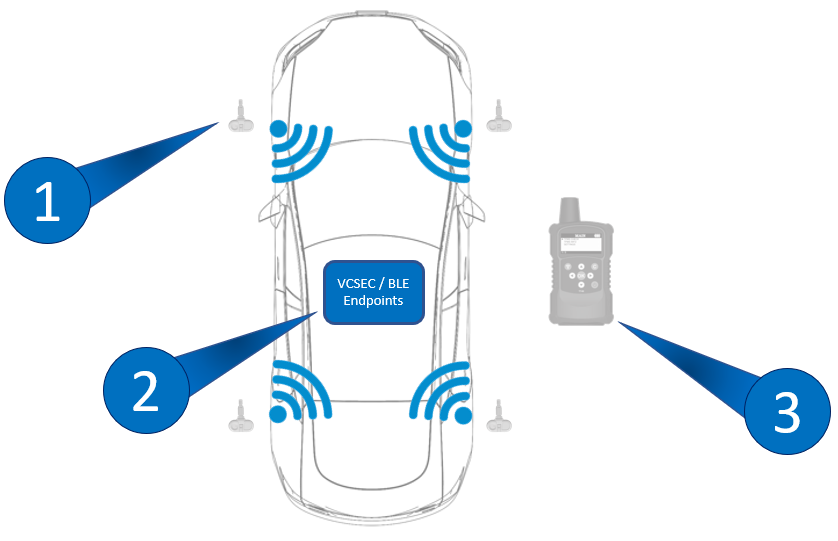
The BLE TPMS includes the regular tire pressure and temperature monitoring functionality of previous generation systems as well as additional features to identify other physical parameters of the tires such as tire diameter, width, speed rating, aspect ratio, and tread name.
No separate dedicated TPMS module is needed, instead the BLE TPMS relies on the Security Controller (VCSEC), its BLE antennas (both located in the A-Header), B-pillars, and rear bumper. The BLE protocol and frequency 2.4Ghz is commonly used worldwide which reduced the need for vehicle market dependent hardware.
 |
|---|
| 1. BLE TPMS Wheel Sensor 2. VCSEC / BLE Endpoints 3. TPMS Service Tool |
| Tesla TPMS Architecture |
TPMS Wheel Sensorslink
 |
|---|
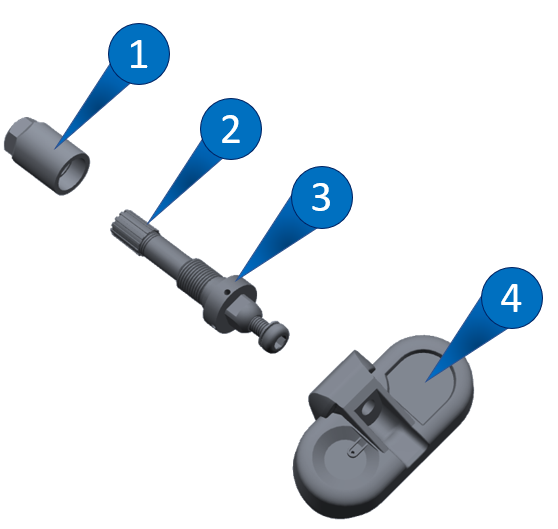
| 1. Valve Nut 2. Valve Cap 3. Valve Stem 4. Sensor Unit |
The TPMS Wheel Sensor is a sensor (also known as the transmitter) that is capable of providing the TPMS the current tire pressure, acceleration, and temperature. The sensor contains a pressure sensor, an accelerometer, a temperature sensor, a signal processor, and a BLE antenna. To avoid any contamination, the wheel sensor is equipped with a filter which prevents water, vapor, or dirt ingress.
The temperature sensor prevents pressure readings from being affected by variations in temperature.
Each sensor has a lithium-ion battery, a CR2640 battery (not serviceable).
The wheel sensors have a pressure measurement range of 0 – 72.5 Psi (0 – 5 Bar absolute) and a temperature operating range of -40° – 105°C.
TPMS Wheel Sensor Identificationlink
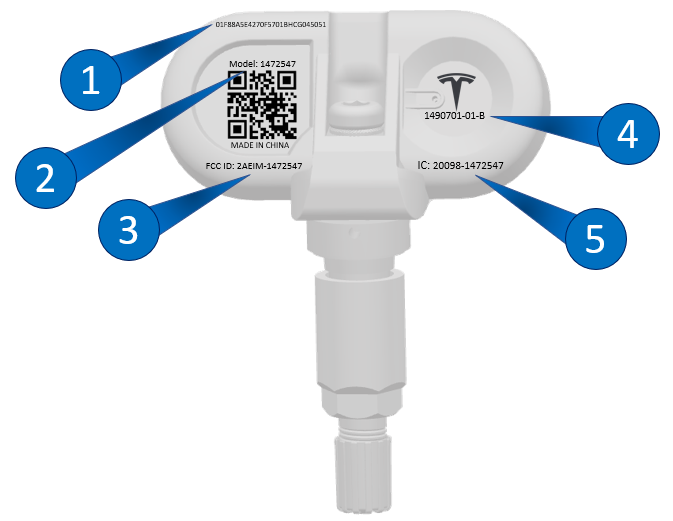
Genuine Tesla Wheel TPMS Sensors can be identified with the following markings, but relevant markings are not limited to these.
 |
|---|
| 1. TPMS ID (ID that TPMS uses to identify the Wheel Sensor) 2. Model 3. Federal Communications Commission Identification number 4. Tesla Part Number 5. Industry Canada's license |
TPMS Wheel Sensor Identification Numberlink
The wheel sensor units have a 12-character identification number. The first 2 digits indicate the color of the TPMS sensor, and the following 12 Hexidecimals are the ID that can be used to program the sensors. This TPMS wheel sensor ID is needed to manually program sensor IDs when an ODIN routine is used.
Note
Previous generation wheel sensor units are not compatible with the BLE TPMS.
TPMS Wheel Sensor Locationlink
The sensor is secured to the valve stem by the valve stem retaining screw. The sensor fits through the valve hole into the wheel rim, and it is secured with the valve nut.
To avoid air leaks, it is sealed with an O-ring.
The curvature of the sensor follows the form of the wheel rim.
Auto-learn and Auto-locationlink
The system has the ability to learn and locate new wheel unit IDs during drive. The status of this learning process is transmitted on CAN. The auto-learn process commences if at least 1 previously known wheel sensor does not connect to VCSEC within 5 minutes of the vehicle speed exceeding and maintaining speed above 25 km/h (15 mph). The BLE TPMS is capable of reading pressures while the vehicle is stationary.
Note
The process of a TPMS sensor connecting to the VCSEC and broadcasting values requires the vehicle speed to exceed and maintain a speed above 16 km/h (10 mph).
TPMS Auto-learnlink
-
VCSEC connects to previously known sensor IDs when vehicle speed > 25 km/h (15 mph).
-
VCSEC unpairs unconnected sensor IDs if all 4 previously known sensor IDs do not connect to VCSEC within 150 seconds while vehicle speed is > 25 km/h (15 mph).
-
VCSEC sets an alert indicating that auto-learn is searching for new sensors. This alert is set if all 4 previously known sensor IDs do not connect to VCSEC within 150 seconds while vehicle speed is greater than 25 km/h (15 mph).
-
VCSEC disables BLE MAC Addresses whitelist and searches for sensor IDs in auto-learn mode if less than 4 sensor IDs are paired and vehicle speed is greater than 25 km/h (15 mph). Auto-learn shall continue to run until 4 sensor IDs are paired.
- VCSEC pairs a sensor ID if its advertisement is verified as a Tesla TPMS sensor while in auto-learn mode.
- VCSEC enables BLE MAC Addresses whitelist and stops auto-learn if 4 sensor IDs are paired or vehicle speed less than 25 km/h (15 mph).
TPMS Auto-locationlink
- VCSEC determines the corner location of each connected sensor within 10 minutes while vehicle speed > 25 km/h (15 mph).
- VCSEC transmits sensor location on CAN.
- The UI displays pressures in the corner locations determined by autolocate during the previous drive.
- The UI updates the locations of pressure values / highlighted text to reflect the updated location of TPMS sensors when autolocate completes if the result differs from the previous autolocate result.
Service Sensor ID Learnlink
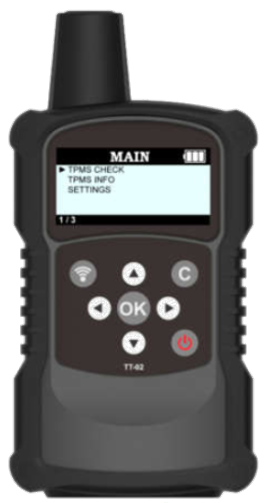
The service sensor ID learn procedure requires a handheld TPMS tool. Please see the service manual for instructions on performing the learning procedure:
 |
|---|
| TPMS Service Tool |
The scan tool used for the BLE TPMS is a dedicated scan tool to read the sensor IDs that uses BLE technology, and is not backwards compatible to previous generation system wheel sensor units. The wake tool works by sending a low frequency wake signal to a circuit on the TPMS sensor. This coupling is dependent on the position and orientation of the tool relative to the sensor, so if the scan takes longer than 3-5 seconds, start to manipulate the orientation of the end of the tool to find a better coupling path. When multiple vehicles are in close proximity of each other, TPMS Service Tool might detect another vehicle's TPMS sensors and this can cause a TPMS fault to occur. Moving the vehicle further away from another vehicle's TPMS sensors improves reliability.
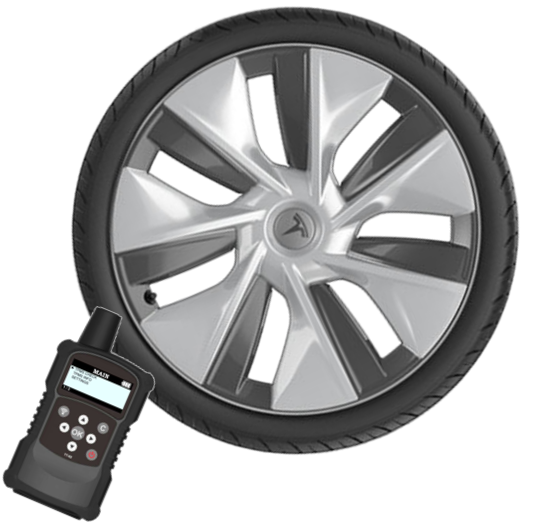 |
|---|
| Location on Wheel to Measure with BLE TPMS |
Tip
Hold the TPMS handheld tool against the tire sidewall for improved reading.
Tire Pressure Warnings and Telltalelink
The user-facing low pressure threshold warning messages (soft threshold or hard threshold) are displayed to the user via the UI within 5 minutes once a TPMS sensor has connected to the VCSEC and broadcast pressure values and a low pressure is detected.
- Soft low pressure warning is set when the measured pressure is less than 20% below RCP for North America and China market and less than 10% below RCP for the European market.
- Hard low pressure warning is set when the measured pressure is <= 1.75 bar (25 psi).
| Telltale | When | Telltale | Chime | Alert |
|---|---|---|---|---|
| Hard Warning | Vehicle in Drive (D) and Tire Pressure less than 1.75 bar (25 psi) |  |
Single Chime | Display Alert |
| Soft Warning | Vehicle in Drive (D) and Tire Pressure less than 20% below RCP for North America and China market and less than 10% below RCP for the European market. | |
No Chime | Display Alert |
| Hard Warning Clearing Condition | Vehicle in Drive (D) and Solid Telltale and Tire Pressure* greater than 2.07 bar (30 psi) |  |
No Chime | Clear Alert |
| Soft Warning Clearing Condition | Vehicle in Drive (D) and Solid Telltale and Tire Pressure* greater than 90% above RCP for North America & China market and 95% above RCP for the European market. | |
No Chime | Clear Alert |
| Wheel Sensor Malfunction | Vehicle in Drive (D) and 10 minutes have elapsed while vehicle speed greater than 25 km/h (15 mph) and 1 or more sensor(s) have not connected and delivered pressure data to the VCSEC. Telltale will flash for 60-90 seconds and stays solid after the 60-90 seconds. At the start of the next drive, the VCSEC telltale will flash again for 60-90 seconds before turning solid (until underlying cause is cleared). |
|
No Chime | Display Alert |
Recommended Cold Tire Pressurelink
The TPMS indicator light does not immediately disappear when the tire pressure is adjusted. After the tire is inflated to the Recommended Cold Pressure (RCP) the vehicle would need to drive above ~15 mph (25 km/h) for the indicator light (telltale light) to disappear. If the vehicle has been stationary for a longer time, the sensors will go to sleep. To awaken the sensors the vehicle would need to drive above ~15 mph (25 km/h) for the indicator light to disappear. In case new sensors are installed, it will fall back to the ID learning routine. RCP values for a vehicle can be found on the driver’s door jamb.
Note
The most reliable source for the specification of tire pressures for a vehicle is the sticker on the driver’s door jamb. If there is a discrepancy between this information and any other source, default to the information in the door jamb and inform the owner of the other document of the discrepancy. Tire pressures impact grip, efficiency, and comfort. Tire pressures are specified as a Recommended Cold Pressure (RCP) which means that pressures should be checked and adjusted after the vehicle’s wheels and tires have been allowed to cool to ambient temperature (approximately 70° F / 20° C). In the Service Manual, refer to General Information > Technical Data > Tire Pressures for a current list of RCP values.