Interiorlink
Last updated: September 18, 2024
Interior Optionslink
There are 3 colorways available for 2021+ Model S; black, white, and cognac. All trim options are polyurethane (PUR), a leather alternative. There are two different variants of 2021+ Model S, long range and performance. Long range covers wood decor to match the colorway while performance includes carbon fiber decor.
Door Panelslink
Component Descriptionlink
 |
|---|
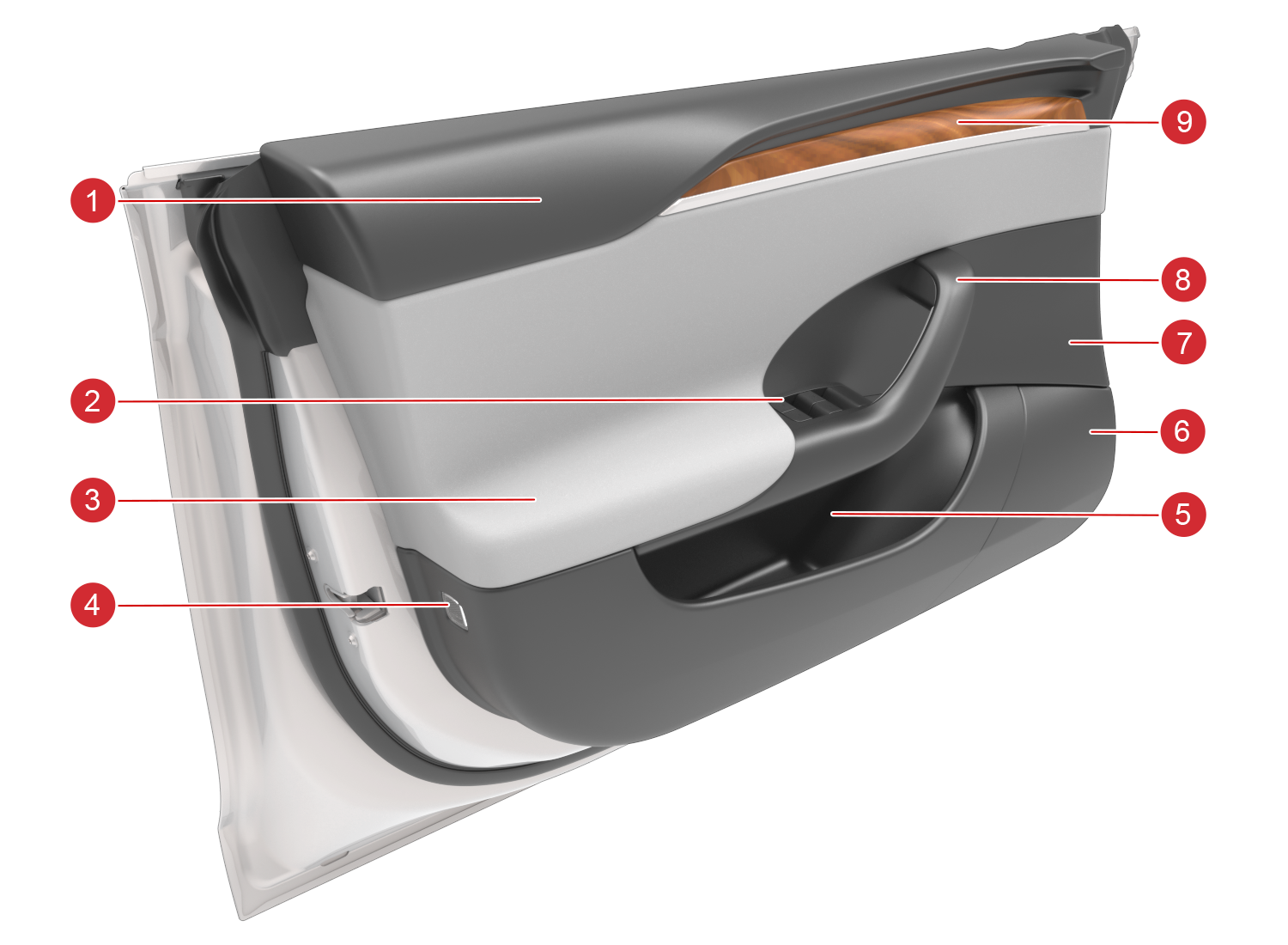
| 1. Beltline 2. Window switch pack & emergency release 3. Armrest 4. Door reflector 5. Map pocket bin 6. Speaker grille 7. Speaker mesh 8. Grab handle 9. Decor |
| Door Panel, Overview |
 |
|---|
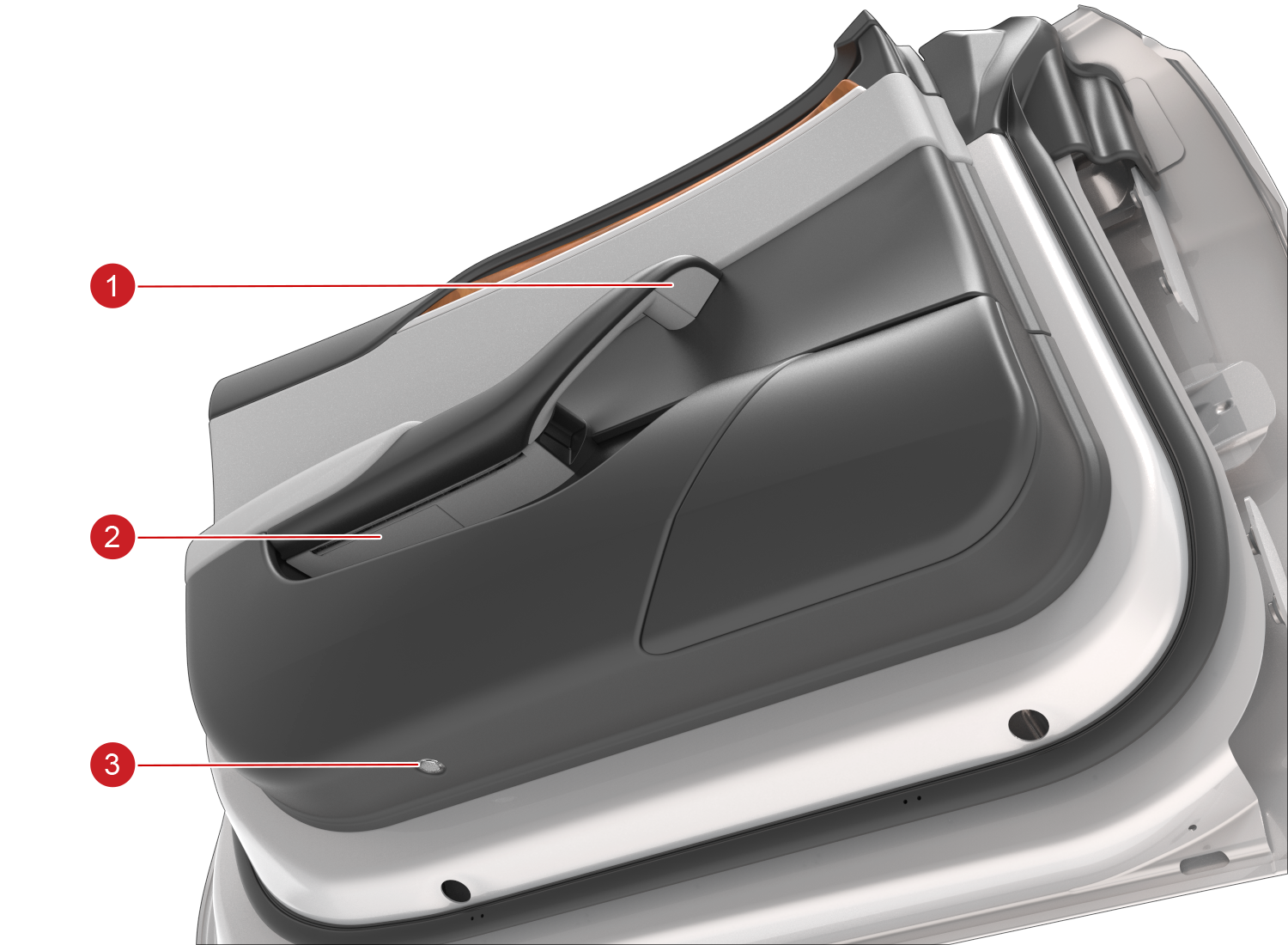
| 1. Grab handle screw cover 2. Armrest service cover 3. Puddle lamp |
| Door Panel, Overview from Underside |
The door trim allows functionality to control opening and closing the door, control of the window, speakers for audio, grab handle for ease of ingress/egress, a map pocket for storage, and various points of lighting.
Theory of Operationlink
Door releaselink
2021+ Model S front doors open mechanically or electronically. The primary mode of opening the door is via the capacitive interior release button which which communicates via the door handle controller. Both release methods will work if the 2021+ Model S has low voltage (LV) power. However, only the mechanical handle will open a door when the 2021+ Model S has no power. The E-release (emergency release) is intended to be a secondary mode of opening the door with the primary functionality being the door switch. While the door button communicates via the door handle controller, the E-release is directly connected to the door latch, allowing the mechanism to be fully mechanical. The rear doors do not have any customer facing ability to mechanically open. Although, if needed in service, the rear doors have a mechanical release located under the second row seat cushion.
Window switchlink
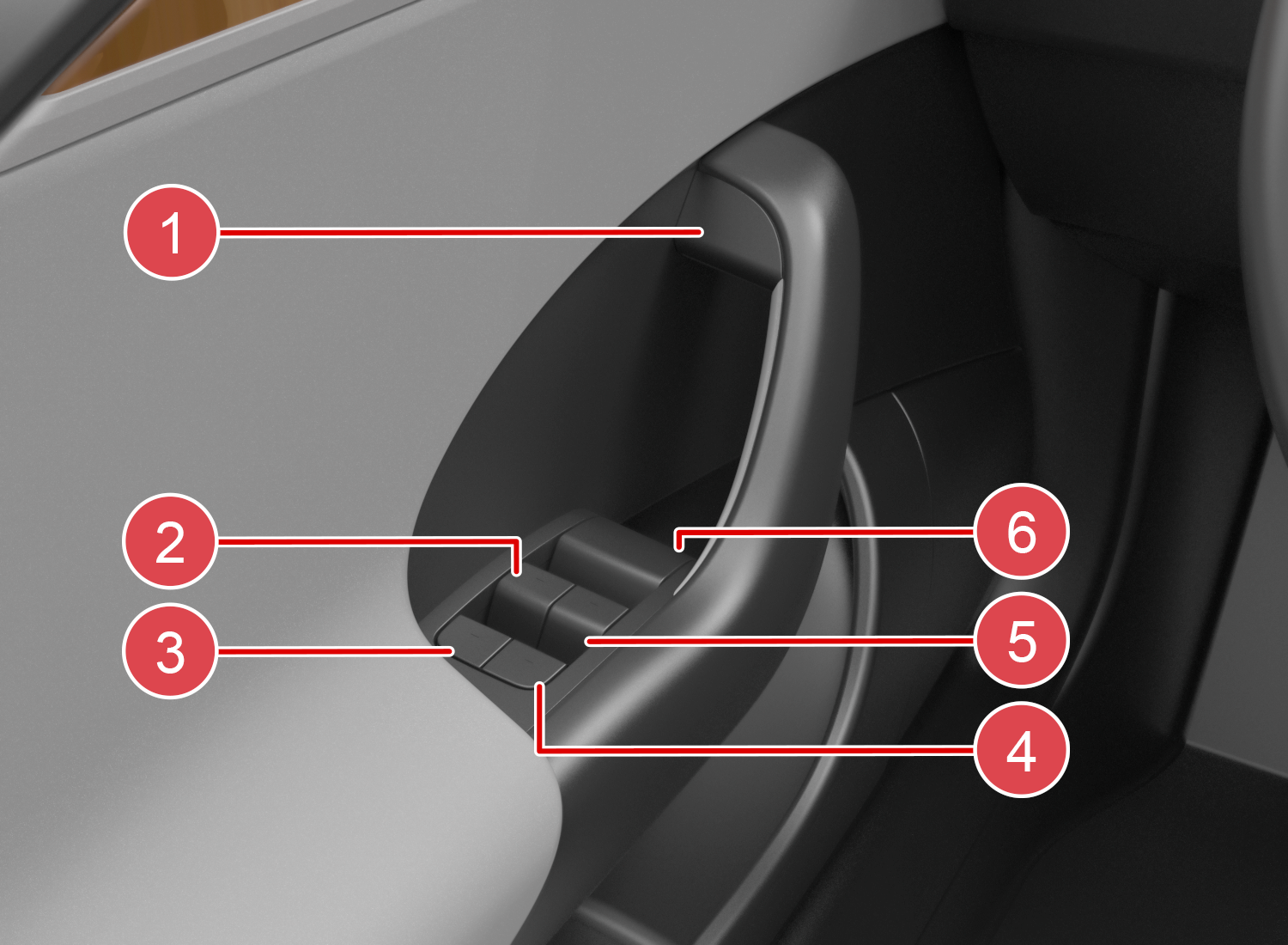
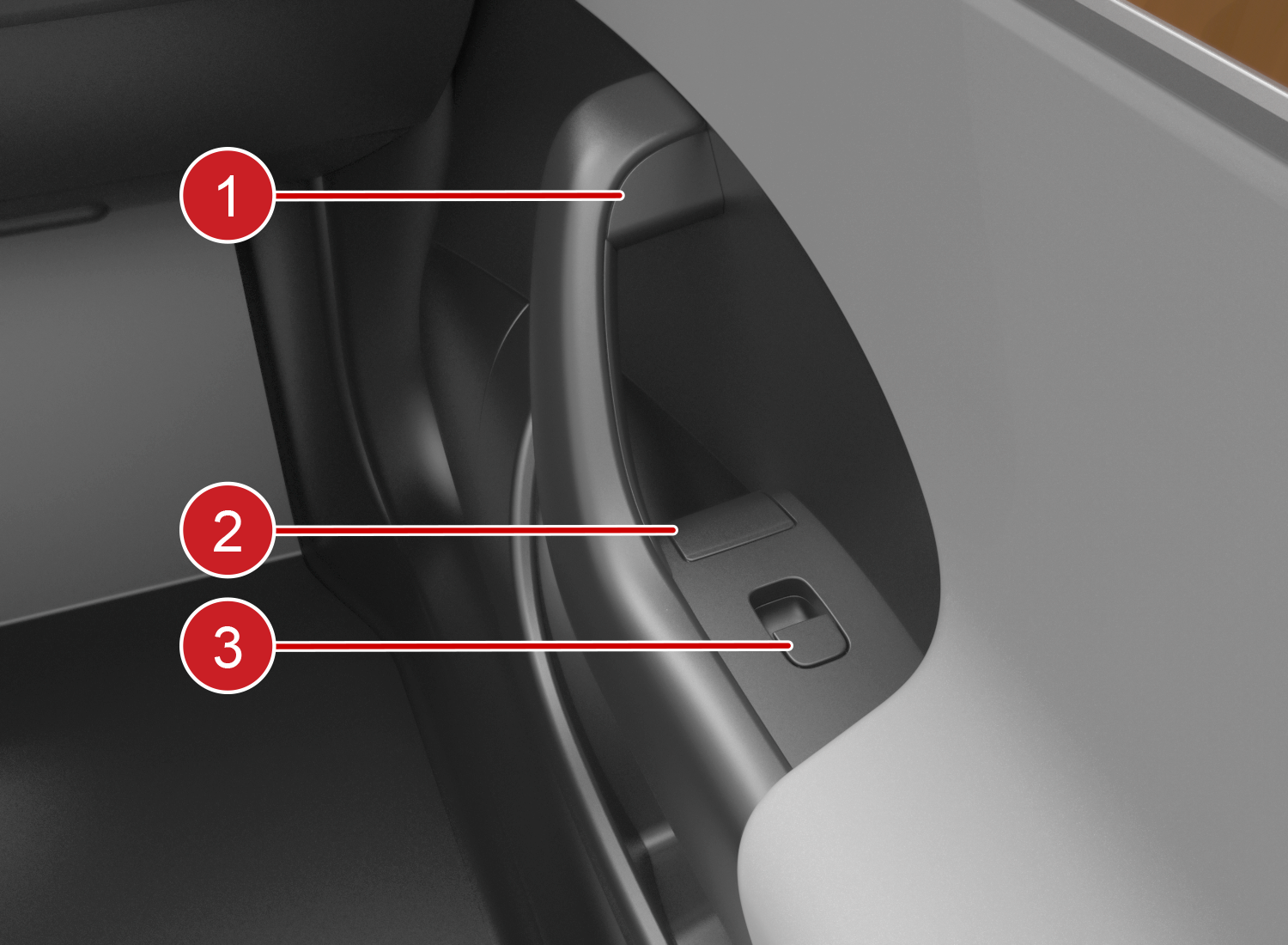
Every door has a window control button. The driver's door window switch pack controls every window. Each passenger door has a single window switch to raise or lower that individual window. The left front, right front, and left rear window switch communicate on the left vehicle controller (VCLEFT), while the right rear window switch communicates on the right vehicle controller (VCRIGHT).
 |
|---|
| 1. Capacitive interior release button 2. Window switch, front left function 3. Window switch, rear left function 4. Window switch, rear right function 5. Window switch, front right function 6. Emergency door release lever |
| Driver's Door Controls |
 |
|---|
| 1. Capacitive interior release button 2. Emergency door release lever 3. Window switch, front right function |
| Passenger's Door Controls |
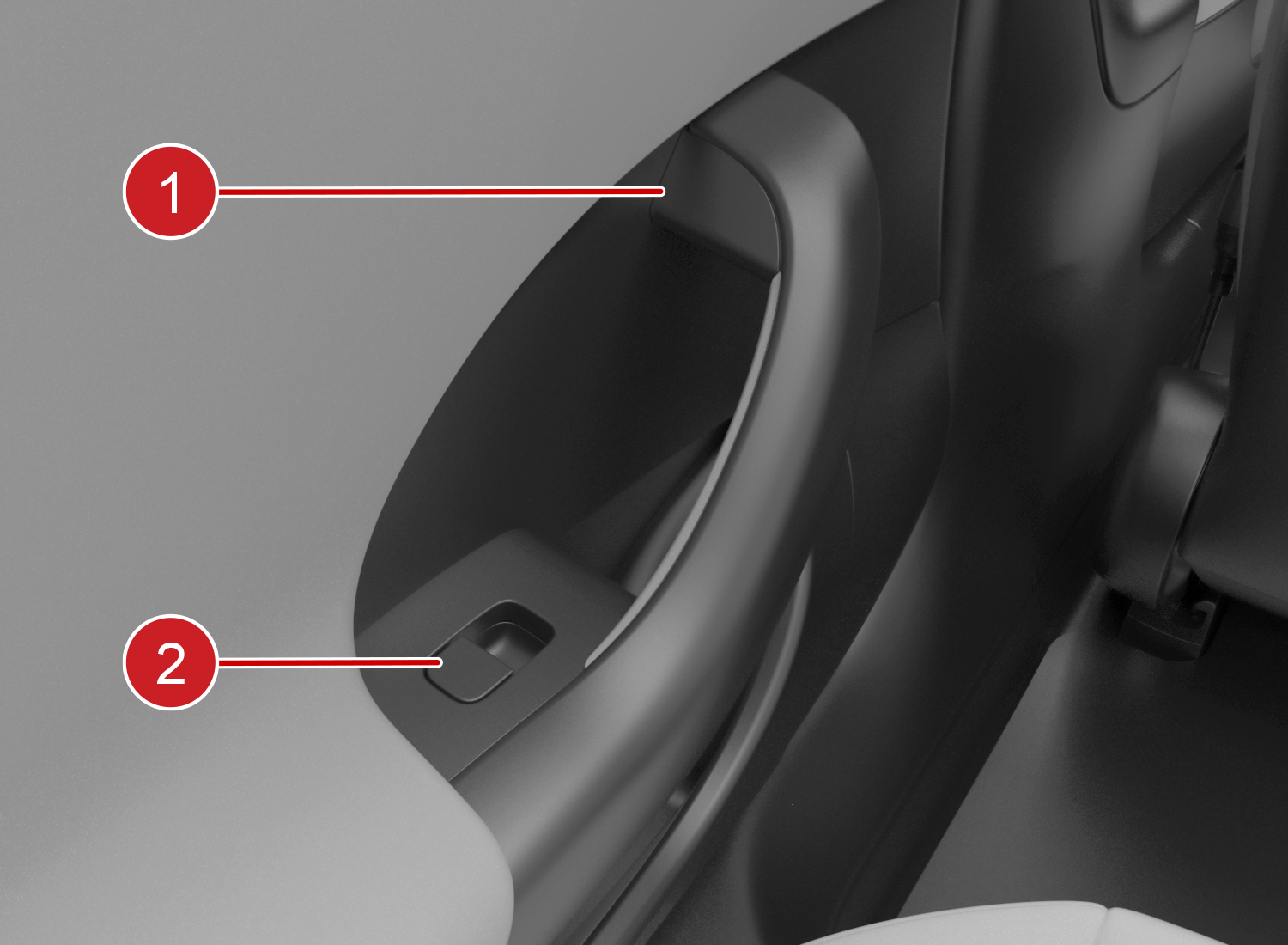 |
|---|
| 1. Capacitive interior release button 2. Window switch, rear function |
| Rear Doors' Controls |
Door lightinglink
Each door has 3 areas that get illuminated. The map pocket has illumination via an LED tube located in the armrest. This LED can be accessed by removing the service panel under the armrest. The decor has bright work which is an RGB LED strip that communicates on local interconnect network (LIN) to the left or right vehicle controller. This ambient lighting is not constantly on. The customer can trigger different lighting modes via the UI. In addition, ambient lighting will turn on white during ingress/egress. There is also a puddle lamp located at the bottom of the door which illuminates when the door is open.
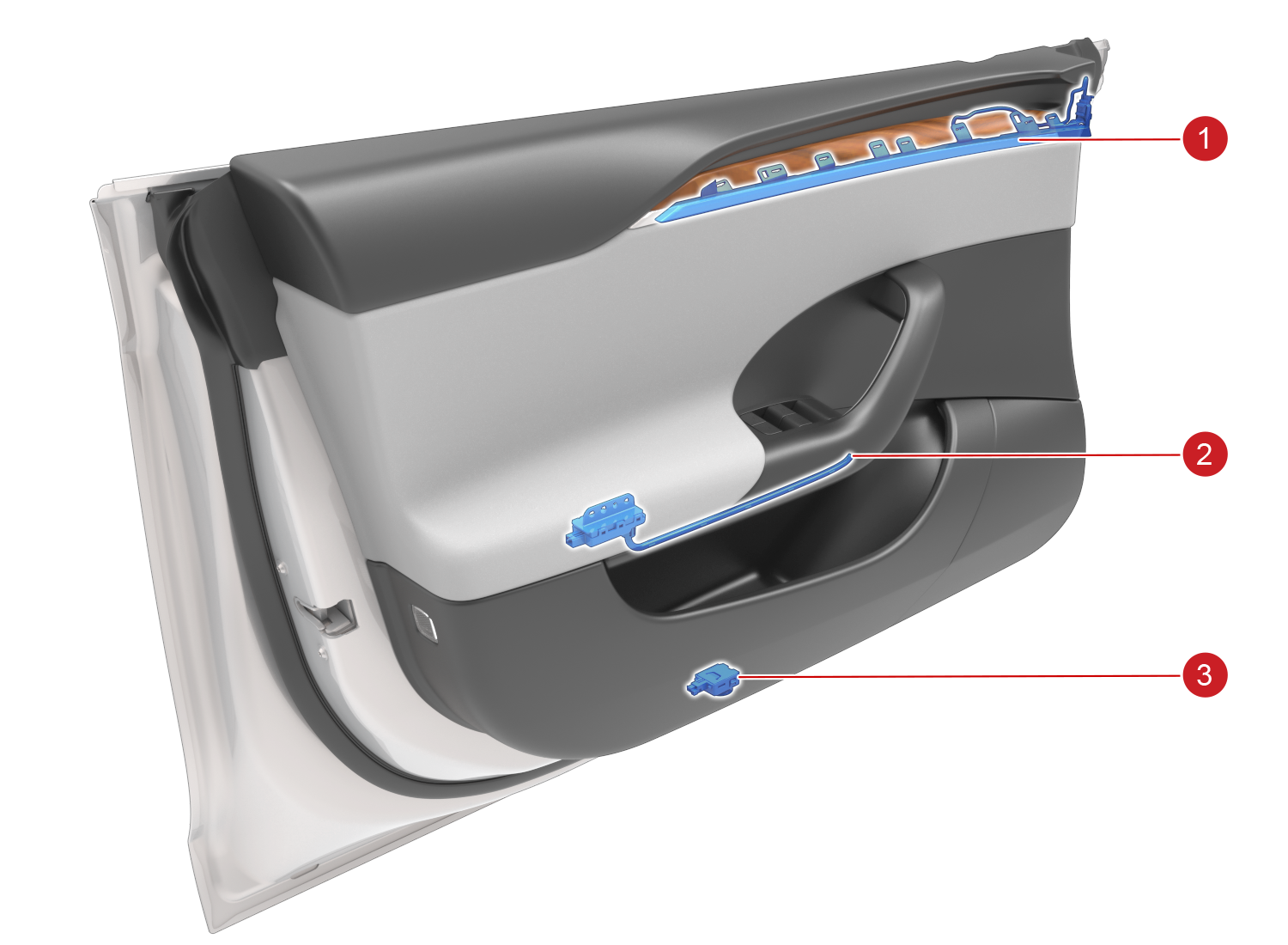 |
|---|
| 1. Decor ambient lighting 2. Map pocket ambient lighting 3. Puddle lamp |
| Door Lighting |
Serviceabilitylink
The door trim panels hook onto the door at the beltline seal. Each door has a bolt under the service panel located on the armrest, under the screw cover, under the decor, and under the reflector.
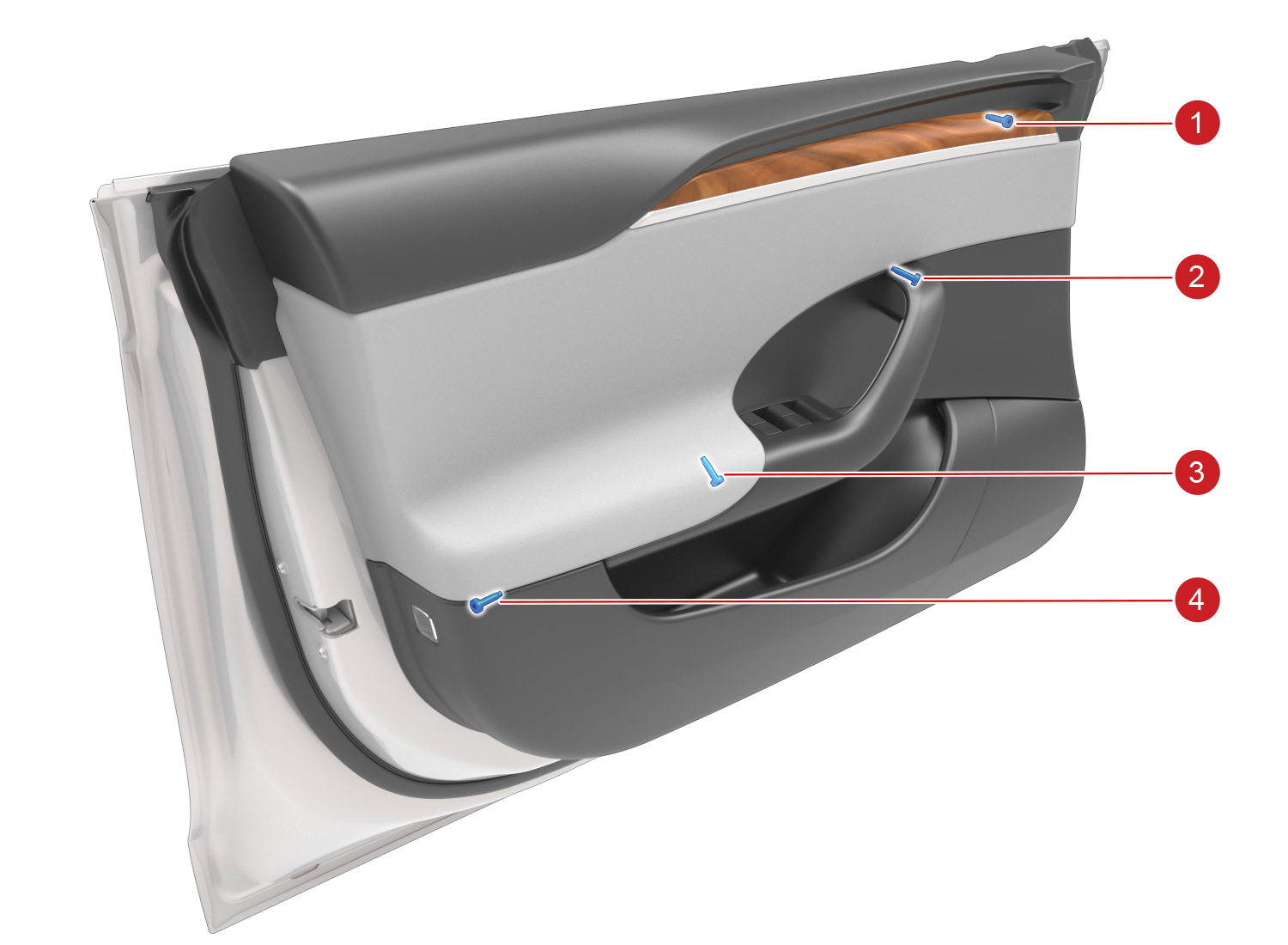 |
|---|
| Fastener Locations |
2021+ Model S doors are best to be taken off using a trim tool around the bottom edge, disengaging the clips, and then removing the trim from U channel in the beltline, moving up in the Z direction.
There is 1mm of adjustment in both the Y, cross vehicle, and Z direction on the front door trim. This adjustment is to allow the ability to minimize the gap and flush issue of the door trim to the instrument panel (IP).
The upper portion of the door trim, which meets the IP, is referred to as the hammerhead.
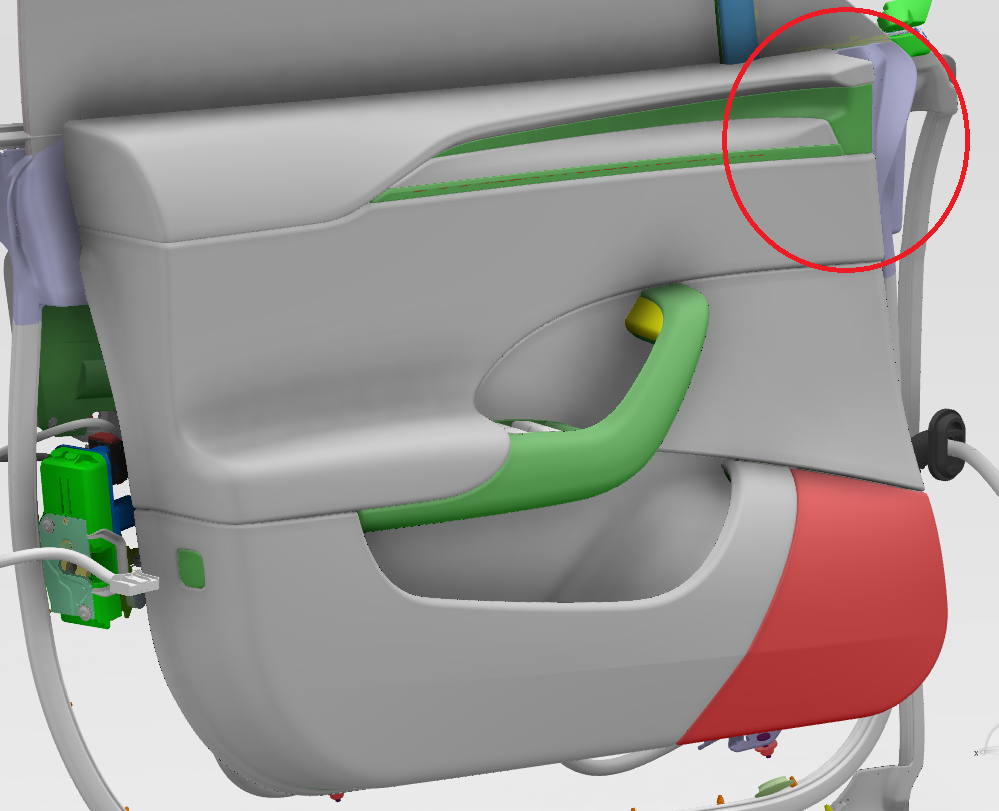 |
|---|
| Hammerhead |
Ambient Lightinglink
Ambient lighting refers to the white lights within the vehicle that turn on when a vehicle door is opened, and dim once the vehicle is put into Drive, or 2 minutes after an occupant has closed the door.
Ambient lights are in the following areas:
- Driver footwell (light pipe)
- Front passenger footwell (light pipe)
- All 4 door map pockets (light pipe)
- Under the driver seat (second row foot well lamp)
- Under the passenger seat (second row footwell lamp)
- Under the center console (second row footwell lamp)
Light pipes snap into a light engine (a PCBA or ECU). The various lights are controlled by the respective vehicle controllers, VCLEFT or VCRIGHT with the center console lamp controllered by VCLEFT.
Carpeting and Matslink
The 2021+ Model S has 3 floor mats. The driver's and front passenger's floor mats are separate, and the rear floor mat is a wide mat that covers the entire rear passenger footwell. Each mat is cut to fit the shape of the footwell it is designed for and must be installed with the carpet facing the occupants. The driver floor mat includes a cover over the dead pedal. A high-retention hook-and-loop fastener backing on the mats keep them in position without visible fasteners.
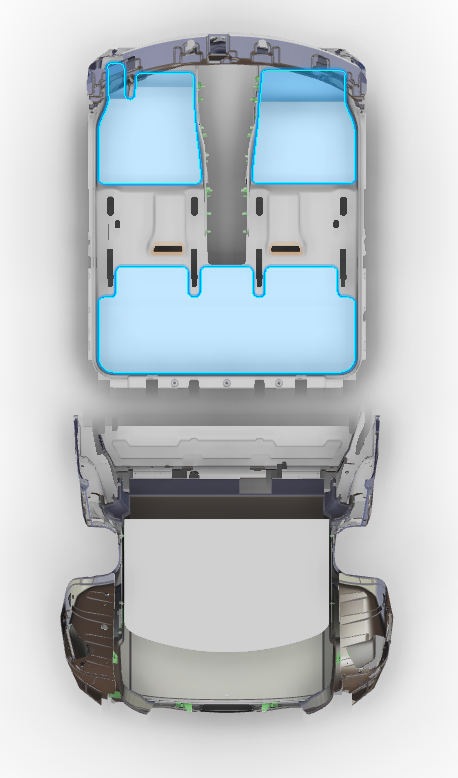 |
|---|
| Floor Mats |
Underneath the 3-piece floor mat kit is the cabin carpet. This is one piece that covers interior floor of the cabin.
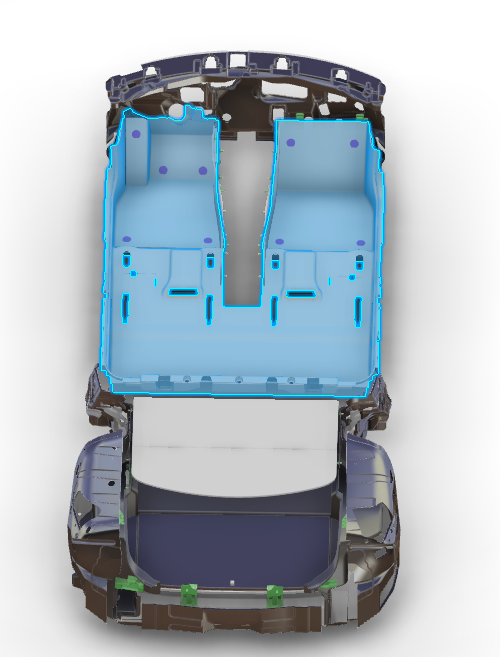 |
|---|
| Cabin Carpet |
Underneath the cabin carpet is the passenger footrest, which sits on top of the footwell cover located on the instrument panel (IP). The passenger footrest is intended to help protect the car computer as well as provide foot support to the first row passenger. Between the footwell cover, located on the IP and the footrest is a noise, vibration, and harshness (NVH) pad to help mitigate any road noise.
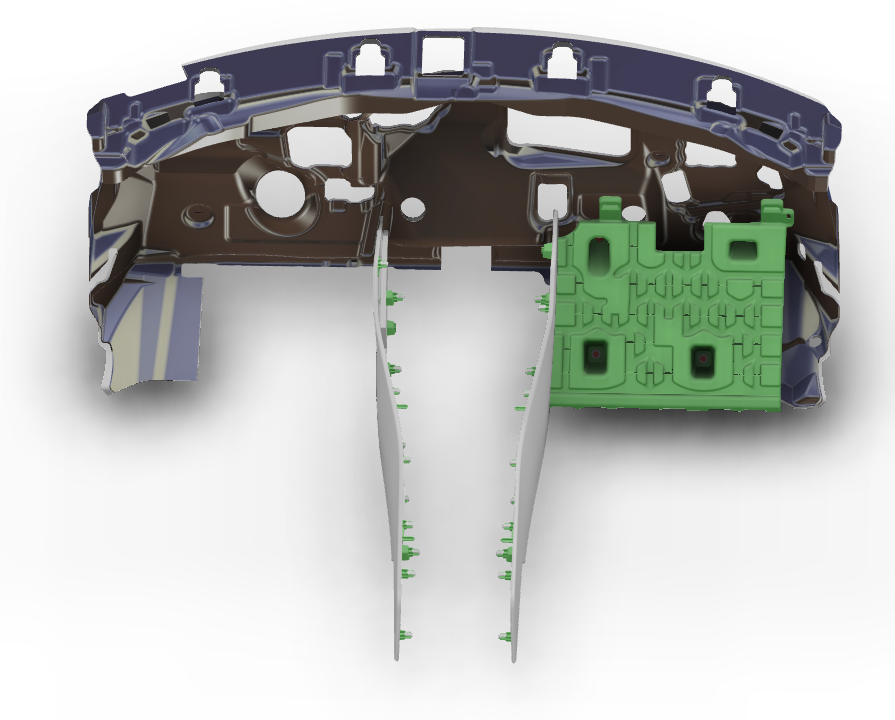 |
|---|
| Passenger Footrest |
Luggage Compartmentlink
Storagelink
The trunk in the 2021+ Model S has storage in the main compartment, under the load floor, and inside storage compartments located on the driver’s and passenger's side. The left hand storage component of the trunk also contains a load floor to allow the customer to maximize loading space.
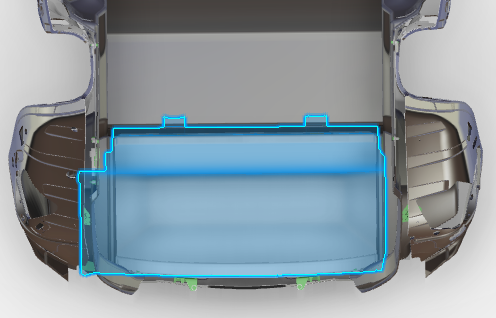 |
|---|
| Main Trunk Storage |
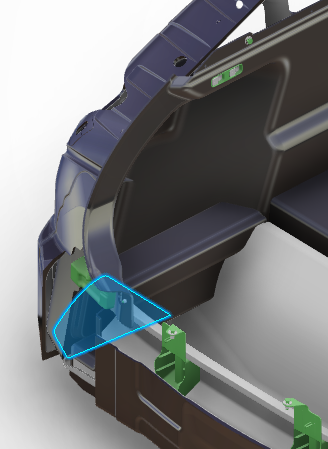 |
|---|
| Left Side Compartment Storage |
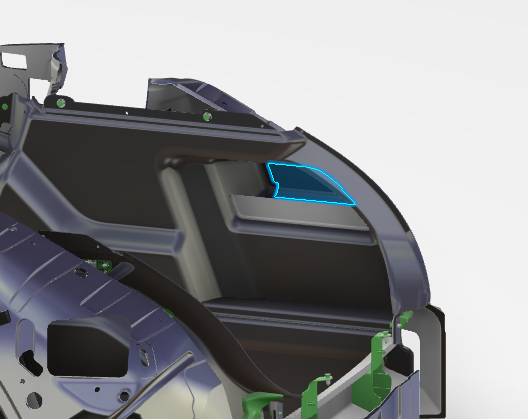 |
|---|
| Right Side Compartment Storage |
Storage compartments illuminate when they are opened and turn off when they are closed.
Load Floorlink
2021+ Model S has two light-weight carbon fiber and aluminum load floors with an easy lift strap. To access the storage space below, lift the load floor upwards. Both load floors have storage underneath. There is the rear load floor, which covers the main compartment storage, and the side load floor that covers the left storage compartment. The rear load floor pivots along the rear edge of the trunk trench so that it can hold itself open. It is preferred that the customer always secures all loose objects.
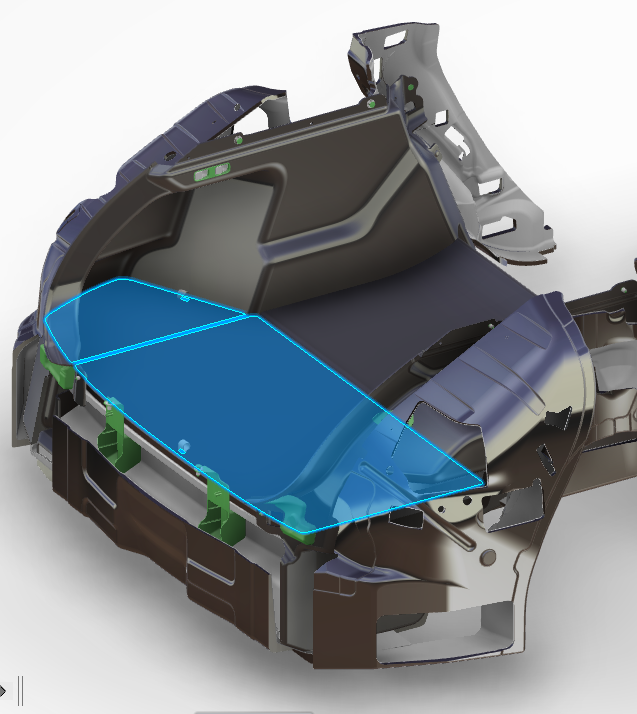 |
|---|
| Dual Load Floor |
Parcel Shelflink
The 2021+ Model S parcel shelf provides coverage for items located in the trunk. The parcel shelf folds in half and can be stowed in the trunk tub. The parcel shelf attaches to the vehicle via magnets located in each of the four corners.
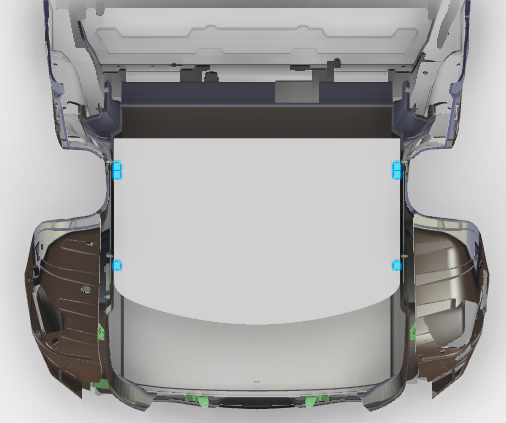 |
|---|
| Parcel Shelf |
Headlinerlink
The 2021+ Model S headliner is one piece which contains:
- For front passengers:
- Two map lights
- Two microphones
- Two sun visors
- For rear passengers:
- Two speakers
- Two coat hooks
- Integrated reading lights
All components a part of the headliner assembly are controlled via VCLEFT with the exception of the speakers, which communicate directly to the car computer.
Interior Mirror and Sun Visorslink
2021+ Model S has a 3-layer, rear view mirror that allows the mirror to "self-dim" for added driver comfort. The first layer of the mirror is a clear glass, the second layer is an electrochromatic film, and the third layer is a mirror. The electrochromatic film activates when a small voltage is applied to it, which causes the amount of light passing through it to decrease (dimming).
There are two sun visors installed to the front of the headliner. Each sun visor has a mirror cover. The mirror cover can be opened and folded down to reveal the mirror and two vanity lights. The sun visor attaches to the headliner via a bracket on the outermost portion and a magnetic visor check on the inner most portion.
Instrument Panellink
Tilt Displaylink
Component Descriptionlink
The 2021+ Model S display built after 18-APR-2022 has the ability to tilt towards the driver or passenger. There are 3 possible positions: tilted 12° to the driver, a center home position (also referred to as stowed), and tilted 12° to the passenger. This system includes the display itself and the tilt mechanism, which is then bolted to a bracket that mounts to the instrument panel (IP). The tilt mechanism is comprised of two motors and each provide linear movement via a spindle. The display is connected to this tilt mechanism at three points: each of the arms that are attached to the spindle as well as the center arm that has the guide pin which allows for a smooth movement as the display tilts. The mechanism slides into the IP in the X direction and is bolted to the bracket in the X direction. The tilt functionality can be requested via the UI.
Theory of Operationlink
The tilt mechanism is powered by VCLEFT and communicates via controller area network (CAN). When the display is in the stowed position, the motors on the mechanism should read an encoder count of zero, and the guide pin should be sitting at the bottom of the “V” in the guide rail. The V grove for the center bolt is necessary to constrain the movement of the display as it keeps the link arms from wobbling back and forth. The center pin travels through the V grove as the link arms push and pull the display left and right. When the user has requested that the display tilt, a nominal current between 2.2 and 4A is supplied to the motor. The tilt direction chosen will determine which motor is the leader and which is the follower. The leader is the motor furthest from the desired tilt position since it is the motor that has to travel the furthest. For example, in a left hand drive (LHD) vehicle, if the display is chosen to tilt the driver, the lead motor will be the right hand motor. If the display is chosen to tilt to the passenger, the lead motor will be the left hand motor. The lead motor should not exceed an encoder count of 500 tics when fully deployed, while the follower motor should not exceed 230 tics. The lead motor travels two times faster than the follower motor, as it has a larger distance to cover. The home position has a hard stop, where the deployed positions use encoder counts to decide end of travel.
Serviceabilitylink
The stowed position can be verified by looking from underneath the mechanism up to ensure that the rail nuts rest flush against each motor mount. This is the hard stop for the system.
Because the display mounts to the link arms via a self tapping screw that creates threads in the link arms, any need to service the display would result in a swap of both the display and the mechanism. If the mechanism needs to be swapped, the old display can be maintained as it will create new threads in the mechanism.
The center pin is made of a softer material than the V grove rail it sits in, so it could be a point of wear or failure. This may cause rehoming or NVH concerns. Other NVH concerns may require relubricating the spindle or regreasing the rail nut.
Vehicles built with a powered center display have a different VCLEFT, as well as a different display mechanism than those built without the powered display.
Vehicles with tilt functionality will have the following configuration: cfg_centerdisplaytilttype": "POWERED". If the vehicle does not have a functioning tilt mechanism, the configuration will be none or manual.
There are thermal limits for the motors. If the mechanism is continuously running for 80 seconds, the button to move the mechanism is greyed out to prevent overheating of the motors. This can resume after 28 seconds.
The stall current for the motors is 12A.
The tilt mechanism does have pinch detection for the times when the display is moving from the deployed position back to stowed. If the system detects a current spike while returning to the home position, it indicates a pinch and the display will then back off and move at 70% speed to return home. The system is compensating for the fact that there may be increased friction over time of using the mechanism. If a false pinch has occurred, diasgnosis can start with checking the gear box, center pin, or for the presence of black dust in the lubricant underneath the link arms.
The following 4 ODIN routines can be used in removing and replacing the mechanism as well as for diagnosis:
- TEST-SELF_VCLEFT_X_DISPLAY-ACTUATORS: Tests if the motors are physically plugged in.
- PROC_VCLEFT_DISPLAY-MECH-CALIBRATE: Brings rails nut to the end stops.
- PROC_VCLEFT_DISPLAY-MECH-TEST: Moves display to the left and right once.
- PING-BASH_DISPLAY_ALL: Test if the display is communicating.
Steering Wheellink
The steering wheel is made of a polyurethane (PUR) wrap and has the ability to be heated by utilizing a resistive pad underneath the PUR.
Switcheslink
The switches are located on both the left and right hand side of the wheel.
The left hand side has the turn signals and high beams. The right hand side has the horn, wipers, and voice control. The center of the steering wheel does NOT actuate the horn. There is a bit of play on the driver airbag cover in order to install it, which may give the idea that this should actuate the horn, but all horn functionality is on the right hand switch.
These switches are both capacitive and force sensing. The capacitive portion indicates which of the controls is being selected. The force sensing is to ensure that switch has been actuated.
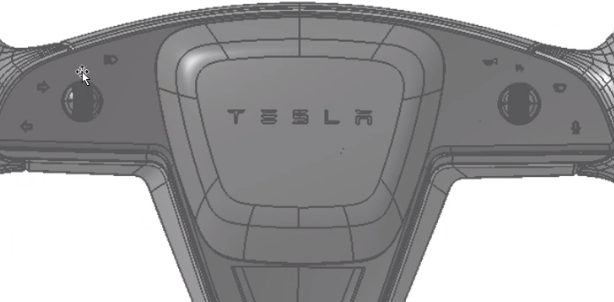 |
|---|
| Steering Wheel Controls |
Scroll wheelslink
The scroll wheels on the 2021+ Model S steering wheel can control the functions listed below:
- Cruise control adjustments
- Autopilot adjustments
- Steering wheel adjustments
- Mirror adjustments
- Volume
- Media controls (skip, play, and pause)
Glove Boxlink
2021+ Model S does not have a physical button to open the glove box. The glove box can only be opened from the touch screen. To prevent damage, the glove box will stop functioning if the glove box door is cycled (opened / closed) ten times in a row.
The glove box opens via an actuator assembly. Inside the glove box is a USB port and functional lighting.
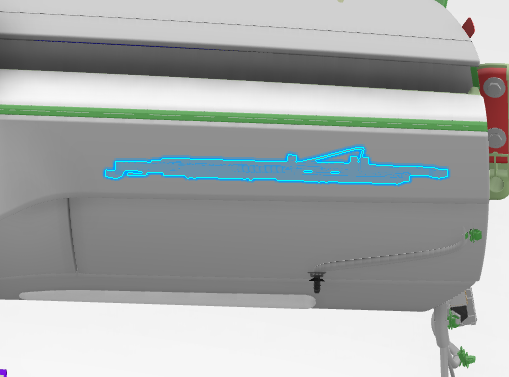 |
|---|
| Glove Box Actuator |
Center Consolelink
The 2021+ Model S center console has storage, cup holders, phone charging, USB-C charging ports, low voltage (LV) port, a rear display, and rear vents.
Storagelink
The 2021+ Model S center console has both a front bin and a rear bin. The rear bin is located underneath the center console armrest. The armrest is on a pivot so that it rotates open to gain access to the rear bin. The armrest latches closed with a magnet. There are switches that the armrest hinge activates in order to illuminate the rear bin.
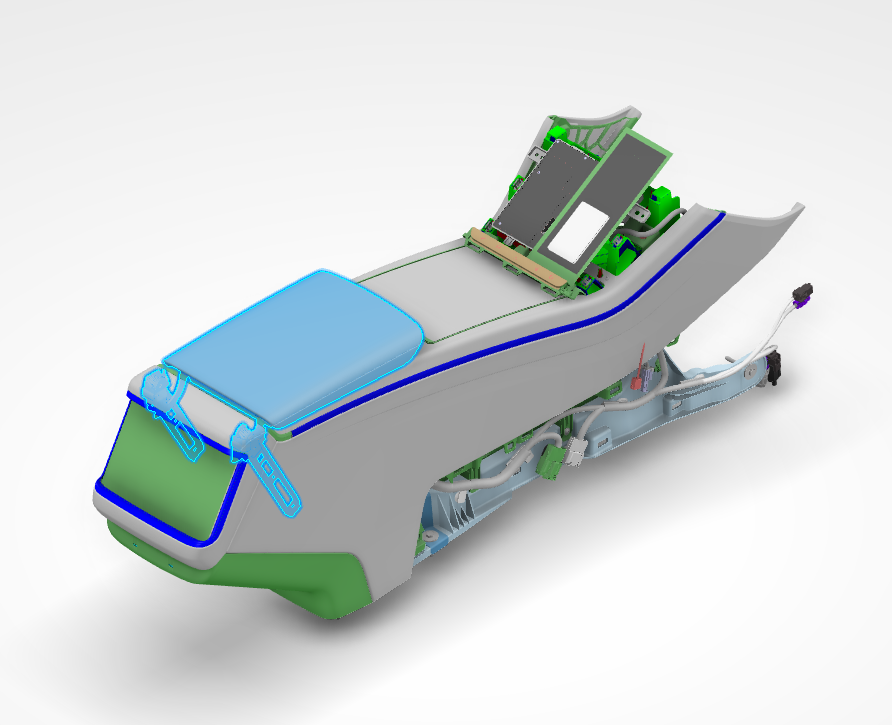 |
|---|
| Center Console Armrest |
The front bin can be accessed by sliding the lid forward. The lid has 3 positions: closed, all the way open, and an intermediate position which exposes the cup holders. When the lid is fully open, the cup holder and sliding tray can be accessed. The cup holders can slide backwards, and the sliding tray can slide forward in order to expose the front bin.
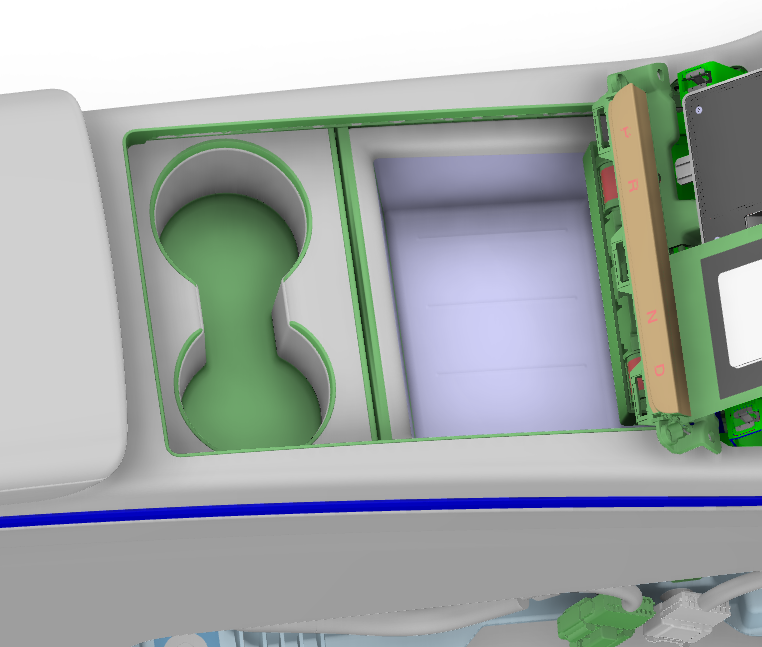 |
|---|
| Cup Holder and Sliding Tray |
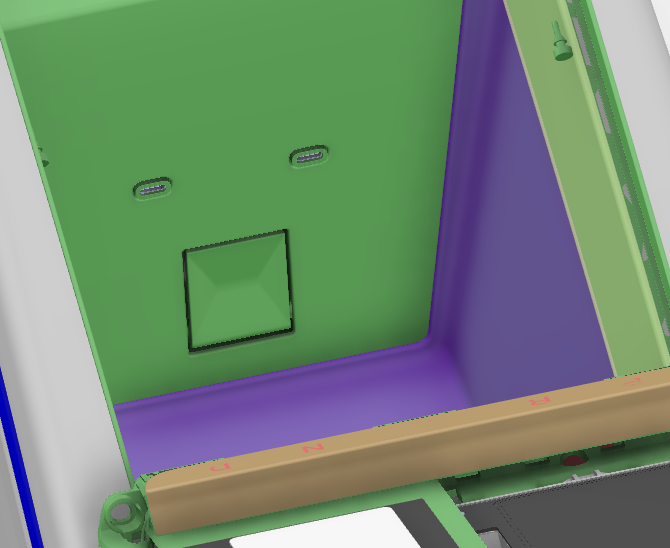
Within the front bin is a service panel. This service panel contains 2 USB-C charging with data ports and an LV outlet. This service panel is easily removable without having to remove the entire center console. The front bin has functional ambient lighting which is illuminated by switches located in the center console that trigger when certain components are in the stowed position, allowing access to the front bin. There are two switches for the bin lid: one switch for the sliding tray and one switch for the cupholder.
 |
|---|
| Service Panel |
Phone Docklink
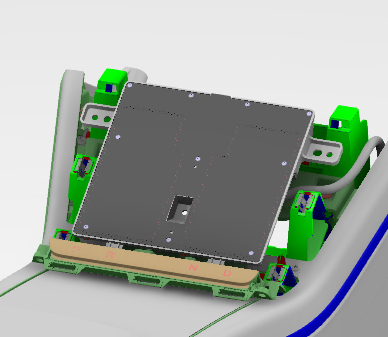
The phone dock, located at the front of the center console, has space for two phones and provides inductive charging. Along with phone charging, the phone dock contains the Near Field Communication (NFC) key card reader to start the vehicle with the keycard. Below the phone dock are switches to select the drive mode or to turn on the hazard lights. Each of the drive mode symbols and the hazard symbol is backlit for ease of visibility. These switches are both capacitive and force sensing. The capacitive portion indicates which of the controls are being selected. The force sensing is to ensure that the switch has been actuated. The center console drive mode selector is intended to be a secondary form of selecting the drive mode, and the primary functionality is intended to be done on the UI. The phone dock tray is able to swing up for serviceability purposes.
 |
|---|
| Phone Dock |
Rear Display and Ventslink
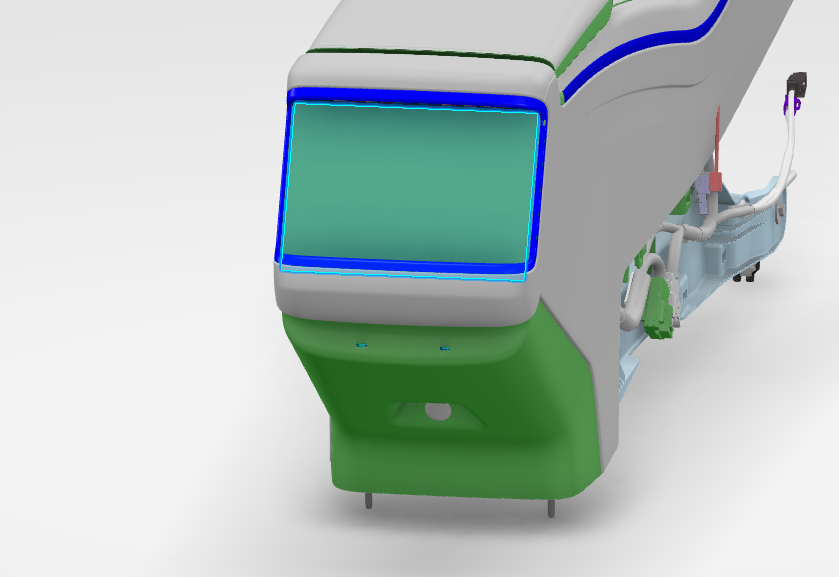
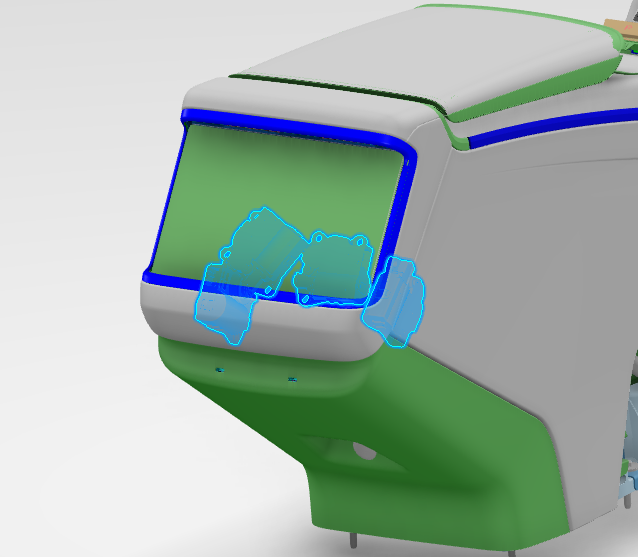
The 2021+ Model S center console has a rear display which is intended for the rear passengers to direct the flow of the rear vents. The rear display is integrated into what is called the airwave. Similar to the instrument panel (IP) vents, the rear center console vents are intended to be non-visible. They are located on the airwave cap, pointing upwards and downwards. The airwave contains four actuators that control how much air goes to the bottom or top outlets. The actuators control this airflow by changing directions of two flaps located behind the vents. Two actuators are controlled by VCLEFT while the other two are controlled by VCRIGHT. Located beneath the rear display are 2 USB-C charing ports (no data).
 |
|---|
| Rear Display |
 |
|---|
| Airwave Actuators |
Lightinglink
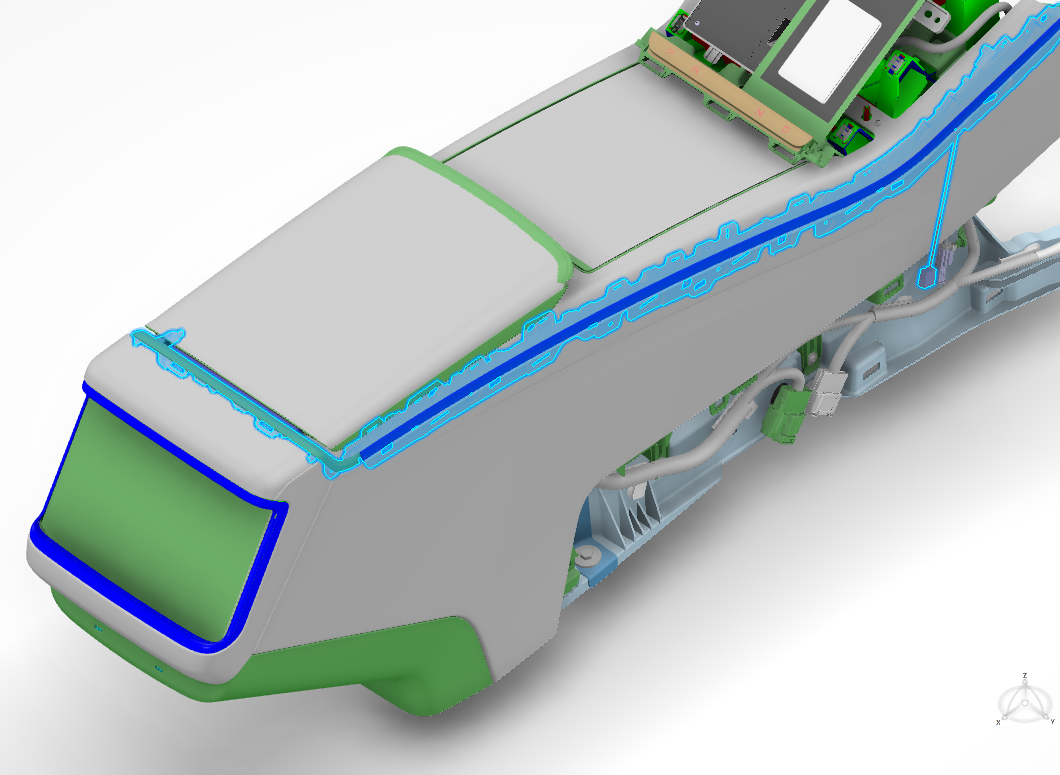
While there are various lighting options that are triggered by opening certain components of the center console, there is also an ambient functional lighting around the upper portion of the center console. This lighting is known as the brightwork. It matches the lighting located on the IP and door trim.
 |
|---|
| Brightwork |