Tire Pressure Monitoring System Gen2 (Continental)link
Last updated: February 28, 2024
Introductionlink
A Tire-Pressure Monitoring System (TPMS) is an electronic system designed to monitor the air pressure inside the pneumatic tires. TPMS reports real-time tire-pressure information to the driver of the vehicle, either via the User Interface (UI) gauge, a pictogram display, or a warning alert notification. Tesla uses a direct TPMS system (dTPMS). The target of a TPMS is avoiding traffic accidents, excessive energy consumption, and increased tire wear due to under-inflated tires through early recognition of a hazardous state of the tires.
Definition of Termslink
| Term | Description |
|---|---|
| BLE | Bluetooth Low-Energy |
| ECU | Electronic control unit |
| RCP | Recommended cold pressure. This is the pressure that a tire should be filled to at the start of drive |
| Sensor ID | Identifies the wheel unit from other wheel units |
| TPMS | Tire pressure monitoring system |
| UI or HMI | User interface or human-machine interface. This refers to the instrument cluster or other driver-facing displays |
| VCSEC | Vehicle security controller - receiver of Tesla TPMS BLE signal |
| Wheel unit / Wheel sensor | The sensor package mounted to the wheel. The wheel unit holds temperature and pressure sensing elements as well as components that send and receive data via wireless communication |
TPMS Typeslink
The following tire pressure monitor systems are available:
| Baolong | Continental (Conti Gen 1) | Continental (Conti Gen 2) | Tesla BLE | |
|---|---|---|---|---|
| Model S | X | X | X | |
| Model X | X | |||
| Model 3 | X | X | ||
| Model Y | X | X |
Conti Gen 1 and Conti Gen 2 have no noticeable difference between operation, the only addition Conti Gen 2 has over Conti Gen 1 is the capability to update the bootloader of the TPMS ECU.
Note
It is the driver’s responsibility to maintain correct tire pressure, even if under-inflation has not reached the level to trigger the TPMS warning light.
Warning
Driving on a significantly under-inflated tire severely increases the risk of the tire overheating, which might lead to sudden tire damage. Under-inflation also reduces range, tire durability, and affects the vehicle’s handling and braking ability.
The Tire Pressure Monitoring System (TPMS) is not a substitute for manually checking wheel conditions and adjusting tire pressures.
Do not use any tire liquid or aerosol tire sealant other than OEM supplied, as this might cause a malfunction of the tire pressure sensors.
Component Descriptionslink
Overviewlink
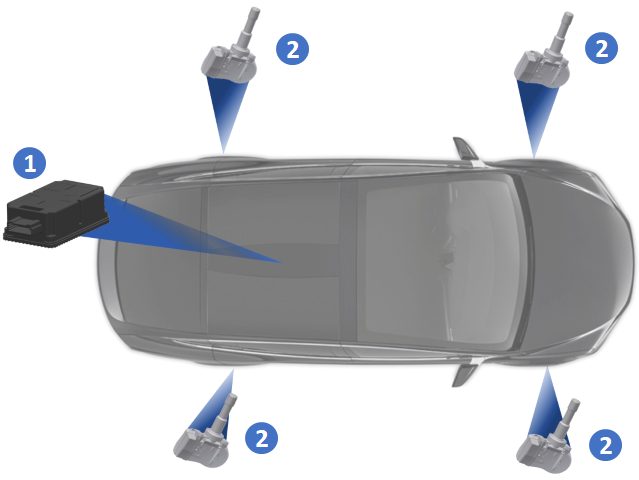 |
|---|
| 1. TPMS Control Unit (MCU) 2. TPMS Wheel Sensor |
TPMS Wheel Sensorslink
TPMS Wheel Sensor componentslink
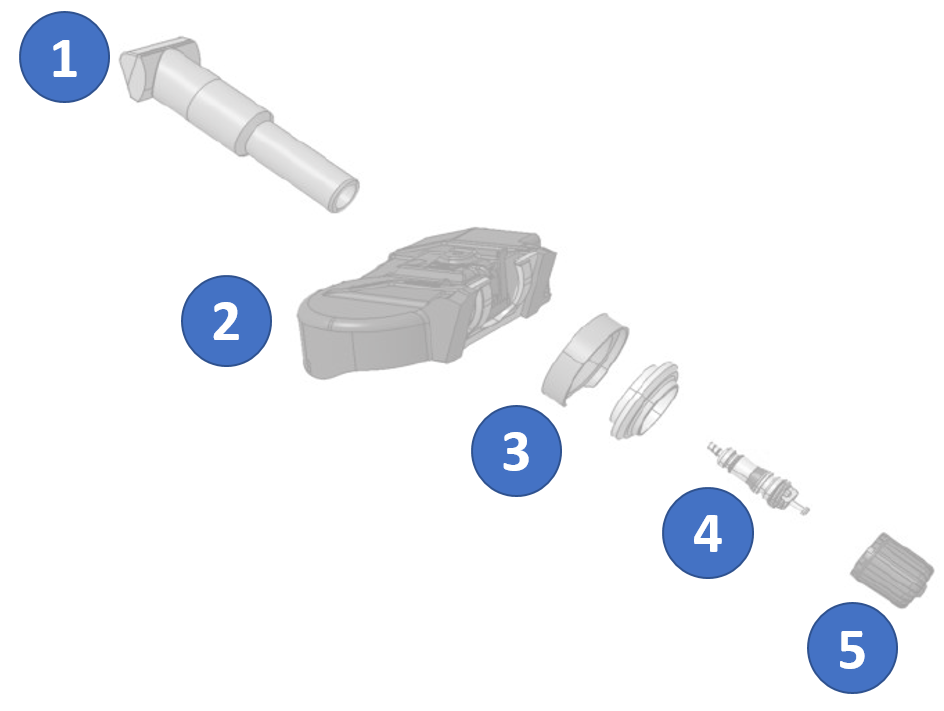 |
|---|
| 1. Valve Stem 2. Sensor Unit 3. O-ring seal 4. Valve 5. Valve Cap |
| Exploded View of Wheel Sensor |
The TPMS Wheel Sensor is a sensor (also known as the transmitter) that is capable of providing the TPMS the current tire pressure, acceleration, and temperature. The sensor contains a pressure sensor, an accelerometer, a temperature sensor, a signal processor, and an RF antenna. To avoid any contamination, the wheel sensor is equipped with a filter which prevents water, vapor or dirt ingress.
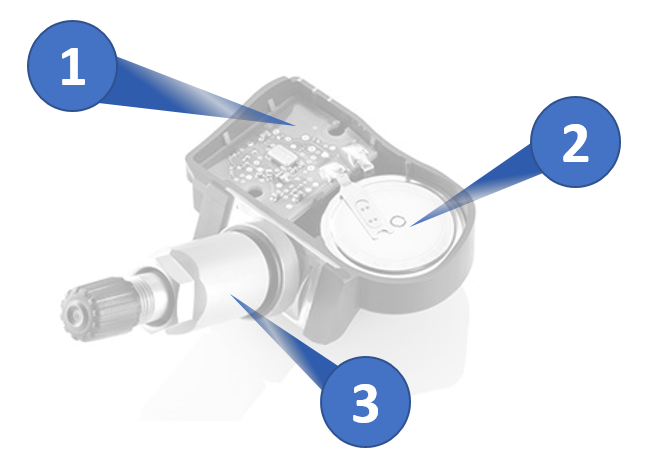 |
|---|
| 1. Circuit Board 2. Battery CR2450 3. Hexnut |
| Internal View of TPMS Sensor |
The temperature sensor prevents pressure readings from being affected by variations in temperature.
Each sensor has a lithium-ion battery that has an estimated battery life of 10 years of average daily driving (2 hour average), depending on temperature.
The wheel sensors have a pressure measurement range of 14.5 – 116 Psi (1 – 8 Bar) and a temperature operating range of -40° – 257°F (-40° – 125°C).
TPMS Wheel Sensor Identificationlink
Genuine Tesla Wheel TPMS Sensors can be identified with the following markings, but relevant markings are not limited to these.
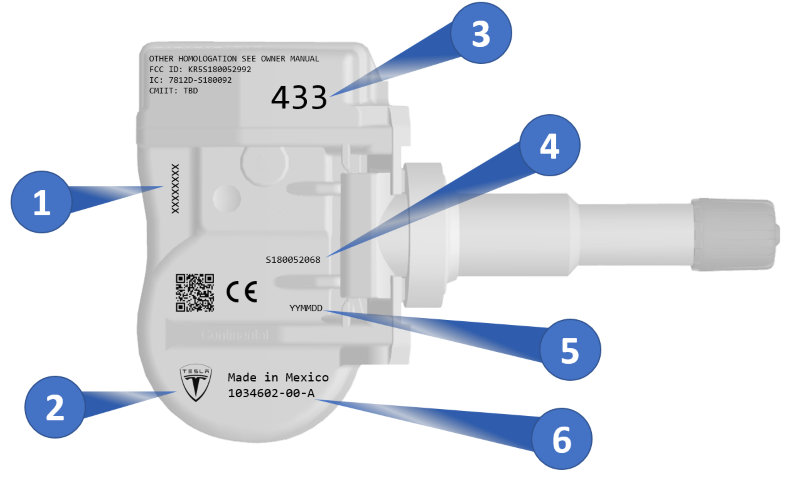 |
|---|
| 1. TPMS ID (ID that TPMS uses to identify the Wheel Sensor) 2. Tesla Logo 3. Frequency value 433/315Mhz 4. Continental Product Reference 5. Date of production 6. Tesla part number |
| TPMS Identification Marks |
TPMS Wheel Sensor Locationlink
The sensor is secured to the valve stem by the insert. The sensor fits through the valve hole into the wheel rim, and it is secured with the valve nut.
To avoid air leaks, it is sealed with an O-ring.
The curvature of the sensor follows the form of the wheel rim.
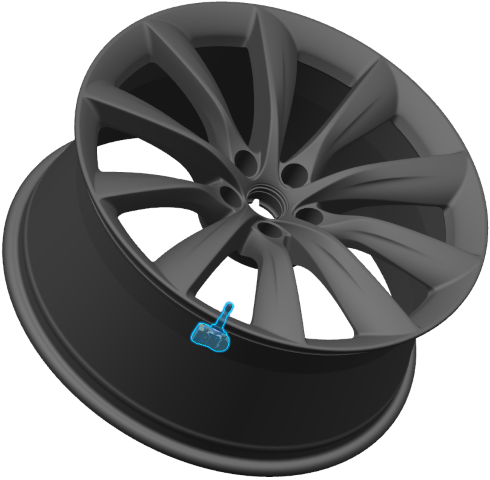 |
|---|
| Installed TPMS Sensor on a Wheel |
Modeslink
The wheel sensor is programmed to allow multiple modes, this has been done for battery life and priorities of transmitting the data in case of tire pressure drops. During these multiple modes the transmission rate is depending of wheel speed or tire pressure.
Storage Modelink
Storage Mode also known as "Off" is when ever the sensor is new, this state is to be seen if a new sensor is received from the parts inventory.
During Storage mode the sensor will not transmit any data. If the sensor has been awakened with a low frequency radio signal by the Ateq TPMS tool and/ or the tire pressure rises with a delta of 4.8 psi / 0.33 bar the sensor will enter stationary mode.
Stationary Modelink
Stationary Mode is also known as "park" when ever the wheel sensor has been installed to a wheel when ever it has been on a vehicle or wheel storage.
Transmission rate is every 13 hours for stationary mode if there is no pressure drops or rise.
When there is a pressure fall or rise of 2.0 psi (0.14 bar) the pressure will be transmitted every 64 seconds. Acceleration will be transmitted every 16 seconds once in motion.
Startup Modelink
Startup Mode is also known as the "first 40 blocks," this is the startup mode when ever the wheel sensor is accelerating to 5g, in normal conditions this will be done when the vehicle is driving with a speed more than 15 mph (25 km/h).
The transmission rate in startup mode is every 16 seconds for 40 blocks. Once the 40 blocks are sent the sensor transitions into run mode the transmission rate will than decrease to every 64 seconds. Both pressure and acceleration will be transmitted with the same rate of once every 16 seconds.
Run Modelink
Run mode also known as "drive" the wheel sensor is rotating with a vehicle speed of 15 mph (25 km/h).
The transmission rate when the pressure is steady is every 64 seconds.
If tire pressure changes rapidly; either falling or rising by 2.0 Psi (0.14 Bar) comparing of the last know transmitted pressure, the sensor will transmit every 2 seconds.
Run Delay Modelink
Run delay mode, also known as the interim state of the wheel sensor. Once the vehicle speed has been decreased below 15 mph (25 km/h), the wheel sensor will switch from run into run delay mode. If the vehicle speed increases to 15mph (25 km/h) or faster the wheel sensor will return to run mode, if the speed remains below 15 mph (25 km/h) for a extended time of 15 minutes the wheel sensor goes into stationary mode.
Auto-learn TPMS Wheel Sensorslink
The wheel sensor is able to detect wheel angle position, this wheel angle position is a known position of the wheel sensor. During motion this position is recognized as a known position and uses that location as a "tick". This tick will then be send to the TPMS ECU, where it is being matched to a wheel speed coming from the ESP (ABS Wheel Speed Sensing). When TPMS matches the ABS wheel speed to the TPMS Wheel Sensor it will allocate a location on the vehicle.
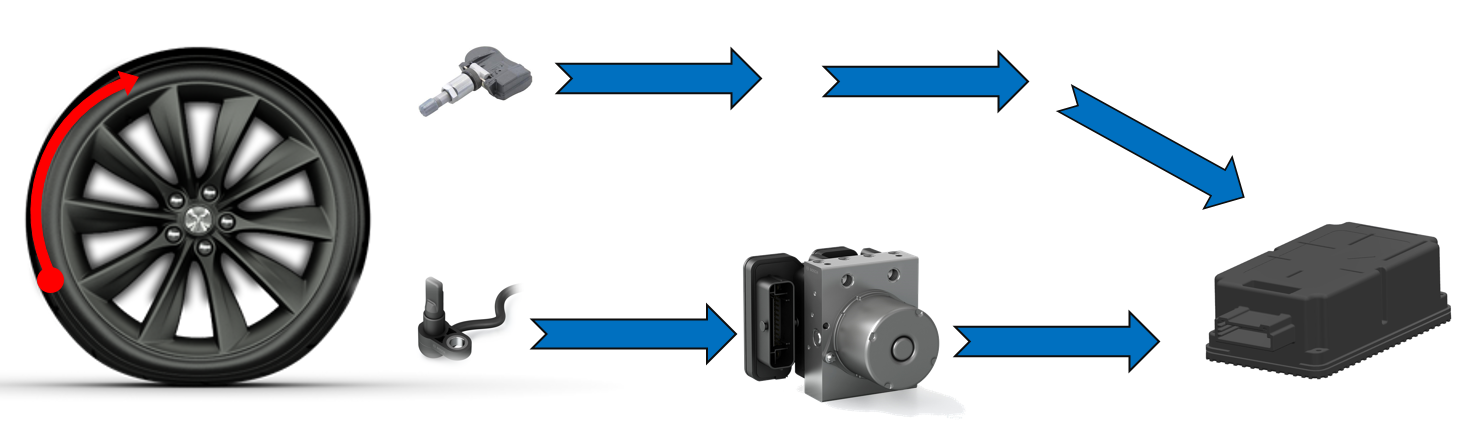 |
|---|
| TPMS sensor reporting wheel rotations (ticks) and wheel speed sensor (ABS) sharing info to TPMS ECU |
| Specification | |
|---|---|
| Transmitter power | 18.5 dBm |
| Transmitting frequency | 433.92 MHz / 315MHz for Japan only |
| Battery life | 10 years (driving for 2 hours average each day) depending on temperature |
| Operation temperature | -40° – 257°F / -40° – 125°C |
| Pressure range | 14.5 – 116 Psi / 1 – 8 Bar |
| Weight | 37 gram |
Warning
There are non-OEM TPMS wheel sensors in the market, these are prone to report application programming errors, sensors not successful relearned to the vehicle, short battery life. Check the physical sensor to determine is the vehicle has a genuine TPMS wheel sensor. See sensor identification.
TPMS ECUlink
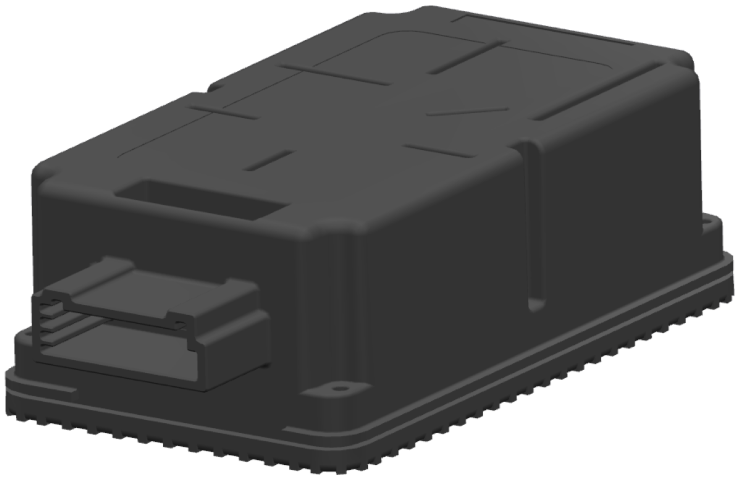 |
|---|
| TPMS ECU |
The TPMS ECU (also known as the antenna/ receiver module) contains:
- 433 MHz or 315 Mhz (for Japan only) RF receiver
- a data de-modulator
- a data decoder
- an antenna.
The TPMS ECU receives the information from the wheel sensors, and process that to the end user. The TPMS ECU is connected to the Chassis CAN bus where it is able to receive the following vehicle information. thetable below shows some the high level signals used:
| Signal | Purpose |
|---|---|
ESP_vehicleSpeed |
ID learning, ID registration, warning algorithm, ID localization, parking supervision |
Locationlink
The TPMS electronic control unit (ECU) is installed inside of the passenger compartment.
Model X behind the headliner at the 2nd row center spine.
Sensor ID retentionlink
The TPMS ECU unit retains the learned sensor ID information in non-volatile memory after execution of learning the ID's.
Module and System Faultslink
| Fault Signal | Meaning |
|---|---|
eolNotCompleted |
Indicates the factory learn procedure has not been completed (THIS MAY BE APPLICATION SPECIFIC) |
ecuOverVoltage |
Voltage above 16V |
rfReceiverFailRF |
receiver no longer able to detect pings |
vehicleSpeedFail |
Vehicle speed send over CAN to the TPMS module not present |
externalTemperatureFail |
External Temperature sent over CAN to the TPMS module not present |
systemMalfunction |
General signal that is a logical OR of all fault signal |
| Specifications | |
|---|---|
| Receiver power voltage | 12V |
| Operation temperature | -40°C ~ +85°C |
| Receiver sensitivity | -105 dBm |
TPMS ECU connectorlink
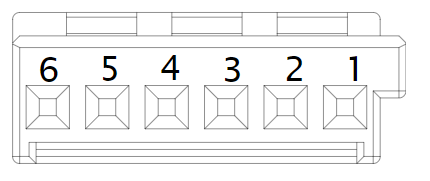 |
|
|---|---|
| Pin | Usage |
| 1. | VBat +30 |
| 2. | Chassis CAN+ |
| 3. | Chassis CAN- |
| 4. | Ground +31 |
| 5. | Ignition +15 |
| 6. | Not used |
TPMS Operationlink
When the vehicle has been parked for more than 19 minutes (long enough to have the wheel sensors been exchanged or replaced), the TPMS will start with a "ID learning" routine. During this time the TPMS UI will show blank (--) pressure values.
When the vehicle starts moving and the accelerometer within the wheel sensor detects centrifugal force, the sensors are beginning to transmit data. The transfer starts at a high rate, then decreases to a lower rate. When the sensor becomes stationary, it will transmit data at a high rate. If tire pressure changes rapidly while driving, the sensor transmits at a high rate to inform the driver the current condition of the tire pressure. The wheel sensor transmits pressure and temperature data over a wireless Radio Frequency (RF) link to the antenna module. Error protection of the transmitted signal is provided by a cyclic redundancy check algorithm. The antenna module receives the data and converts it to a CAN message, which is then broadcast on the chassis bus. The TPMS ecu firmware determines when to display the TPMS indicator light.
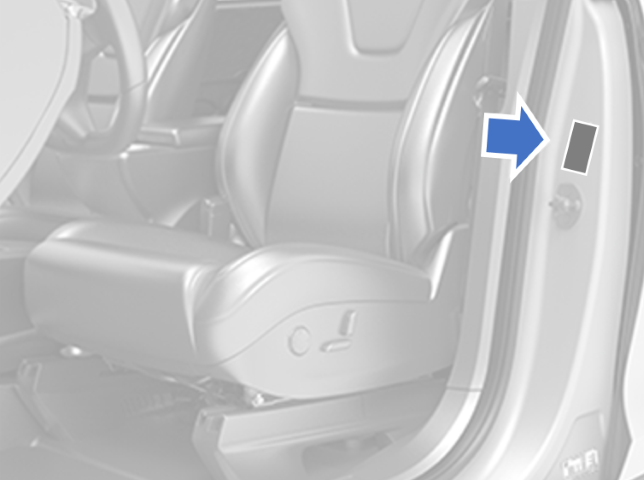
The TPMS indicator light does not immediately disappear when the tire pressure is adjusted. After the tire is inflated to the Recommended Cold Pressure (RCP) it should not take more than 3 minutes for the indicator light to disappear, if the vehicle has been restarted with in the 19 minutes window. If the vehicle has been stationary for a longer time >19 minutes, it will take around one minute of driving above 10 mph (16 km/h) for the indicator light to disappear. Incase new sensors are installed it will fall back to the ID learning routine. RCP values for a vehicle can be found on the B-Pillar sticker.
Note
Ideally pressurize the tires where the vehicle has been stationary for over three hours, as temperature can influence the RCP. In the Service Manual, refer to General Information > Technical Data > Tire Pressures for a current list of RCP values.
 |
|---|
| Tire Recommended Cold Pressure Label* |
UI and Telltale Behaviorlink
If a TPMS sensor becomes unresponsive, faulty, or the TPMS module itself becomes unresponsive, this will be captured as a system fault. At this moment, the flashing telltale shall be present and a chime will sound. The telltale remains until the fault causing the telltale has cleared. Upon shifting into drive, the TPMS telltale shall blink with the other telltales to indicate it is functional. This sequence repeats for subsequent vehicle start-ups as long as the malfunction exists. During a system malfunction, the system might not be able to detect or signal low tire pressure as intended.
TPMS malfunctions can occur for a variety of reasons, including the installation of replacement or alternate tires or wheels on the vehicle that prevent the TPMS from functioning properly.
| Telltale | Description | Telltale | Chime | Alert |
|---|---|---|---|---|
| Hard Warning | Tire pressure falls below 23 PSI / 1.58 Bar |  |
Single Chime | Display Alert, Red Text |
| Soft Warning | See Soft Warning section | |
No Chime | Display Alert |
| Over Temperature | Temperature goes above 70°C | |
No Chime | Display Alert |
| System Fault | Generic fault message for the system. Often caused by unresponsive wheel sensors. | |
No Chime | Display Alert |
| MIA Module | If the TPMS ecu itself is unresponsive for more than 2s while in drive then a telltale shall be raised indicating a system fault |  |
No Chime | Display Alert |
Soft Warninglink
The TPMS ECU firmware contains the appropriate pressure thresholds. TPMS thresholds vary depending on suspension type, tire size, and region. To reduce driver annoyance, TPMS mutes soft warnings at the start of drive for a period no greater than 20 minutes for North America and 10 minutes for Europe/ROW, scaled by a wheel's proximity to the hard warning pressure. Soft warnings are detected on a per wheel basis.
European Soft Warning Determinationlink
A telltale shall be raised for any wheel that falls below 80% of P_warm.
P_warm shall be calculated as follows independently for each wheel:

| Variable | Meaning |
|---|---|
| RCP | Recommended Cold Pressure |
| Tambient | Ambient temperature (C°). This is sent to the TPMS module over CAN. This value shall be saved at start of drive after the vehicle has been stationary for at least 1 hour |
| TBarom | Ambient Barometric Pressure (Bar). This is sent over CAN to the TPMS module. If unavailable, 100kPa shall be assumed |
| Ttire | Tire Temperature (C°) This value is read by each wheel unit |
Service Sensor ID Learnlink
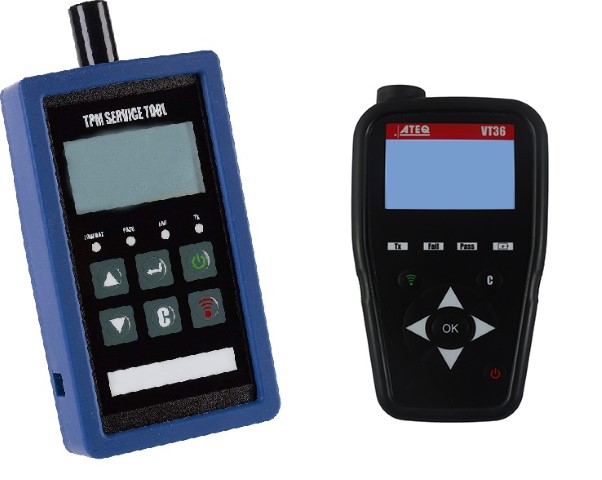
The service sensor ID learn procedure requires a handheld TPMS tool. See the service manual on how to perform learning procedure:
TPMS Sensor - ID Learn Procedure Correction Code 34041100
 |
|---|
| TPMS Service Tools |
Note
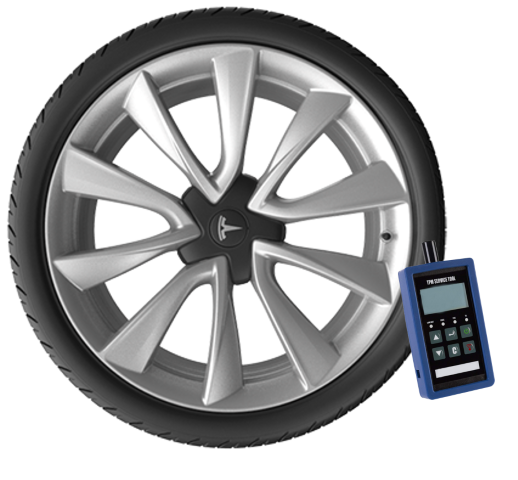
When multiple vehicles are in close proximity of each other, TPMS Service Tooling might detect other vehicle's TPMS sensors that can cause a TPMS fault to occur. Moving the vehicle further away from another vehicle's TPMS sensors improves reliability.
 |
|---|
Tip
Hold the TPMS handheld tool against the tire sidewall for improved reading
UI Wheel Configurationlink
With the introduction of Firmware 2019.32.X, customers are able to change the wheel configuration on their display(s).
Vehicles running firmware versions earlier than 2019.32.X and have an incorrect wheel configuration should be updated to the latest firmware version or have the wheel configuration changed with a Toolbox routine.
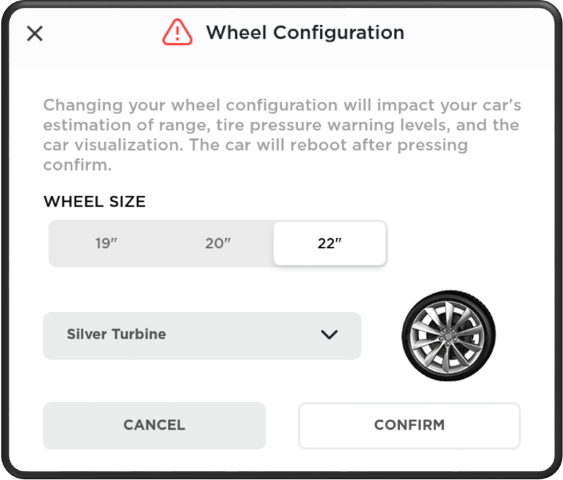
Selecting a new type of wheel will impact the following items:
- Vehicle range estimation
- Vehicle visualization (avatar)
- Tire pressure warning levels
- Recommended Tire Pressures
When selecting the wheel configuration as desired the configuration of the vehicle will be updated to the desired wheel. The Gateway reboots to set the new configuration. When selecting a new wheel set, the TPMS Recommended Cold Tire pressure setting will also change accordingly.