Tire Pressure Monitoring System (Baolong)link
Last updated: October 20, 2023
Introductionlink
The Tire Pressure Monitoring System (TPMS) monitors the air pressure and temperature of each tire and transmits this information via a Radio Frequency (RF) signal to the antenna module.
The main purpose is to provide a warning when a tire pressure is under or over certain limits. The pressure limits are different depending on vehicle configuration and wheel type.
If the tire pressure is above or below the defined values, an alert is set and a solid indicator light is displayed in the instrument cluster. A flashing indicator light that turns solid after 60 seconds indicates a TPMS system fault.
Note
Model S manufactured before November 2014 were originally equipped with 1st generation TPMS (Baolong). Some of these vehicles may have later been retrofitted with a 2nd generation system (Continental, a.k.a. Conti). Check which generation has been installed on the vehicle by checking the vehicle configuration.
TPMS Type Configurationslink
The following tpmsType configurations are available:
- Baolong (early Model S only)
- Conti (Model S)
- Conti2 (Model S and Model X)
- Conti_2 (Model 3)
- TESLA_BLE (Model 3 and Model Y)
Conti and Conti2 has no noticeable difference between operation, the only addition Conti2 has over Conti is the capability to update the bootloader of the TPMS ECU.
Note
It is the driver’s responsibility to maintain correct tire pressure, even if under-inflation has not reached the level to trigger the TPMS warning light.
Warning
Driving on a significantly under-inflated tire severely increases the risk of the tire overheating, which might lead to sudden tire damage. Under-inflation also reduces range, tire durability, and affects the vehicle’s handling and braking ability.
The Tire Pressure Monitoring System (TPMS) is not a substitute for manually checking wheel conditions and adjusting tire pressures.
Do not use any tire liquid or aerosol tire sealant other than the one supplied with the vehicle, as this might cause a malfunction of the tire pressure sensors.
Component Descriptionslink
Overviewlink
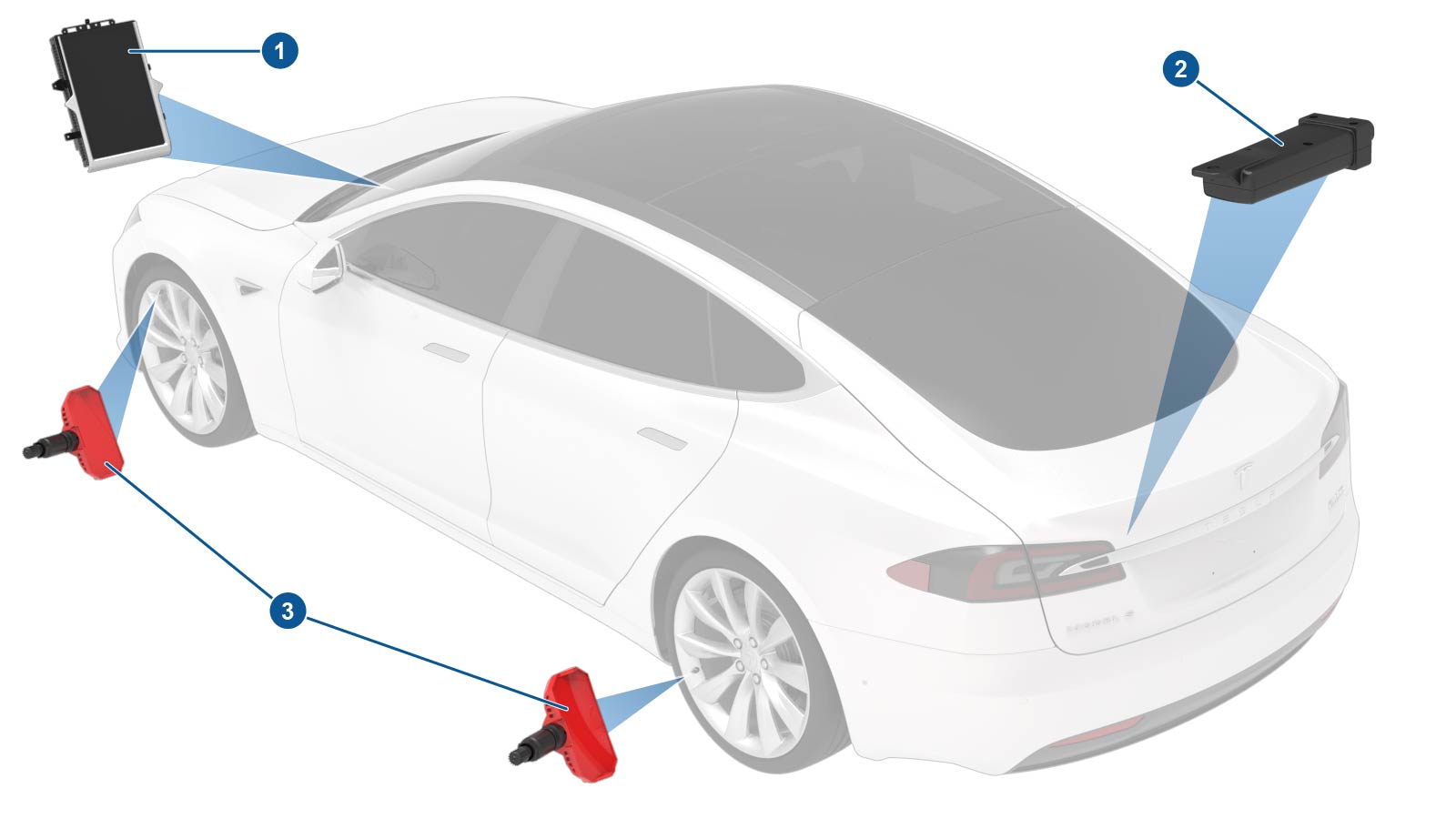 |
|---|
| 1. Multimedia Control Unit (MCU) 2. TPMS ECU 3. TPMS Wheel Sensor Not shown external Antenna* |
TPMS Wheel Sensorslink
TPMS Wheel Sensor componentslink
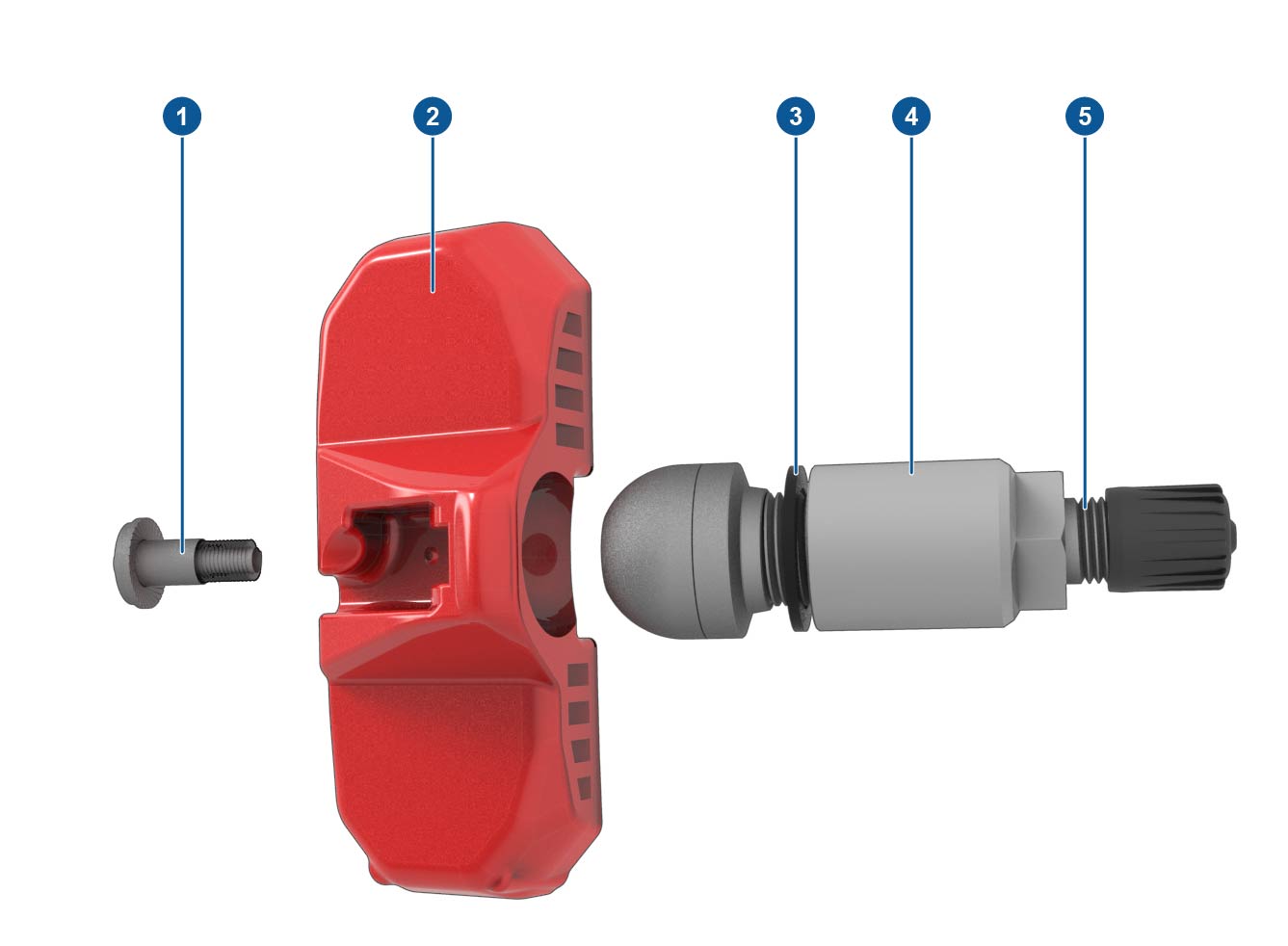 |
|---|
| 1. Valve stem retaining screw 2. Sensor unit 3. O-ring 4. Valve nut 5. Valve stem |
The TPMS Wheel Sensor is a sensor (also known as the transmitter) that is capable to provide the TPMS the current tire; pressure, acceleration and temperature. The sensor contains a pressure sensor, an accelerometer, a temperature sensor, a signal processor, and an RF antenna. To avoid any contamination The wheel sensor is equipped with a filter which prevents water, vapor or dirt ingress.
The temperature sensor prevents pressure readings from being affected by variations in temperature.
Each sensor has a lithium-ion battery that has an estimated battery life for average daily driving (2hours average) of 5 years.
The wheel sensors have a pressure measurement range of 0 – 87 Psi (0 – 6 Bar) and a temperature operating range of -40° – 185°F (-40° – 85°C).
Locationlink
The sensor is secured to the valve stem by the valve retaining screw. The sensor fits through the valve hole into the wheel rim, it is secured with the valve nut. To avoid air leaks it is sealed with an O-ring. The curvature of the sensor follows the form of the wheel rim.
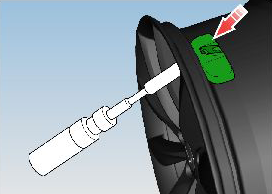 |
|---|
| Installed TPMS Sensor on a Wheel |
Transmitting Datalink
The transmission rate of data is dependent of wheel speed or tire pressure.
Storage Modelink
During Storage mode the tire pressure is below 4.3 psi (0.3 bar), the sensor will not transmit any data. If the tire pressure rises above the 4.3 psi (0.3 bar) and/ or waken up with the SmarTool, the sensor will enter stationary mode.
Stationary Modelink
Transmission rate is every 2 minutes for stationary mode if there is no pressure drops or rise. If the pressure is either falling or rising by 2.2 Psi (0.15 Bar) within 15 seconds, the sensor will transmit every 8 seconds.
Startup Modelink
If the speed above 25 mph (40 km/h) is detected the sensor goes into startup mode, the transmission rate increases to every 4 seconds for 4 times. When the 4 messages are sent the sensor transitions into run mode the transmission rate will than decrease to every 30 second.
Run Mode - Drivelink
The transmit rate when the pressure is steady is every 30 seconds. If tire pressure changes rapidly, either falling or rising by 2.2 Psi (0.15 Bar) within 15 seconds, the sensor will transmit every 2 seconds.
Run Delay Modelink
Once the wheel speed decreases below 25 mph (40 km/h) for an extended time of 2 minutes or longer it will return into stationary mode.
Localization of the TPMS Wheel Sensorlink
Different than the Continental TPMS version (Generation 2), the position of the sensor on the vehicle is required to be learned, and is NOT automatic detected.
Note
See TPMS Sensor - ID Learn Procedure - Baolong Correction Code 34041000 in the Service Manual on how to learn.
Warning
If the User Interface Button Reset Sensors has been used the TPMS will randomize the locations of the sensors. This UI option is intended for customer use, not recommended for Service. This is particularly important when a vehicle is equipped with a staggered wheel option (front and rear different wheel width).
Specificationlink
| Transmitter power | 4 ± 2 dBm |
| Transmitting frequency | 433.92 MHz |
| Battery life | 5 years (driving for 2 hours average each day) |
| Operation temperature | -40°C ~ +85°C / -40°F ~ 185°F |
| Pressure range | 0-87 psi / 0-6 bar |
| Weight | 40 gram |
Warning
Tesla Roadster 2.X are also equipped with Baolong TPMS Wheel Sensors. To distinguish Roadster versus Model S, look up the writings that are located on the Sensor Unit. Tesla Roadster = V1.1 Tesla Model S = V02
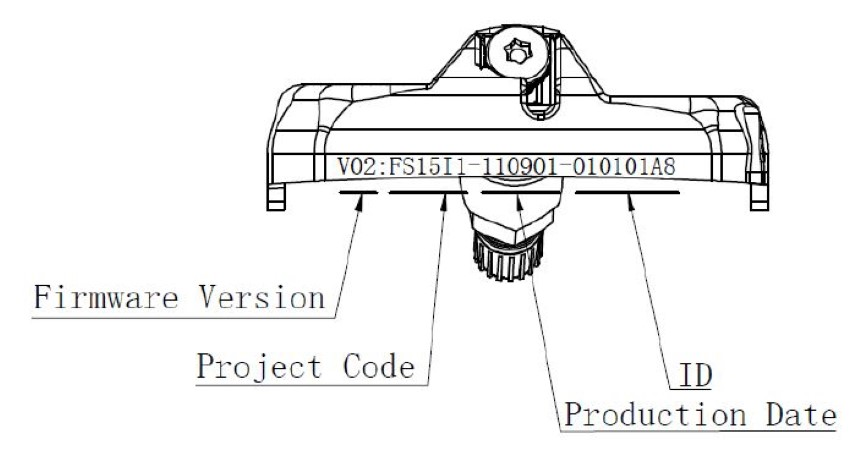 |
|---|
| TPMS Wheel Sensor Identification |
TPMS ECUlink
 |
|---|
| TPMS ECU |
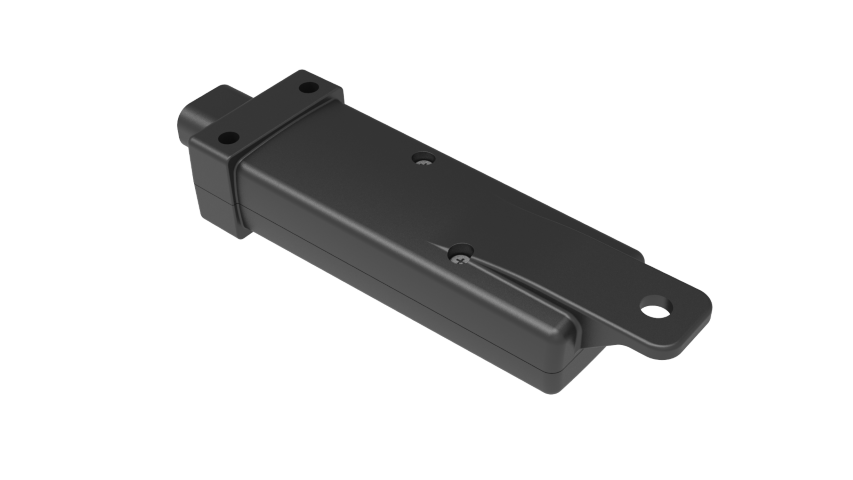
The TPMS ECU (also known as the antenna module) contains; 433 MHz RF receiver, a data de-modulator, a data decoder and an antenna. Earlier versions of the TPMS ECU prior to the "-D" revision, were equipped with an antenna that didn't receive reliable readings from the front sensors. For some of these vehicles these where equipped with external TPMS antenna extenders for a period of time.
See TPMS External Antenna section for more information.
Locationlink
The TPMS electronic control unit (ECU) is installed externally at the rear of the vehicle, above the rear diffuser and between the Rear Drive Unit and the Rear Subframe.
Sensor ID retentionlink
The TPMS ECU unit retains the learned sensor ID information in non-volatile memory after execution of learning the ID's.
Specificationslink
| Receiver power voltage | 12V |
| Operation temperature | -40°C ~ +85°C |
| Receiver sensitivity | -105 dBm |
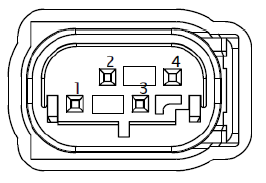
TPMS ECU Pin Outlink
 |
|---|
| TPMS ECU pin out |
| Pin | Usage |
|---|---|
| 1. | Ground -31 |
| 2. | Ignition +15 |
| 3. | Chassis CAN- |
| 4. | Chassis CAN+ |
TPMS External Antennalink
Some earlier versions of the TPMS ECU were equipped with an external antenna.
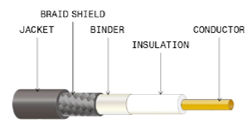
The external antenna is a coax cable, where the shielding is removed from the last 173mm on each end of the coax. The ends of the cables are sealed with a adhesive lined shrink tube.
 |
|---|
| External Antenna |
Locationlink
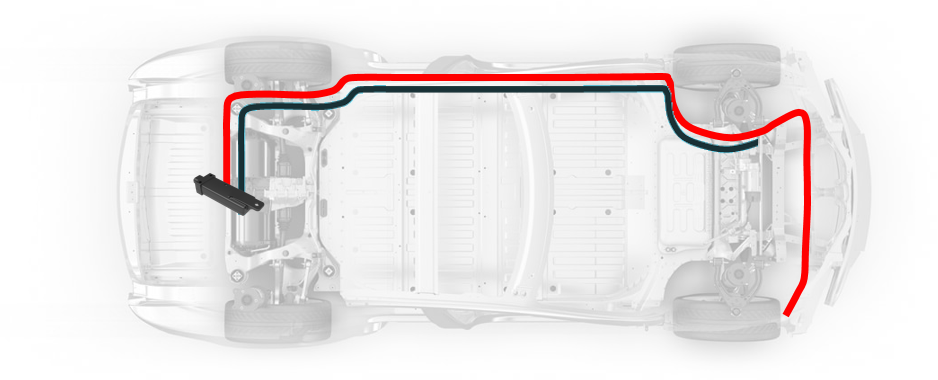
Two antennas are coupled with the ECU in the rear and then routed up the left side of the vehicle to the front wheel wells. See below image of the routing.
 |
|---|
| External Antenna routing |
The retrofit option of this external antenna has been discontinued in favour of a TPMS System generation upgrade to Continental.
TPMS Operationlink
When the vehicle starts moving and the accelerometer within the wheel sensor detects centrifugal force, the sensor begins transmitting data. The transfer starts at a high rate, then decreases to a lower rate. When the sensor is stationary, it transmits data at a very low rate. If tire pressure changes rapidly while driving, the sensor transmits at a high rate. The wheel sensor transmits pressure and temperature data over a wireless Radio Frequency (RF) link to the antenna module. The antenna module receives the data and converts it to a CAN message, which is then broadcast on the chassis bus. The vehicle firmware determines when to display the TPMS indicator light.
The TPMS indicator light does not immediately disappear when the tire pressure is adjusted. After the tire is inflated to the Recommended Cold Pressure (RCP) it should not take more than 3 minutes for the indicator light to disappear, if it has been less than 15 min from the last drive. If the vehicle has been stationary for a longer time than that, it will take around 1 minute of driving above 10 mph (16 km/h) for the indicator light to disappear. RCP values for a vehicle can be found on the B-Pillar sticker. Ideally pressurize the tires where the vehicle has been stationary for over three hours, as temperature can influence the RCP.
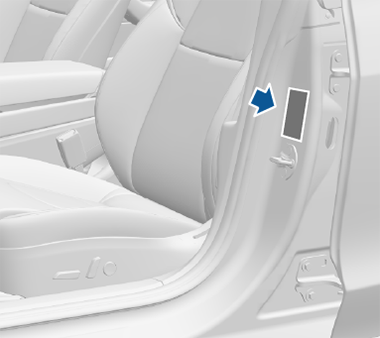 |
|---|
| Recommended Tire Pressure Label |
In the Service Manual, refer to General Information > Technical Data > Tire Pressures for a current list of RCP values.
TPMS Malfunctionslink
The TPMS indicator light displays when the system is not operating correctly.
The TPMS malfunction indicator light (MIL) is combined with the tire pressure indicator. When the system detects a malfunction, the indicator light flashes for approximately one minute after the vehicle drive rail is on and then displays continuously. This sequence repeats for subsequent vehicle start-ups as long as the malfunction exists. During a system malfunction, the system might not be able to detect or signal low tire pressure as intended.
TPMS malfunctions can occur for a variety of reasons, including the installation of replacement or alternate tires or wheels on the vehicle that prevent the TPMS from functioning properly.
Any time the TPMS sensors location are switched (for example, when rotating the tires), a TPMS sensor ID learn procedure should be performed.
 |
|---|
| TPMS indicator light |
Automatic Sensor ID Learnlink
TPMS has a built-in feature that automatically learns a new set of wheel sensors. The TPMS sensors can be reset via the vehicle's touchscreen. If the User Interface Button Reset Sensors has been used the TPMS will randomize the locations of the sensors. This UI option is intended for customer use, not recommended for Service. This is particularly important when a vehicle is equipped with a staggered wheel option (front and rear different wheel width). The Reset Sensors button is reached from the Service tab control menu under Tire Pressure Monitor section. Reset the sensors based on the wheel size. Auto learning will start when performing a following road test and when the vehicle exceeds 40 km/h (25 mph).
Note
When auto-learning completes, it clears the TPMS indicator light.
Auto-learning can take up to 20 minutes during a test drive.
Warning
Automatic Sensor ID learn, is not a substitute of a repair.
Service Sensor ID Learnlink
The service sensor ID learn procedure requires a handheld Tesla SmarTool.
Note
See TPMS Sensor - ID Learn Procedure - Baolong Correction Code 34041000 in the Service Manual on how to learn).
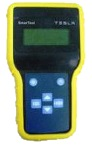 |
|---|
| Tesla SmarTool |
Note
When multiple vehicles are in close proximity of each other, Tesla SmarTool might detect other vehicle's TPMS sensors that can cause a TPMS fault to occur. Moving the vehicle further away from other vehicles improves reliability.
Setting Pressure Thresholdslink
TPMS thresholds vary depending on suspension type, tire size, and region. In the Service Manual, refer to General Information > Technical Data > Tire pressures for a current list of thresholds.
When performing the Sensor ID Learn Procedure, the vehicle sets the pre-defined Recommended Cold Pressure (RCP) target values and pressure limits according to the selected wheel size.
Note
See TPMS - Set Thresholds Correction Code 34041300 in the Service Manual.