Infotainmentlink
Last updated: January 15, 2024
Overviewlink
Infotainment is a general term used to describe how a customer accesses vehicle settings, information, entertainment, climate controls, and audio. It has since grown to encompass navigation, connectivity, voice recognition, and (to a point) mobile app and mobile controls.
Infotainment Evolutionlink
2024+ Model 3 continues the evolution of the Tesla Infotainment system with the introduction of the AMD Ryzen system on chip and the carry-over of the gen3 Gateway. Before we delve into the operation of this new generation of Infotainment let's take a moment to review the nomenclature surrounding evolution of infotainment up to this point.
| Customer Facing / Central Processing Unit (CPU) | Model S/X NVIDIA Tegra | Model S/X Intel Atom | Model 3/Y Intel Atom | Model S/X/3/Y AMD Ryzen |
|---|---|---|---|---|
| Configuration Nomenclature | mcu | mcu_transition | ice | infoz |
| Toolbox Article Tag | [Info-Tegra] | [Info-Atom] | [Info-Atom] | [Info-Ryzen] |
Note
Toolbox article tags may further specify model ([Model S/X] or [Model 3/Y]) if the issue described is specific to CPU and Model.
Car Computerlink
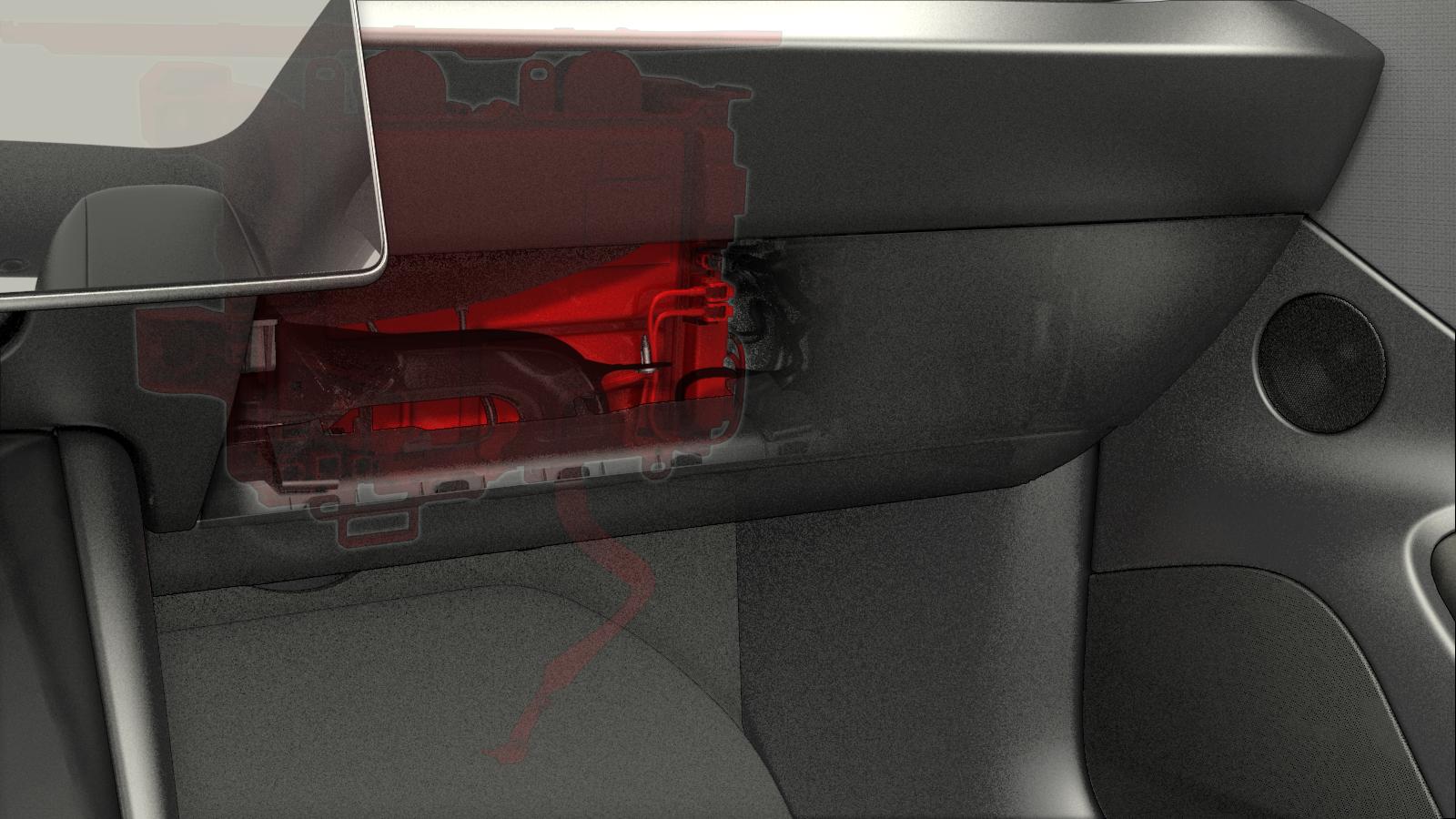
The car computer is mounted in the passenger front footwell and is cooled by the vehicle's cooling system.
 |
|---|
| Car computer location |
The car computer consists of a cold plate, top and bottom cover, and two printed circuit board assemblies:
- Ryzen infotainment board
- Autopilot hardware 4.0
The Autopilot board sits under the bottom cover and connects to the Ryzen infotainment board via a gigabit ethernet jumper.
The bottom cover also acts as the car computer's mounting bracket and ground path to the body in white.
Ryzen Infotainment Boardlink
The top of the Ryzen infotainment board is the side that faces the cold plate. This side of the board contains the following major components:
- AMD Ryzen CPU
- Gateway
- Audio Digital Signal Processor (ADSP)
- Ethernet switch
- Gateway microSD card reader
The bottom of the Ryzen infotainment board is the side facing the top cover and contains the following major components:
- Connections to vehicle harness
- Real time clock battery
Gatewaylink
2024+ Model 3 continues the usage of the gen3 Gateway that is evolved from Model 3. The gateway is a microcontroller containing three CPU's (2 160 MHZ 32-bit and 1 80MHz 32-bit), 6MB flash memory, and 768 KB of RAM. The Gateway serves many functions of not only the Infotainment System but the entire vehicle.
- Routing: Enables module-to-module communication across CAN buses by routing CAN messages from one bus to another.
- Vehicle Configurations: Stores vehicle configuration data in on-chip Non-Volatile Random Access Memory (NVRAM).
- Logging: Records selective CAN signal data and stores on its microSD card.
- Update: Controls and determines required vehicle states, securely fetches and distributes packages for each updatable module, and is specific to Ryzen system on chip selection of kernel bank to boot the UI.
- Touch Via Gateway: Analyzes touch data from the Display, and forwards it to the UI as touch input.
Gateway Communicationlink
The gen3 Gateway in 2024+ Model 3 communicates with several modules over a variety of protocols.
- Ethernet switch via a Reduced Media-Independent Interface (RMII).
- Touchscreen over I2C to a Multiplexer transmitting touch signals to both Ryzen and Gateway.
- MicroSD card over a Secure Digital Input/Output (SDIO) connection.
- Audio Digital Signal Processor (ADSP) over a Serial Peripheral Interface (SPI).
- Ryzen over a Universal Asynchronous Receiver-Transmitter (UART) connection.
The gen3 Gateway in 2024+ Model 3 also benefits from some dedicated wake lines:
- Ring line from the TCU via Ethernet.
- Wake line from the Audio Digital Signal Processor (ADSP-GTW-WAKE).
- Wake line to the Audio Digital Signal Processor (GTW-ADSP-WAKE).
Touch via Gatewaylink
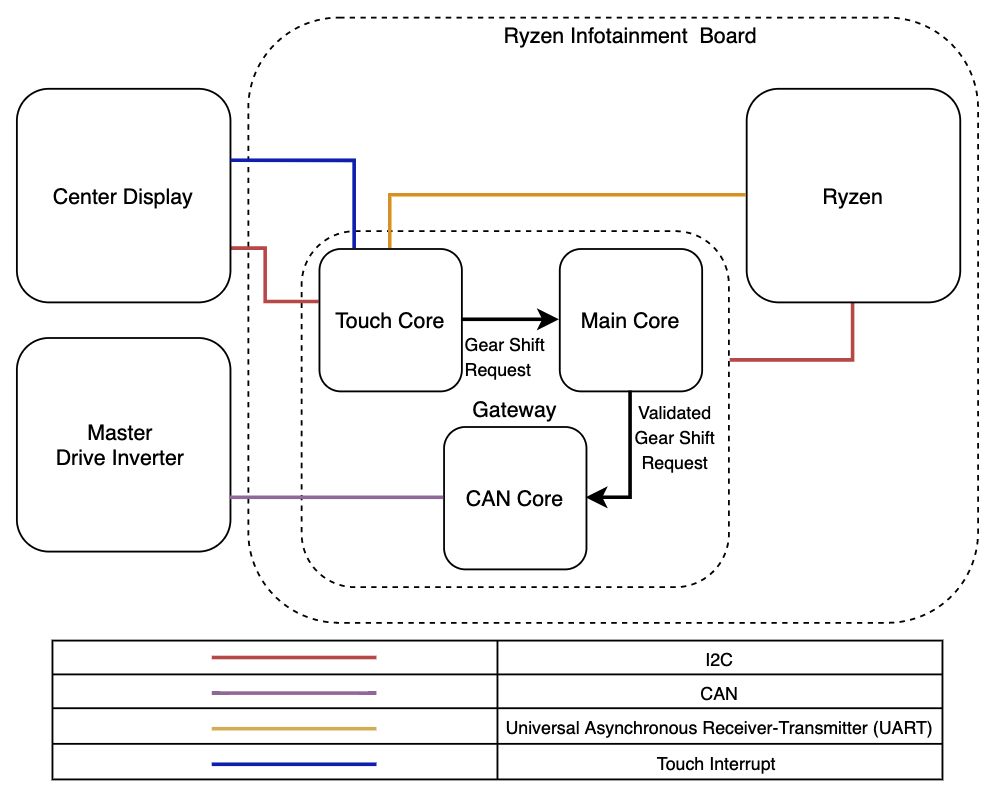
With the loss of the stalk and the addition to select drive gears via the touchscreen, the Gateway for 2024+ Model 3 takes on a new responsibility of analyzing touch data. This is accomplished by routing touch-reliant data from the touchscreen over I2C to the Gateway's CPUs for analysis and then sending it over UART to the Ryzen.
The touchscreen is connected to the Gateway via a I2C Bus. When touch is asserted, the touchscreen sends an interrupt via the touch interrupt line. Once Gateway sees the interrupt, touch data can be retrieved over the I2C bus.
Gear shift requests are first analyzed by the Gateway's touch core, then validated by the Gateway's main core, and sent to the CAN core where they leave the Gateway to the master drive inverter.
 |
|---|
| Touch Via Gateway Overview |
Gateway microSD Reader and Cardlink
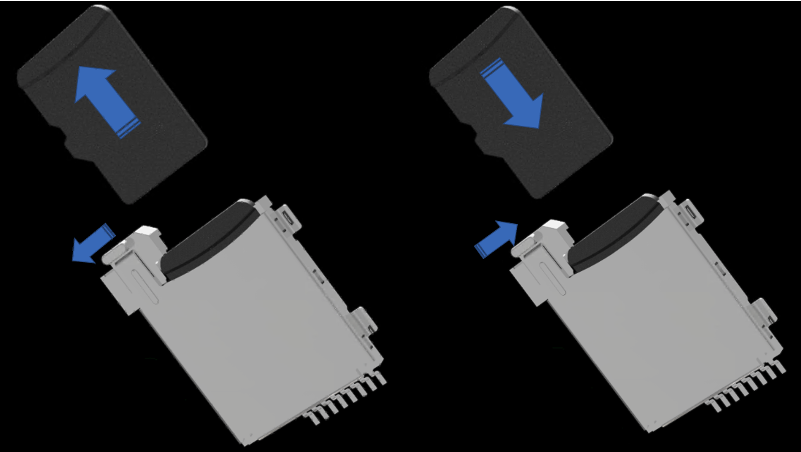
The gateway uses a serviceable 16GB microSD accessible via a provision in the car computer's cold plate.
The microSD card can be formatted over a local connection while the vehicle is in Park and a Gateway alert for the microSD is present using the PROC_ICE_X_FORMAT-SD-CARD action.
The card is spring ejected by release of the locking tab. The locking tab will automatically engage during installation once the spring ejection force is overcome.
 |
|---|
| Gateway microSD Card Eject / Inject |