Electric Park Brakelink
Last updated: June 28, 2023
Summarylink
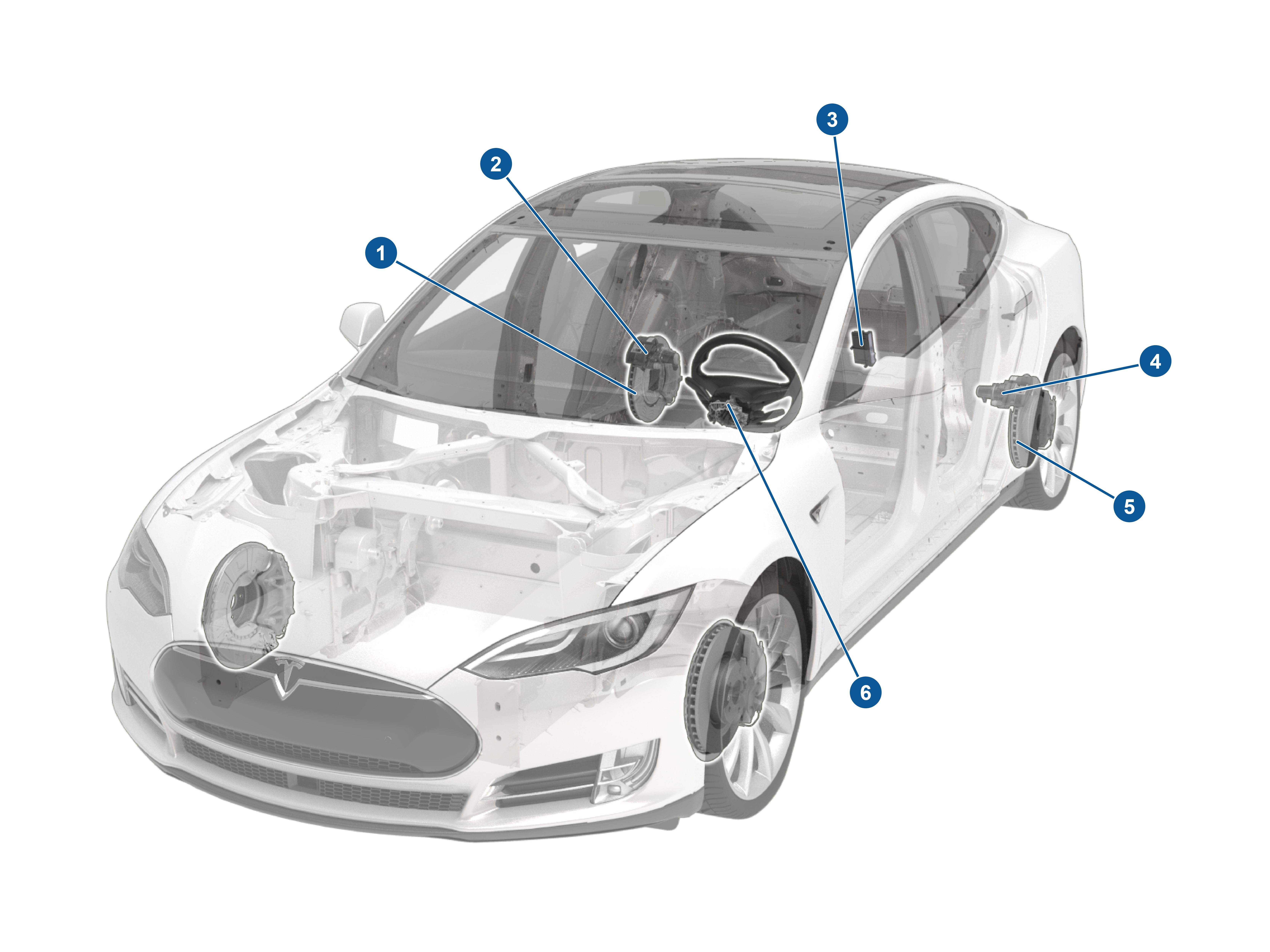
The Electronic Park Brake (EPB) system operates on the rear wheels only. It works independently from the brakes operated by the brake pedal. The vehicle uses one electrically operated sliding-type park brake caliper on each rear wheel. Each caliper uses a single piston, operated by an electric motor, through a mechanical gear reduction. The piston is applied and released electrically, but is held in the applied position mechanically. The EPB system is driven by a dedicated Electronic Control Unit (ECU) located in the trunk on the passenger’s side, behind the rear wheel.
The EPB is operated either by using the touchscreen or by pressing the P button on the selector stalk. To engage the parking brake, touch Controls > Safety & Security > Parking Brake and follow the on-screen instructions. The EPB is automatically applied when the vehicle speed is below the threshold and the driver is leaving the vehicle.
Activation of the system applies the EPB calipers to stop the vehicle moving and enables parking of a fully loaded vehicle on a 20% grade.
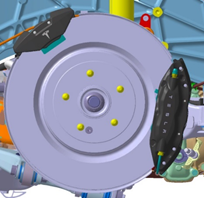
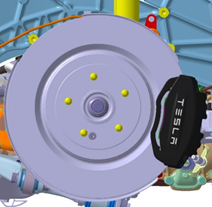
There are 2 main variants of the Electronic Park Brake, Brembo and Mando park brakes. Brembo park brakes are separate calipers on the rear wheels while Mando park brakes are integrated into the rear calipers.
- Brembo park brakes are used on all Model S built before November 2016 and also on performance Model S built after that date.
- Consequently Mando park brakes are used on all all non-performance Model S built after November 2016.
 |
 |
|---|---|
| Brembo park brake (top left) |
Mando park brake (integrated in rear caliper) |
Component descriptionslink
Locationlink
 |
|---|
| 1. Rear right brake rotor 2. Right park brake caliper 3. Electronic Control Unit (ECU) 4. Left park brake caliper 5. Rear left brake rotor 6. Stalk park brake button |
ECUlink
 |
|---|
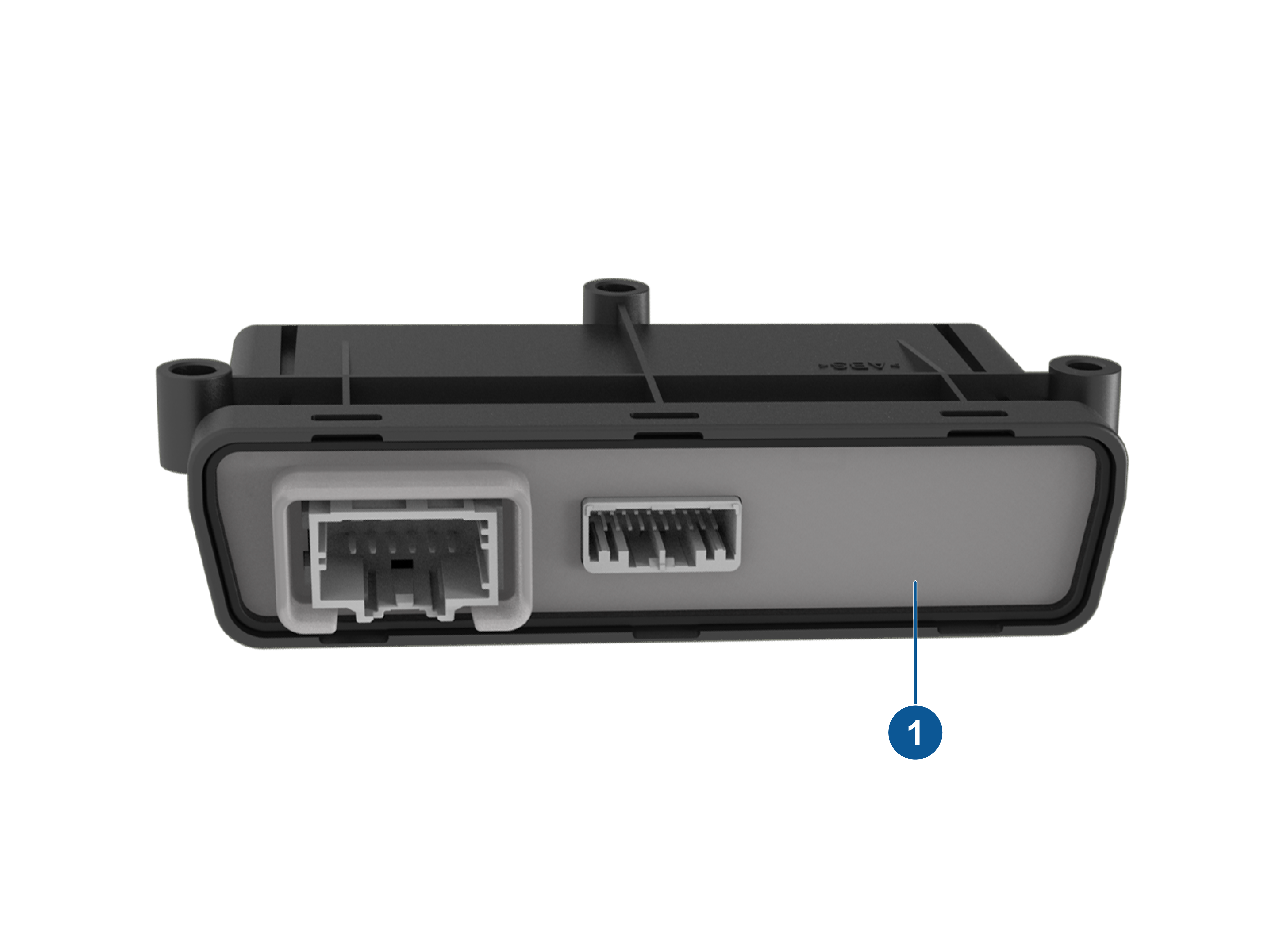
| 1. EPB Electronic Control Unit (ECU) |
The ECU comprises two individual controllers that simultaneously monitor the calipers, the main Electronic Park Brake (EPB) and the Electronic Park Brake Monitor (EPBM). If one controller fails or there is a mismatch between the two, an alert is triggered. With respect to firmware, the controllers are identified as EPB and EPBM.
The ECU is pre-programmed with operating parameters for the EPB, and determines the clamping force applied to the calipers using signals received from the driver and CAN data signals from other vehicle management systems.
Diagnostic Trouble Codes (DTCs) and live data parameters can be accessed using Toolbox.
The ECU receives user input CAN signals from the P button on the gear selector stalk and the Park Brake icon on the touchscreen. These CAN signals are used in conjunction with CAN signals from other systems to apply and release the EPB. The calipers receive a 12 Volt supply from the ECU through 20 Ampere fuses that are located in the under hood fuse box. The ECU uses a target current level to clamp the calipers to the rotors. This ensures that the correct clamping loads are used for the prevailing conditions.
Caliper (Brembo)link
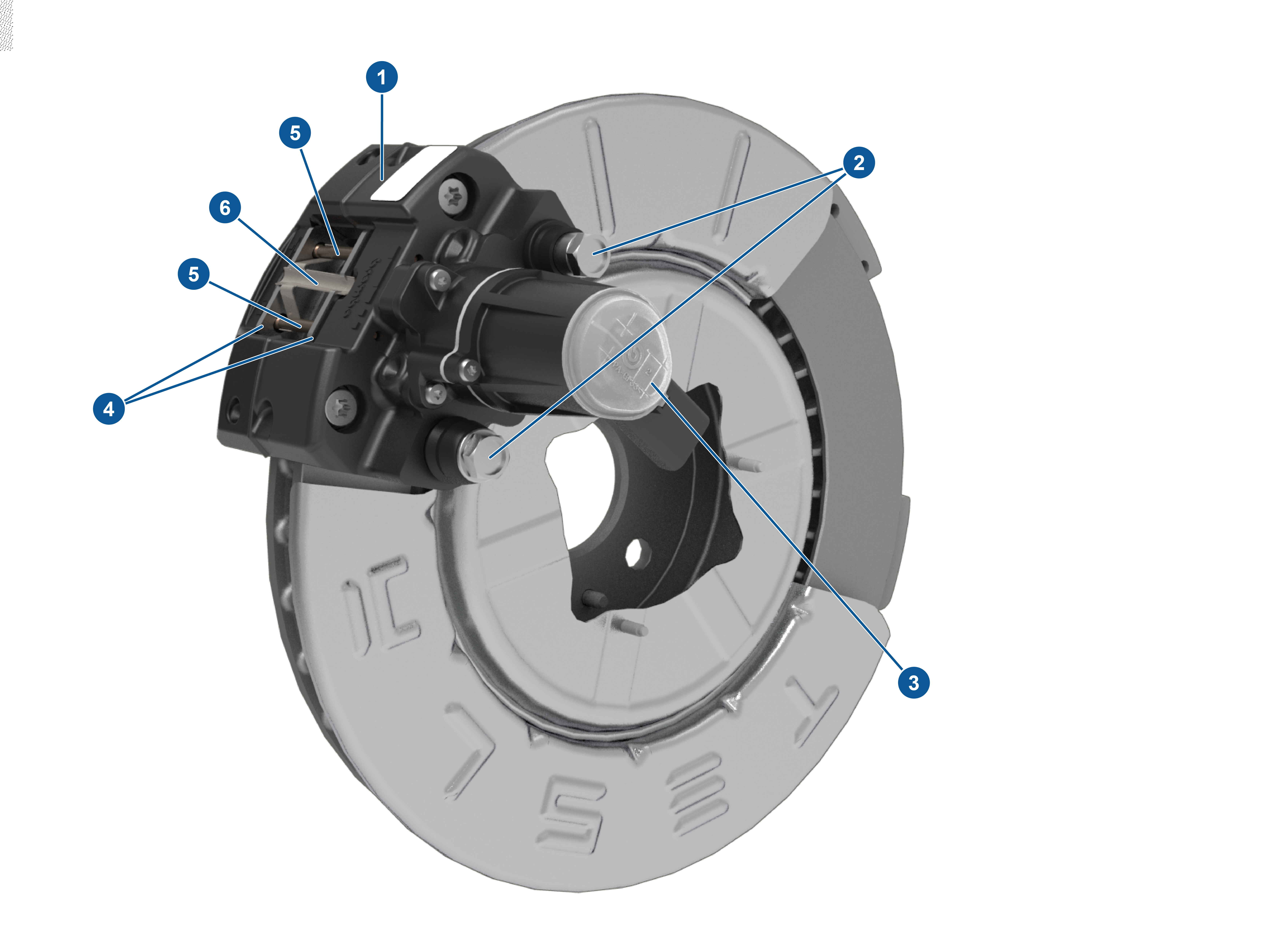 |
|---|
| 1. Caliper body 2. Caliper securing bolts (x2) 3. Caliper motor 4. Brake pads 5. Brake pad retaining pin (x2) 6. Anti-rattle pin |
The parking brake calipers are operated by electric motor. When the parking brake is applied, the motor, which is inboard of the rotor, pushes the inboard pad against the rotor. This causes the caliper body to slide inward on the guide pins, pressing the outboard pad against the rotor.
The clamping force is increased with increased ambient temperature and hill gradient. Hall effect sensors within the calipers provide feedback on piston position to the ECU. If a fault occurs in the EPB system, the red EPB indicator light displays in the instrument panel and on the touchscreen.
To release the EPB, the ECU reverses the polarity of the caliper motors.
Toolbox has a function that allows the EPB caliper piston to be automatically retracted for servicing.
Caliper (Mando)link
After November 2016, all non-performance Model S are build with integrated Mando parking brake calipers. New integrated parking brake caliper is a cost and mass reduction compared to current independent parking and service brake calipers. New caliper will be used for base level Model S vehicles and the Brembo brake calipers will remain for performance level Model S vehicles.
Operationlink
The parking brake operates by switching between operational modes depending on desired behavior. This section explains the different states in detail. The desired behavior is either initiated by the driver as active request, or by the vehicle system as passive request.
Park (engage)link
Park mode is the most commonly used mode. It is applied in order to keep the vehicle from rolling under static conditions. The clamping force is adopted to environmental factors such as slope and temperature. The park brake can only enter this state if the vehicle speed is below 5 mph (8 km/h). The gear indicator in the instrument cluster indicates when Park mode is engaged. Park mode is activated by active or passive requests.
Active requestlink
- Using the gear selector stalk. The calipers automatically engages when the Park button on the gear selector lever is pressed.
- Pressing and holding the Park button makes the calipers apply with a higher clamping force. A red park brake telltale is lit indicating the higher force. This is also referred to as 're-apply'.
Passive requestlink
- The driver door is opened.
- The driver is leaving the driver seat.
- Various vehicle system requests, such as Summon or Battery Management System.
Open (disengage)link
The parking brake system automatically disengages and switch to open state when the gear selector is shifted from Park to Drive, Reverse or Neutral, as indicated on the instrument cluster.
Tow Modelink
The parking brake automatically shifts into Park when it detects the driver leaving the vehicle, even if it has previously been shifted into Neutral. To keep the calipers in Open state, Tow mode must be activated. When Tow mode is active, an indicator light is lit on the instrument panel, along with a message telling that Model S is free-rolling. To cancel Tow Mode, disable it via touchscreen or use the Park button and confirm via touchscreen.
- To activate Tow mode, press and hold the brake pedal, then on the touchscreen touch Controls > Service > Tow Mode.
Handbrakelink
When the handbrake is applied the vehicle is in Neutral. The clamp force, and hence motor current, for the handbrake is higher than normal park and similar to re-apply. The red park brake telltale is lit indicating a higher clamping force.
- The handbrake mode can be applied via the Park Brake icon on the touchscreen (Controls > E-brake & Power off) when the vehicle is stationary and the gear selector is in Drive, Neutral, or Reverse.
Dynamic Modelink
The dynamic park brake mode is designed to slow a moving vehicle in the unlikely event of a hydraulic brake system malfunction. Dynamic park brake mode applies the calipers at low force to slow the vehicle at a moderate rate. If the vehicle is brought to a complete standstill using dynamic mode, the EPB adopts Park mode and remains engaged. Dynamic mode is activated by active request only.
- To activate the dynamic mode, press and hold the Park button on the gear selector stalk.
The calipers releases when the button is released, when vehicle speed is above 5 mph (8 km/h).
Controlslink
Engaging the park brakelink
During application, the motor is current controlled. Motor current is proportional to motor torque so this allows us to control the clamping force. To control the motor current, the motor voltage (PWM) is regulated. The required clamping force depends on temperature and slope.
Each time the park brake is applied, position is reset (zeroed) to compensate for brake disk and brake pad wear.
Clamping forcelink
| Grade | Temperature (T) | Temperature (T) | Temperature (T) |
|---|---|---|---|
| T < -4°F (-20°C) | -4°F (-20°C) <= T < 32°F (0°C) | 32°F (0°C) <= T | |
| Low (dynamic) | 3 A | 3 A | 3 A |
| Nominal (0 – 20%) | 13 A | 10 A | 8 A |
| High (> 20%) | 13 A | 13 A | 13 A |
Disengaging the park brakelink
During release the motor is position controlled. Although the Brembo park brakes are fitted with an encoder to measure position, this encoder has not been used since software version 2018.10. The Mando park brakes do not have an encoder. To determine the piston position the motor voltage is continuously measured (voltage between P and N leads). Since voltage applied to a DC motor is proportional to rotational speed, piston position can be calculated from measured motor voltage.
During release, the park brake caliper travels from the applied position, which reset to zero on each apply event, to an fixed released position. At this position, the pads do not touch the disk. Target position is 500 counts. This target position must be reached within 3.25 seconds. If not, the park brake times out and triggers an