Seatslink
Last updated: October 20, 2023
Seat generationslink
Through the years Model S has been built with various types of seats. This section explains the different seat generations that have been used thus far. This section will also explain the difference between NCAP and non-NCAP seats.
There are 3 different seat generations:
- Model S Gen 1
- Model S Gen 2
- Model X Gen 1
Model S Gen 1 seatlink
Production dateslink
- Leather base seats are produced from 22-Jun-2012 (SOP) until 16-Sep-2015 (LHD).
- Leather base seats are produced from Jun-2014 until 27-May-2015 (RHD).
- Fabric base seats are produced until Model X Gen 1 seats were introduced.
How to recognizelink
Model S Gen 1 seats can be recognized easiest by the flat seat bottom with little side support. All base seats have fixed headrests
Trim levelslink
Model S Gen 1 seats exist in 4 different trim levels.
| Trim level | Description | Picture |
|---|---|---|
| Base | Micro fiber (Textile) with partial synthetic leather. Model S Gen 1 seats are only available in black. | 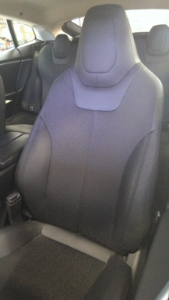 |
| Premium | Plain leather without contrast. Available in black, tan and grey. | 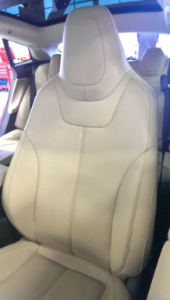 |
| Performance | Leather with contrasting piping along the seat edges. Available in black with red, tan with grey, white with grey, or grey with white. | 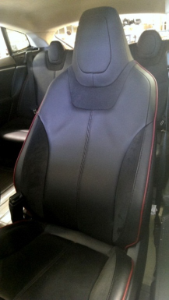 |
| Signature | Perforated leather that is only installed in Signature series VINs. Available in black, tan, and white. | 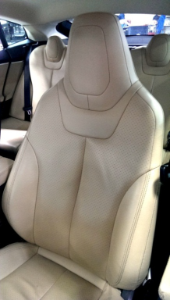 |
Model S Gen 2 seatslink
Production dateslink
- Produced between 16-Sep-2015 and 5-Jan-2017 (LHD).
- Produced between 27-May-2015 and 5-Jan-2017 (RHD).
Model S Gen 2 seats are always leather. No fabric Model S Gen 2 seats were produced. Fabric seats that overlapped Model S Gen 2 production were still Model S Gen 1 seats.
Vehicles produced before these dates (leather base seats) could be retrofitted with Model S Gen 2 seats. This retrofit is no longer available. The retrofit required installation of a door trim retention strap and Passive Restraint Controller (SDM) software calibration update.
How to recognizelink
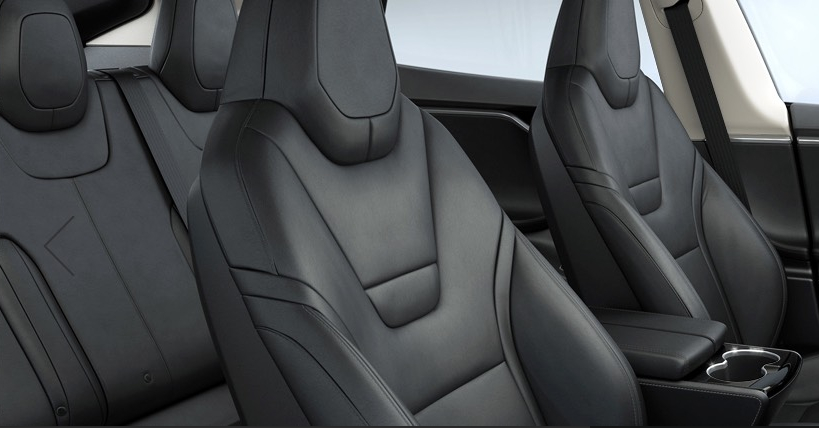
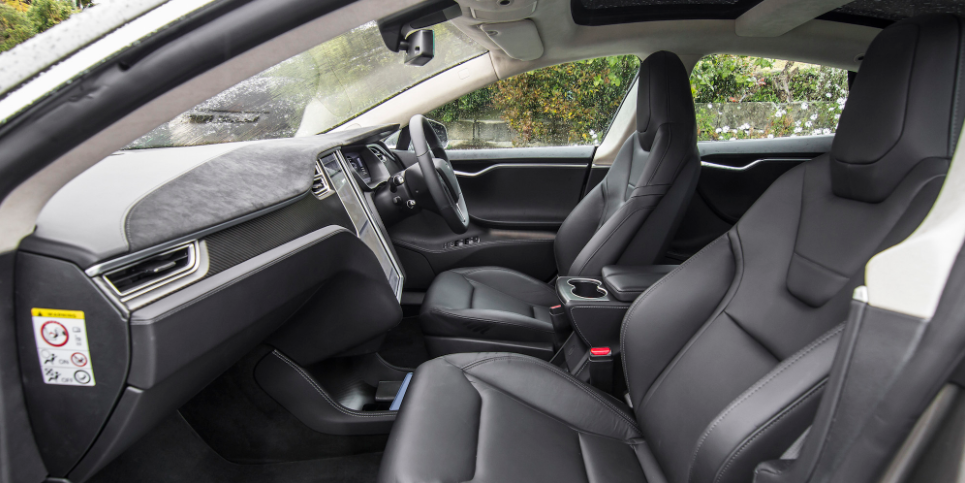
Model S Gen 2 seats have a lot more side support at the base and at the backrest than the base seats. The seat bottom is not as flat as the base seats. They look much more like a bucket seat.
Trim levelslink
Model S Gen 2 seats were available in black, tan and grey. They could be recognized from their additional side support on both the backrest and the seat bottom. Slightly different seam pattern and thicker headrest. Model S Gen 2 seats are always heated, are not available in fabric and the leather was never perforated.
 |
|---|
 |
Model X Gen 1 seatslink
Production dateslink
Model X Gen 1 seats are also known as 'Model X seats into Model S'. Tesla started to produce its own seats with the start of production of Model X. Shortly after, Model S was built with the same Model X seats. There is no clear cut-in date as Tesla started to produce cars with Model X Gen 1 seats in small batches. The first Model S vehicles fitted with 1st Generation seats were build in May 2016. Model X Gen 1 seats come with adjustable headrests.
How to recognize?link
Model X Gen 1 seats are recognized by their adjustable headrests. They have slightly less side support than the Model S Gen 2 seat but significantly more than the base seats. If a seat is perforated, it is always a Model X Gen 1 seat.
Trim levelslink
Model X Gen 1 seats exist in 3 different trim levels. Model S Gen 1 trim level always comes as black, premium and luxury trim levels are available in black, white and tan.
| Trim level | Description | Picture |
|---|---|---|
| Base | Textile | 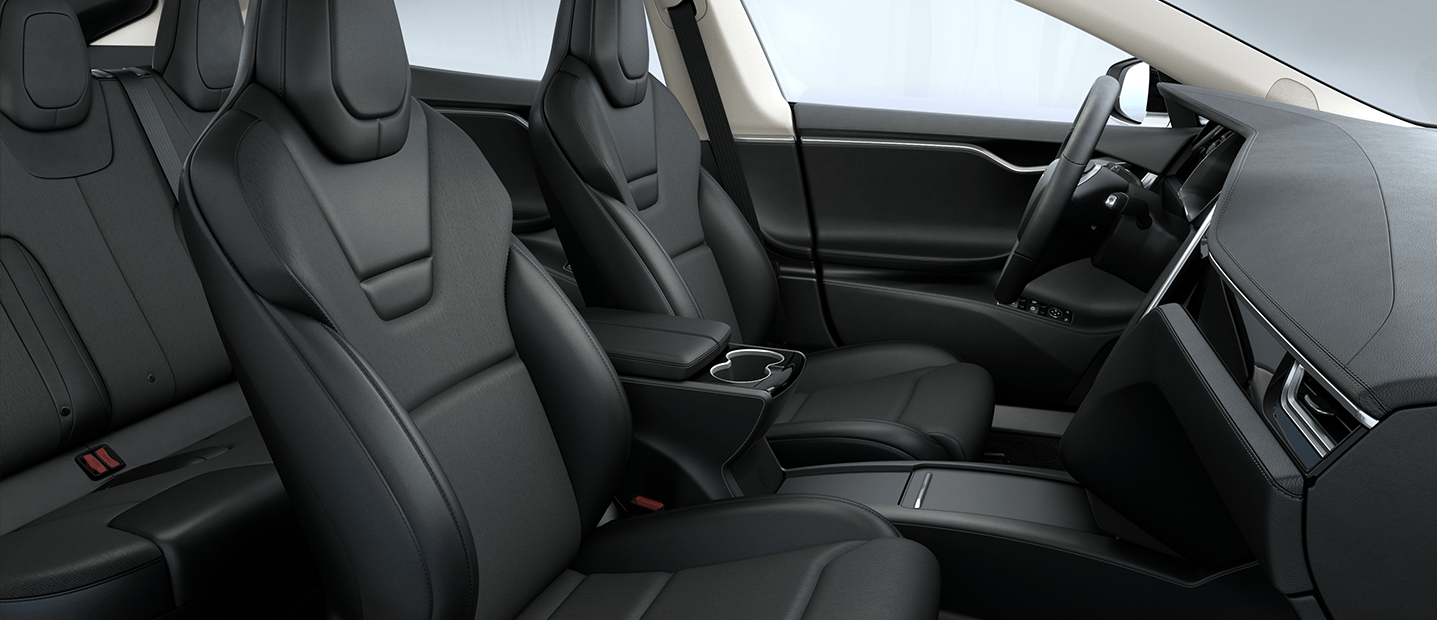 |
| Premium | Leather | 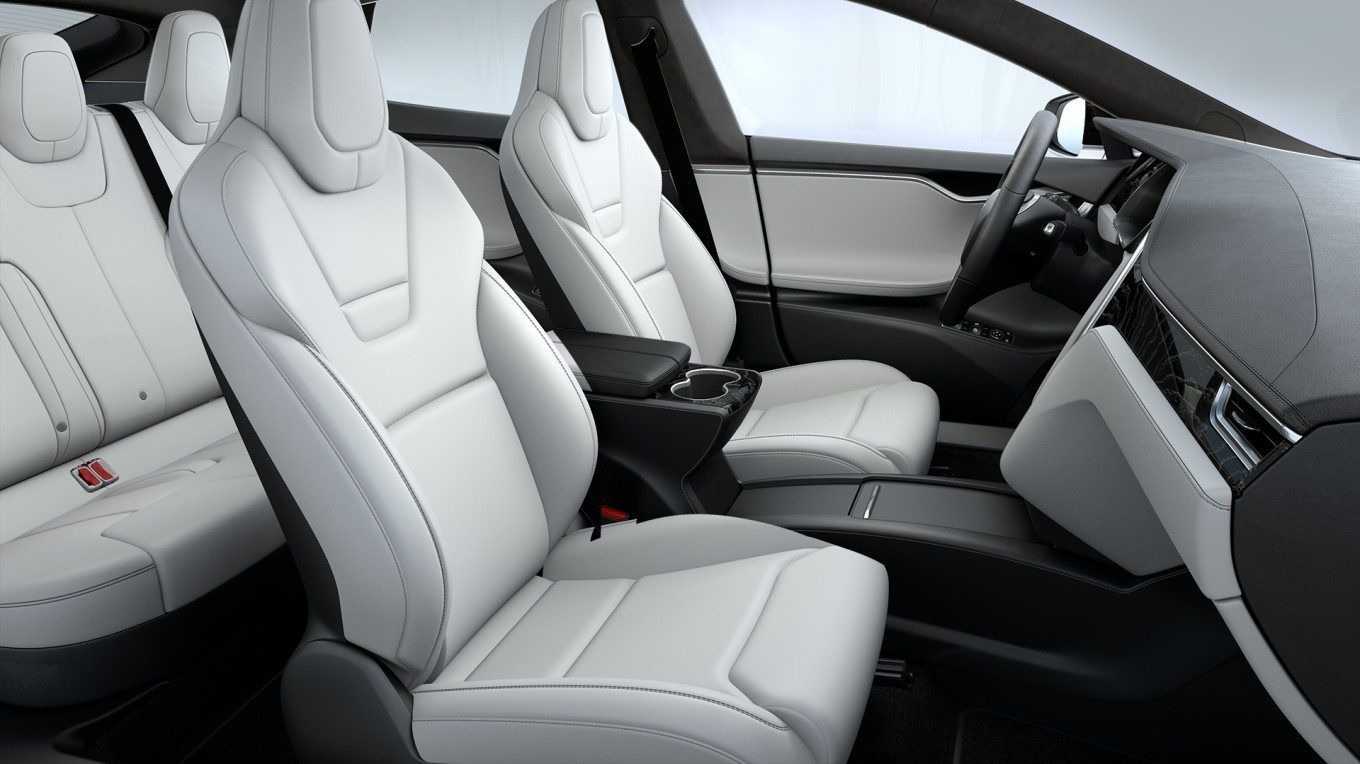 |
| Luxury | Perforated leather | 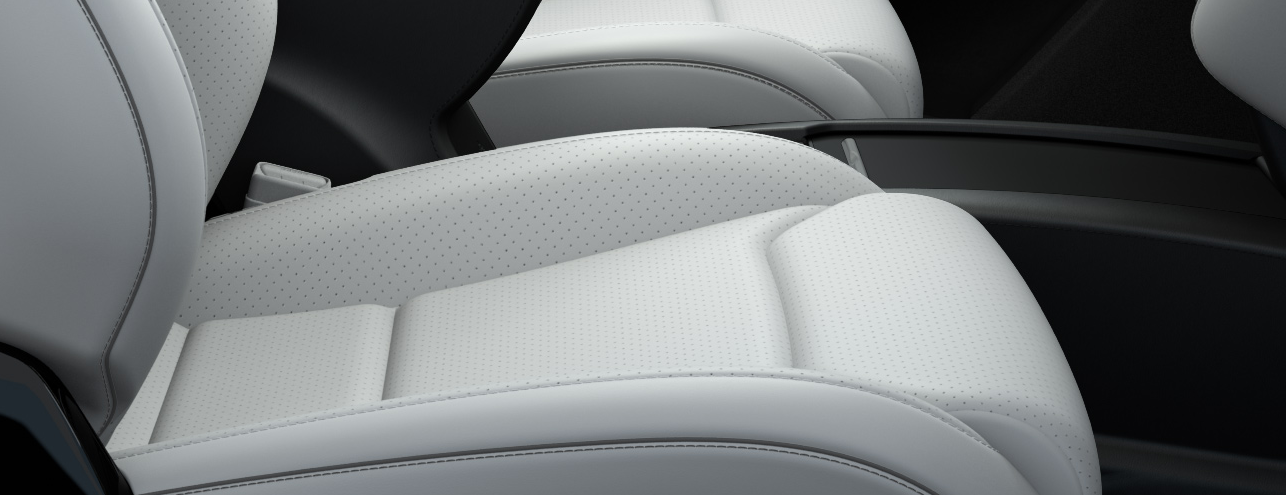 |
Note
Since August 2017 all Tesla seats are made of polyurethane (PUR) instead of leather. Initially Tesla didn't produce ventilated PUR seats but since June 2018 the PUR seats are available with seat ventilation meaning that the 'leather' is perforated. Model X Gen 1 PUR seats come in the same trim levels and colors as the non-PUR versions.
NCAP vs Non-NCAPlink
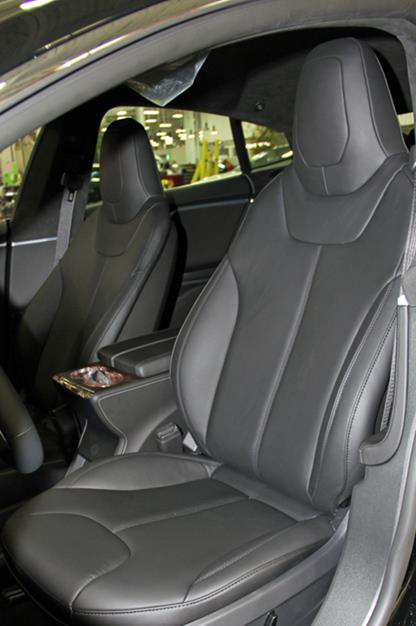
- NCAP:
- The headrest on the seat is 22 cm at its widest and 27 cm tall from the stitch
- The bib has more round edges
- The bib drops lower and is wider
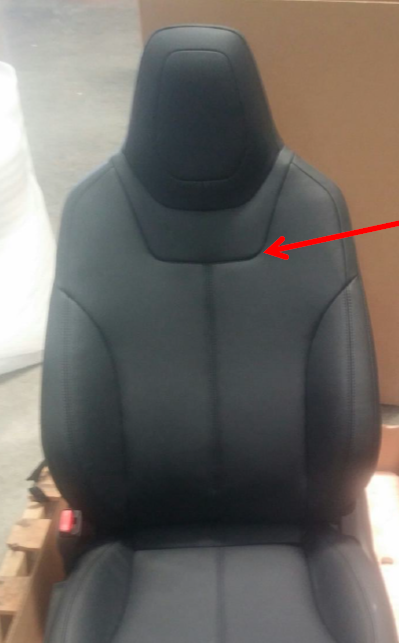
- Non-NCAP:
- Seats with the old-style headrest.
- A non-NCAP seat is slightly smaller than the NCAP versions
- The bib has straighter edges
| NCAP | non-NCAP |
|---|---|
 |
 |
Regional differenceslink
All seats produced for Europe, Canada and APAC are fitted with a red seat belt buckle for homologation purpose. For North American cars, the buckle is black.
Seat componentslink
Memory Seat Modulelink
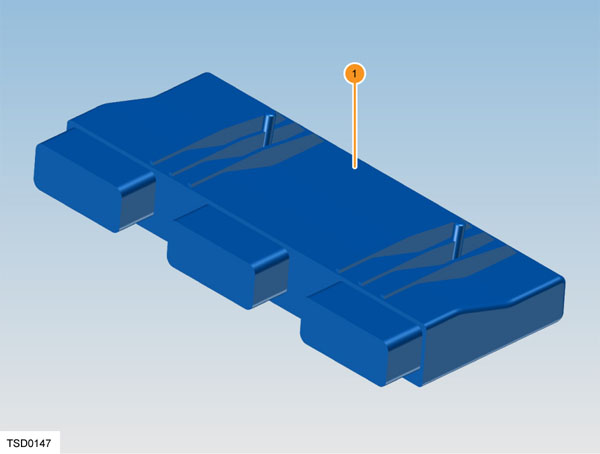
Memory Seat Modules are manufactured by Bitron. The Memory Seat Module controls all the electro-mechanical functions of the seat(s). The Memory Seat Module operates on the Body Fault Tolerant (BFT) CAN-bus connected to the gateway.
 |
|---|
| 1. Memory Seat Module |
Depending on the generation of the seat, the seat(s) are fitted with Bitron Gen1 or Bitron Gen2 memory seat modules.
The Memory Seat Module can be found here:
| Memory Seat Module version | Seat installed in |
|---|---|
| Bitron Gen1 (MSM) | Driver seat |
| Bitron Gen2 (MSMD) | Driver seat |
| Bitron Gen2 (MSMP) | Passenger seat |
Bitron Gen1 (MSM)link
Model S Gen 1 and Model S Gen 2 seats are built with a Bitron Gen1 Memory Seat Modules. Only the driver seat is equipped with an MSM.
Warning
Because the MSM is always only present on the driver's side, there cannot be 2 MSM seats installed. Doing so will cause 2 identical modules to report on the CAN bus. So never install a RHD driver seat as a passenger seat in a LHD vehicle and vice versa.
The MSM stores the seat positions as well as the steering column position. The MSM also controls the steering column.
The MSM receives digital inputs from the side shield switch pack and controls the driver side actuators (motors, heat pads, etc.). On the passenger side these actuators are directly controlled by the side shield switch pack
Bitron Gen2 (MSMD and MSMP)link
Model X Gen 1 seats are fitted with Bitron Gen2 Memory seat modules. Each front seats has its own Memory Seat Module, MSMD for the driver side, MSMP for the passenger side.
Both MSM controllers receive digital inputs from the side shield switch pack and control the corresponding actuators (motors, seat heat pads, etc.).
Other than the Bitron Gen1 MSM, the Bitron Gen2 MSMD/MSMP do not control the steering column. This is done by the sunroof module (SUN).
Front seat movement switchlink
Model S Gen 1 and Model S Gen 2 Seatslink
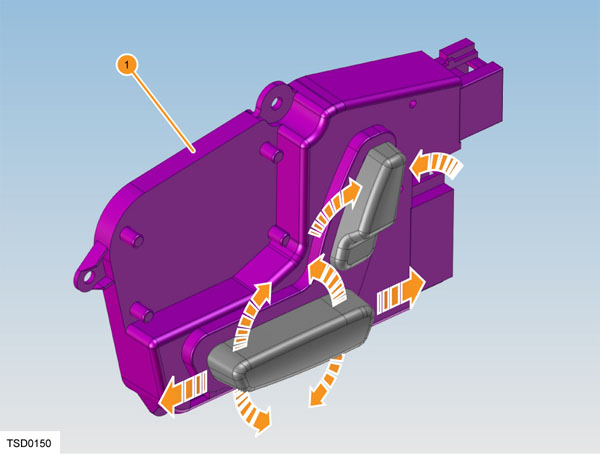
The front seat movement switch is also called side shield switch pack and contains the switches and logic to operate movement of the seats.
 |
|---|
| 1. Front seat movement switch (Model S Gen 1 and Model S Gen 2) |
The seat movement switch is located on the outer side cover of each front seat and secured by 4 screws.
The front seat movement switch controls all seat movement functions (4 seat motors). This is done differently on the driver seat than on the passenger seat.
On the driver seat the seat movement switches and the motor encoders are inputs to the MSM. The MSM controls the seat motors.
On the passenger seat the motors are directly controlled by the seat switches as there is no MSM in the passenger seat. For that same reason there is no position feedback from the motor encoders and therefore the seat cannot move automatically.
Model X Gen 1 Seatslink
 |
|---|
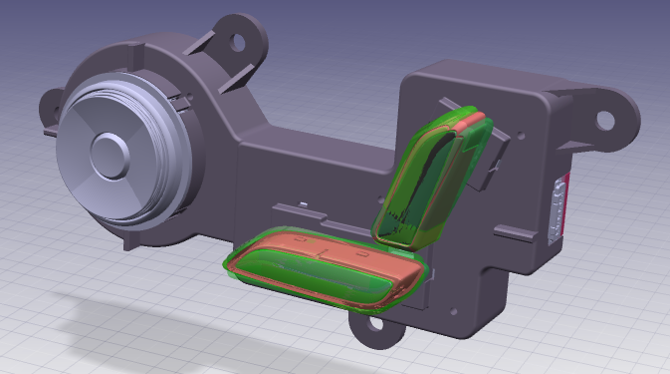
The seat position and lumbar switch are in one unit located on the outer side cover of each front seat.
The seat switches work on a very simple principle. There are 3 circuits on the PCBA of the switch pack, each for every button (lumbar, base and back). Each circuit consists of a combination of switches and resistors. Pressing any of the switches changes the resistance of the corresponding circuit. The MSM measures the voltage drop over each of the 3 circuits and determines which button is pressed. The switches are mechanically limited such that only one detent can be activated at any given time.
Note
If the Seat ECU is in sleep mode and a switch is pressed, the micro controller inside the MSMD/MSMP wakes up.
Lumbar switchlink
Model S Gen 1 and Model S Gen 2 Seatslink
 |
|---|
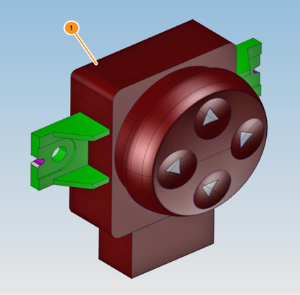
| 1. Front seat lumbar switch (Model S Gen 1 and Model S Gen 2) |
The lumbar switch is located on the outer side cover of each front seat. The switch increases or decreases the amount of support in the lower back (lumbar) area, and moves the Lumbar support up and downwards.
The lumbar switch always directly controls the lumbar motors. So the positions are not stored on both the driver seat and the passenger seat.
Seat belt reminder sensor and buckle switchlink
The Seat Belt Reminder (SBR) sensors are fitted in the bottom cushion of all seats, except the Model S rear facing 3rd row seats (if fitted).
The seat belt reminder sensor and the buckle switch for both front seats are inputs to the SDM. The SDM transmits the buckle status for both front seats to the Body Control Module (BCM) over the Chassis CAN bus. The BCM uses it for:
- Drive rail on/off: If no driver is detected, the drive-rail turns off
- Gear selection: Gear selection is not possible when the driver is not present
- Parking brake behavior: when driver is not detected, the parking brake automatically applies when vehicle speed is less than 5 mph.
The SBRs always actuate for 5th percentile occupants and larger, but may actuate for other smaller occupants or objects below this weight.
Note
A seat is reported unbuckled if an occupant is detected but the seat belt is unbuckled.
Operationlink
Front seatslink
For the front seats both the seat belt reminder sensor and buckle switch are read by the SDM.
Rear seatslink
The rear seat belt reminder sensors and buckle switches are combined in one parallel- series circuit. The circuit is a combination of buckle switches, seat belt reminder switches and resistors. The SDM measures the voltage drop over the circuit and determines how many occupied seats are unbuckled.
Seat Belt Reminder (SBR) is open when the seat is not occupied and closed when the seat is occupied. The buckle switch is closed when unbuckled and open when buckled.
When the seat is occupied (SBR switch closed) and the seatbelt is unbuckled (buckle switch is also closed), the total resistance of that series circuit is 900 Ohm. In all other scenarios the resistance is Open Loop.
So for every occupied unbuckled seat, 900 Ohm of resistance is added to the total circuit. This leads to the following resistance values:
| Nr of occupied unbuckled seats | Total resistance |
|---|---|
| 0 | Open Loop |
| 1 | 900 Ohm |
| 2 | 450 Ohm |
| 3 | 300 Ohm |
SDM sends one buckle status to the BCM. This status tells the BCM if there is 0, 1, 2 or 3 seats unbuckled.
Occupant Classification Systemlink
Note
Occupant Classification System is used in North America only.
The Occupant Classification System (OCS) is manufactured by Delphi. OCS monitors the seated weight plus conductive presence on the cushion and seat-back to estimate the type of occupant sitting in the front passenger seat, and communicates the status to the Passive Restraint Controller over the Chassis CAN bus.
The SDM uses this information to determine whether to enable or suppress the deployment of the front passenger air bag and if applicable, corresponding knee air bag. The SDM also determines the status of the passenger airbag light (PASS AIRBAG OFF/ON).
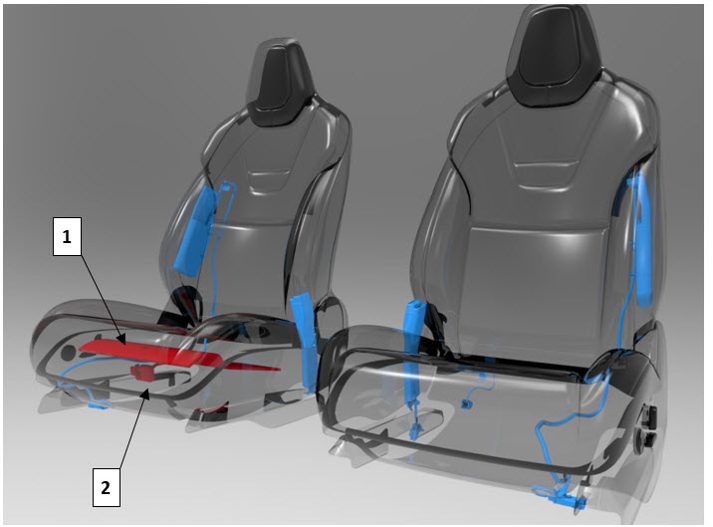
OCS is only present on the passengers front seat. OCS consists of an ECU, a sensor mat in the seat, a harness, and a passenger airbag ON/OFF indicator.
 |
|---|
| 1. OCS sensor mat (fluid filled) 2. ECU |
The OCS measures the pressure change in the mat fluid (and pattern through cell arrangement) to determine the type of occupant in the front passenger seat. The ECU compares this pressure change to the internally stored threshold to determine whether the seat is occupied, and what size of passenger is detected.
The OCS communicates the status to the SDM using the Chassis CAN-bus. The SDM uses this information to determine whether to enable or suppress the deployment of the front passenger airbag and corresponding knee airbag.
The occupant size determines if the active vent is used during higher energy collisions. The Active Vent lowers the force to the occupant which is preferable on a smaller occupant. If the OCS detects an empty seat or child seat in the front passenger seat, the front passenger upper airbag is disabled. The intent is to detect a child booster or rear facing infant vehicle seat where even stage 1 deployment provides too much energy absorption for these types of occupant.
The SDM notifies the occupants of the disable status by displaying the PASSENGER AIRBAG ON/OFF indicator in the center display
If a fault is detected, the OCS sends a message to the SDM. The SDM responds by sending a command message to the instrument cluster to display the Tesla Restraint System airbag indicator.
Calibration of the system when it is new can be done using a Toolbox routine
| Front Passenger Seat Occupancy | Passenger Airbag Indicator | Passenger Airbag Stages |
|---|---|---|
| Seat empty, child seat, or small child | PASS AIRBAG OFF | None |
| Small occupant (~100 lbs) | PASS AIRBAG ON | 1st, 2nd and Active Vent |
| Large occupant (>160 lbs) | PASS AIRBAG ON | 1st and 2nd |
Note
Values are approximate weight placed on seat bottom. Seat position and weight distribution can affect the sensed value. Occupants whose weight is close to the low weight threshold can cause the status to occasionally switch on and off depending on seating position and physique.
Note
The OCS is precisely calibrated for each individual seat at the factory. When servicing the OCS or the Seat Assembly with OCS, Tesla’s service procedures must be followed so that OCS system function is not compromised. Any service performed on the Seat Assembly with OCS must be followed by a Seat Re-Zero procedure.
Seat heater modulelink
Model S Gen 1 and Model S Gen 2 Seatslink
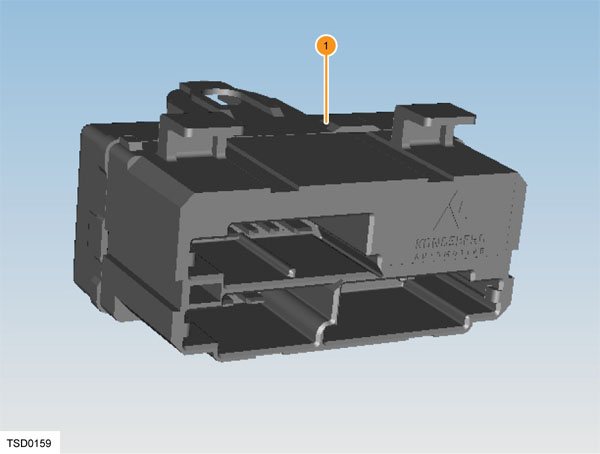
When Model S is equipped with seat heating, each seat (front and rear) has its own seat heater module. the seat heater module is located beneath the seat at the front edge, held in place by a clip.
 |
|---|
| 1. Seat heater module from a Model S Gen 1 or Model S Gen 2 seat |
The seat heater module controls the temperature of the seat heaters to pre-determined limits. Seat heating can be controlled by the MCU and from the mobile app. The heating command is transmitted from the MCU to the corresponding seat heater module through LIN. Both front seats are connected to the MCU via one LIN network. The 3 rear seat heaters are also connector to the MCU but via another LIN network.
The temperature for each seat is monitored by the corresponding seat heater module to ensure the temperature in each of the seats remains constant. Integral seat heater pads are fitted to both front seat cushion and back rest.
Note
There is a difference in driver and passenger seat heater module, double check the marks on the new unit before installing.
Model X Gen 1 Seatslink
Model X Gen 1 seats do not have separate heating modules. Instead seat heating is controlled by the Bitron Gen2 MSMD/MSMP. Communication between Center display and the seat MSMD/MSMP still goes via LIN.
There are 3 heating targets (low, medium and high).
Target temperature for both the cushion and the back rest is:
- low = 28 degrees Celsius
- medium = 35 degrees Celsius
- high = 42 degrees Celsius
Heater pads are Pulse Width Modulated (PWM) controlled to reach the desired target temperature. The PWM voltage depends on the difference between actual and target temperature.
When the desired temperature is reached the MSMD/MSMP stops providing voltage to the heater pads. As a result the temperature of the heater pads drops slowly. When the temperature has dropped too low, the heater pads get powered again with a new PWM voltage which is likely lower than 100% since the temperature difference is less. This sequence continues until another target temperature is chosen.
Note
Depending on the seat generation and build variances some seats may heat up quicker than others. Also some seats may feel warmer than others. this could be due variances in distance between the temperature sensor and the heating element.
Track motorlink
 |
|---|
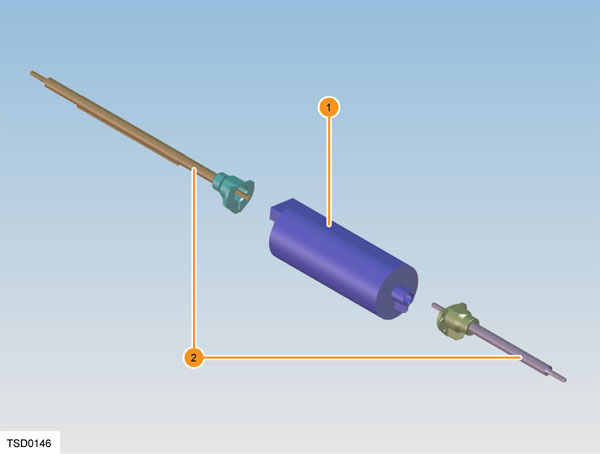
| 1. Motor 2. Flex drive |
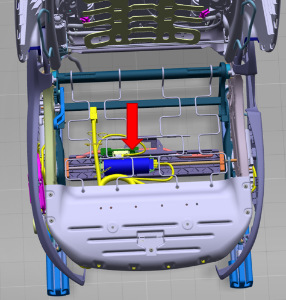
Each forward/backward motor is located beneath the front seat. The motor is secured by the motor bracket. A track position sensor sits under the seat cushion frame. The driver seat can move 254 mm and the passenger seat can move 239 mm.
 |
|---|
| Location example (left seat) |
Track position varies approximately between 0 and 1433 counts.
Driver side (Model S Gen 1 and Model S Gen 2)
- Powered by the MSM
- Motor encoder feedback signal to MSM to determine seat position
Passenger side (Model S Gen 1 and Model S Gen 2)
- Powered by the seat position switch
- No motor encoder feedback signal
Driver and passenger side (Model X Gen 1)
- Powered by the MSMD/MSMP
- Motor encoder feedback signal to calculate seat position
Pinoutlink
- Slide motor +
- Ground
- Hall Sensor +
- Slide motor -
Seat Lift motorlink
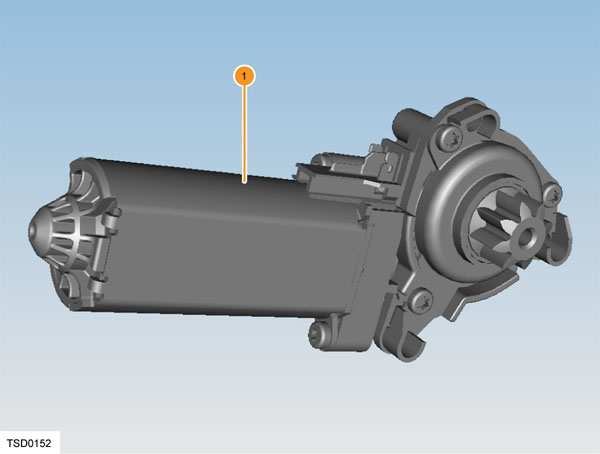
The seat lift motor, raises and lowers the seat. It is on the right-hand side of a right-hand seat and on the left-hand side of the left-hand seat. 3 nuts attach the motor to the seat. The vertical height range is 60 mm.
 |
|---|
| 1. Seat lift motor |
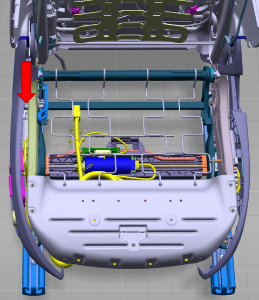 |
|---|
| Location of the seat lift motor (left seat) |
Seat raise position varies approximately between 0 and 931 counts.
Driver Seat Lift Motor (Model S Gen 1 and Model S Gen 2)
- Powered by the MSM
- Motor encoder feedback signal for memory function
Passenger Seat Lift Motor (Model S Gen 1 and Model S Gen 2)
- Powered by Seat Position Switch
- No Motor encoder feedback signal
Passenger and Driver Seat Lift Motor (Model X Gen 1)
- Both powered by the MSM
- Motor encoder feedback signal to calculate seat position
Pinoutlink
- Lift+Back Motor DOWN/BACK
- Lift motor UP
- Ground
- Tilt Motor Hall Sensor +
Cushion tilt motorlink
The cushion tilt motor adjusts the forward most portion of the cushion. Tilt position varies approximately between 0 and 587 counts.
The Cushion Tilt Motor is on the left-hand side of the right-hand seat and on the right-hand side of the left-hand seat.
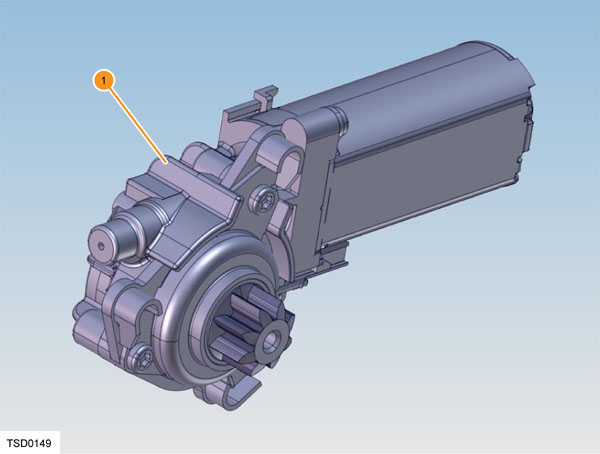 |
|---|
| 1. Cushion tilt motor |
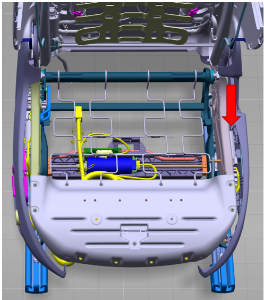 |
|---|
| Location of the seat cushion tilt motor (left seat) |
The motor engages directly with a gear integral with the seat slide mechanism. A welded cross tube assembly makes sure that both sides of the seat have the same tilt. When the motor rotates, it turns the gear that is connected to a rod and a quadrant. the rod transmits the movement to the seat mechanism on the opposite side of the seat, and the quadrant converts the rotary motion of the motor into vertical movement. The seat cushion can achieve a maximum incline of 5 degrees.
Driver Seat Tilt Motor (Model S Gen 1 and Model S Gen 2)
- Powered by the MSM
- Motor encoder feedback signal to calculate seat position
Passenger Seat Tilt Motor (Model S Gen 1 and Model S Gen 2)
- Powered by Seat Position Switch
- No Motor encoder feedback signal
Passenger and Driver Seat Tilt Motor (Model X Gen 1)
- Powered by the MSMD/MSMP
- Motor encoder feedback signal to calculate seat position
Pinoutlink
- Tilt motor up
- Headrest + Tilt Motor DOWN/BACK
- GND
- Tilt Motor Hall Sensor+
Backrest motorlink
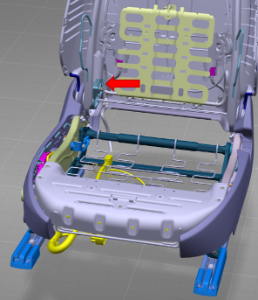
This motor is an integral part of the seat back rest assembly and therefore is a non-serviceable unit. When the motor turns, it rotates the back rest gear which adjusts the rake of the backrest. The back rest can move 77 degrees: 40 degrees forward and 37 degrees backward.
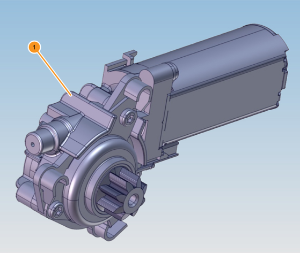 |
|---|
| 1. Backrest motor |
 |
|---|
| Location of the back rest tilt motor (left seat) |
Backrest position varies approximately between -1132 and 652 counts.
When the motor turns, it rotates the back rest gear which adjusts the angle of the backrest. the back rest can move approximately 77 degrees: 40 degrees forward and 37 degrees backward.
Driver Seat Back Rest Tilt Motor (Model S Gen 1 and Model S Gen 2)
- Powered by the MSM
- Motor encoder feedback signal for seat memory
Passenger Seat Back Rest Tilt Motor (Model S Gen 1 and Model S Gen 2)
- Powered by Seat Position Switch
- No Motor encoder feedback signal
Passenger and Driver Seat Back Rest Tilt Motor (Model X Gen 1)
- Powered by the MSMD/MSMP
- Motor encoder feedback signal to calculate seat position
Pinoutlink
- Backrest Motor Power
- Backrest Motor Hall sensor +
- Lift & Backrest Motor Down/Back
- GND
Lumbar supportlink
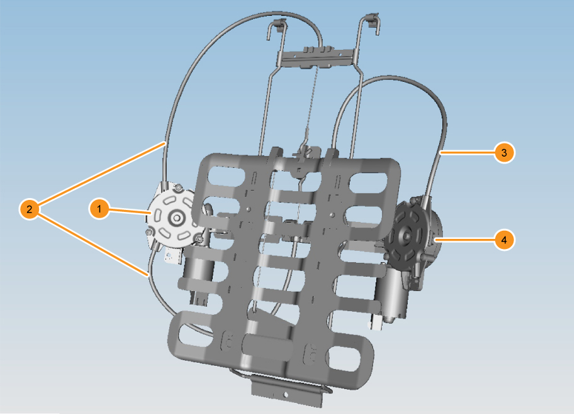
The lumbar support mechanism is integral to the back rest and is therefore not serviceable.
 |
|---|
| 1. LH motor 2. Support height adjust cables 3. Support compression cable 4. RH motor |
Horizontal and vertical lumbar position varies approximately between 0 and 800 counts.
When the ‘up’ or ‘down’ vertical button on the lumbar switch is pressed, power passes through the switch to the left-hand motor inside the seat back rest. the motor uses 2 cables to move the lumbar support up or down inside the seat backrest.
When the ‘in’ or ‘out’ horizontal button on the lumbar switch is pressed, the right-hand motor uses a single cable to pull down the top of the lumbar support. As the bottom of the support is fixed, this compresses the lumbar support, thereby providing lower back support for the seat occupant.
Pinout (vertical motor)link
- Up
- Ground
- Down
- Sensor+
Pinout (horizontal motor)link
- Backward (Bwd)
- Ground
- Forward (Fwd)
- Sensor+
Adjustable headrestlink
Adjustable headrests were introduced with the introduction of Model X Gen 1 seats.
Headrest position varies approximately between 0 and 600 counts.
The headrest on Model X Gen 1 seats can be adjusted up and down with the round lumbar adjust button on the side of the seat. When a user touches the button, the touchscreen displays a popup with an image of a seat. If the head support shown on the image is not highlighted in blue, select it to specify that the headrest should be adjusted. This setting can be saved to the driver profile.
Pinout (vertical motor)link
- Down
- Ground
- Up
- Sensor+
Ventilationlink
Seat ventilation is only available for front seats. Ventilated seats were introduced with the introduction of Model X Gen 1 seats. Model S Gen 1 and Model S Gen 2 seats are never ventilated.
Note
Opposite to what would be expected seat ventilation does not blow air, it sucks air.
Note
Even though Model S Gen 1 seats exists with perforated leather, these were not ventilated.
There are 3 ventilation targets (low, medium, high). The ventilation motors are PWM controlled.
- Low = 30%
- Medium = 60%
- High = 94%
There is not much controls involved here. The MSMD/MSMP just outputs a PWM voltage which changes the blower speed.