Chassislink
Last updated: October 20, 2023
Wheels and Tireslink
Overviewlink
Wheels are mounted to the suspension at each corner of the wheel. The tires are mounted to the wheels. The tires transfer vehicle force to the road, therefore, are a major factor in a the vehicle's acceleration, braking, handling, range and comfort performance.
The wheels on Model 3 are all cast aluminum alloy with a stylistic coating. If a wheel sustains cosmetic damage to the coating, there is no affect on wheel functionality. Model 3 has wheel covers on the 18" wheels, which reduce aerodynamic turbulence to improve range.
Tires are the interface between the vehicle and the road. A tire with a large amount of grip excels at handling, braking and acceleration but tends to have a higher rolling resistance leading to less range and due to being softer has a shorter service life. Modern advanced materials used in tire construction have allowed both higher grip levels and lower rolling resistance to be achieved. Tesla is constantly working closely with tire manufacturers to use the latest technologies for optimal performance and all of Tesla tires are co-developed specifically to meet Tesla's needs.
Component Specificationslink
Tesla does not recommend using aftermarket wheels or tires. Wheels and tires are specifically engineered to meet the requirements of the vehicle and as such, using aftermarket parts may yield reduced performance in many aspects of the vehicle.
The main specifications for wheel sizes are their diameter and width. Common terminology around wheel sizes are “Square” vs. “Staggered” sizes. This refers to is that the wheel size is the same front and back, while a staggered setup means that the wheel sizes are different front to back. Generally speaking this means that the rear wheels are wider than the fronts.
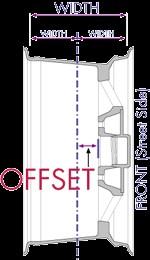
The offset of a wheel refers to the distance from the wheel center line to the mounting surface. Remember that since the mounting surface of the wheel is fixed, a smaller numerical offset means the wheel is shifted outwards of the vehicle. Fitting rims with an offset that is different than stock will induce higher loads into suspension components, which could result in damage to nearby suspension and braking components, potentially leading to component malfunction. An altered offset on the front wheels will change the scrub radius, potentially increasing or decreasing steering effort. Refer to the service manual for offset values.
 |
|---|
Tire Sizelink
Tires are sized to appropriately match their rims. The diameter of a tire has to match the diameter of the wheel. A range of tire widths can be used on the same wheel width, however only one tire size is truly optimal for a particular width. If the tire width is not appropriately matched to the wheel, the sidewalls will experience deformation which can lead to increased rolling resistance, lower traction and decreased comfort. Additionally, incorrect tire sizes might result in damage to surrounding components. The last specification to a tire size is its aspect ratio, which is the height of the tire sidewall given as a percentage of the tire width. This ultimately impacts the overall diameter (and thus circumference) of a wheel and tire combination. Having a circumference that is different than the specified size will result in inaccurate speedometer readings. Furthermore, if the ratio of front to rear circumferences is changed, the relative speeds of the wheels change causing systems that rely on wheel speed measurements to not function correctly. This includes: ABS, traction control, launch control and TPMS.
Tire Pressurelink
The most reliable source for the specification of tire pressures for a vehicle is the sticker on the driver’s door jamb. If there is a discrepancy between this information and any other source, default to the information in the door jamb and inform the owner of the other document of the discrepancy. Tire pressures impact grip, efficiency and comfort. Tire pressures are specified as a “Recommended Cold Pressure” or RCP for short, which means that pressures should be checked and adjusted after the vehicle’s wheels and tires have been allowed to cool to ambient temperature (~70° F, ~20° C).
Tire Wearlink
Tire treads wear over time, thus reducing performance. This reduced performance is especially hazardous in wet or snowy conditions. Most tires come with tread indicators, which are a special pattern on the side on the tread blocks that show when the minimum acceptable tread depth has been reached.
Serviceabilitylink
Wheels are not serviceable in any way and must be replaced if damaged. Some curb rash is acceptable and generally considered just cosmetic. Deep gouging, cracks or off round wheels are indications of impact, and their source should be investigated. If a wheel is damaged, the rest of the vehicle should be inspected for damage as well. Even if the suspension looks unharmed, the alignment should be checked. A tire that does not hold pressure may also be caused by a damaged wheel.
The primary service that tires require is regular top offs to maintain a correct pressure. Low pressure can reduce range and the excess heat generated may even destroy a tire. High pressure can cause undesirable handling behaviors and decrease tire service life. Tires are wear items and thus should be replaced regularly. Tires wear down due to both mileage and age. A high mileage tire will wear away the tread and become unsafe in wet, snowy or icy conditions. Even in areas with low precipitation, tires without enough tread depth may become a hazard if puddles form for whatever reason.
When replacing tires on a wheel, the tire must also be balanced. Balancing involves using a machine to measure the amount and direction of vibration a wheel and tire combination has when spun up and then using this information to attach weights to the wheel to offset the imperfections. Refer to the service manual for instructions on balancing a tire.
Steeringlink
Overviewlink
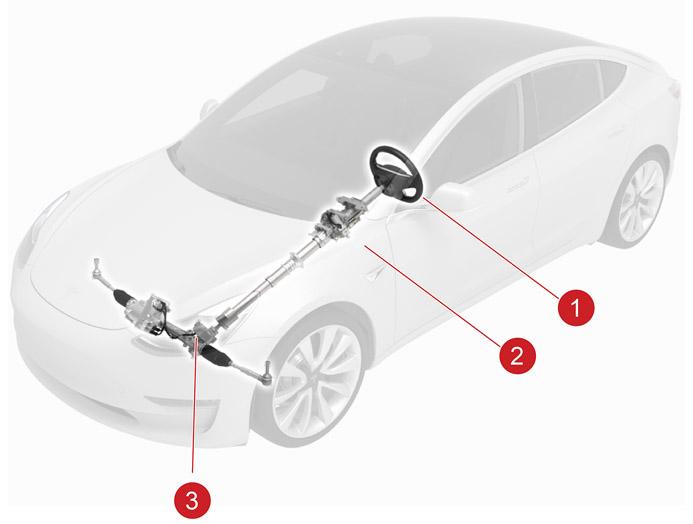
The steering wheel connects to the steering rack through a column. The rack is bolted to the front subframe and, through tie rods, connects to and articulates the wheels and tires.
Electric Power Assisted Steering (EPAS) is a system that provides steering assistance for turning the front wheels on Model 3. This system primarily uses torque input from the driver to determine how much assist the electric motor should provide. Other inputs include the selected steering feel mode, absolute steering angle from the column and vehicle speed. EPAS is energy efficient and can be used for self-driving as well.
 |
|---|
| 1. Steering wheel 2. Steering column assembly 3. Steering rack assembly |
| Component Location, Overview |
Component Specificationslink
Steering Columnlink
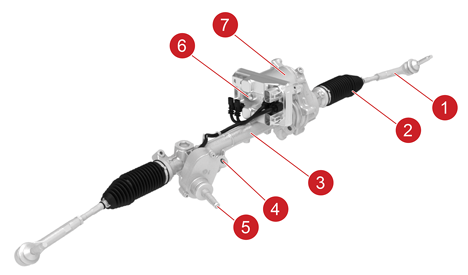
The steering input column translates the motion of the steering wheel into the EPAS unit. The input goes through a torque sensor that is read by the ECU and is the primary input for control. The input is also mechanically connected to the rack and pinion and will continue to allow for directional control in case of a complete assist system malfunction. The ECU reads the torque as well as other parameters and drives the 3 phase brushless motor. The motor connects to the rack through a belt drive actuating a recirculating ball mechanism. The rack connects to and actuates the knuckle through an adjustable length tie rod.
 |
|---|
| 1. Outer tie rod 2. Inner tire rod 3. Steering rack 4. Torque sensor 5. Input shaft 6. ECU 7. Motor |
| Steering Column, Overview |
Torque Sensorlink
Consists of a tuned torsional spring and 4 hall effect sensors. The sensors measure the twist of the spring and calculate the input torque from this. The spring has a mechanical stop that solidly connects the input shaft to the pinion when it reaches the end of its travel. The sensors work in pairs, like the pedal position sensors; they are oriented inversely so that when one reads 100% the other reads 0% and vice-versa. If there is a mismatch from expected behavior then a plausibility error is thrown. There are 2 such pairs of sensors for redundancy. Below is a visual explanation of how the plausibility check works. If either pair fails this check, the other is used and an error is thrown to warn of the malfunction.
Motorlink
The motor is a 3-phase, brushless motor, known for its good reliability and power density characteristics. The motor attaches through a belt drive to a recirculating ball mechanism to actuate the rack. This design has low friction and very little slop, but the precisely set tension of the belt means the motor cannot be replaced in the field.
Steering Rack (EPAS3) ECUlink
The ECU reads the torque as its primary input and runs control algorithms to ensure the motor provides optimum assist at all times. The ECU is the same for all Model S and Model X equipped with Driver Assistance 2.5 and above hardware.
The Electronic Power Assisted Steering Primary (EPAS3P) ECU controls the motor. If there is a suspected error or communication issue one ECU, the Electronic Power Assisted Steering Secondary (EPAS3S) ECU takes over. Each ECU has its own torque sensor and inverter circuitry to drive the motor and when control is handed off the phase disconnect cuts the connection to the motor for one ECU and makes the connection to the other. The ECUs have individual connections to the electrical systems of the vehicle so that if one bus or electrical connection is lost, the system will still continue to operate. The primary ECU is connected to the Party Bus (Secondary CAN) while secondary ECU is connected to the Chassis Bus (Primary CAN) and an internal bus between them relays the messages the other is not receiving.
The ECU takes in other secondary inputs in order to tailor its behavior. Information from the user interface (UI) informs the ECU the level of assist the driver desires. Speed information from the DI also impacts the level of assist, with more being provided at low speeds. Data from the SCCM, ESP and the RCM is combined to get an estimate of the direction of the vehicle and minor adjustments are made to compensate for offsets in the alignment of the vehicle. The VCFRONT provides information regarding the electrical and power state of the vehicle. Lastly the DAS module can directly request steering outputs for autopilot features. The most critical systems communicate with the EPAS over two buses in order to provide redundancy in case of various faults. It is important to note that EPAS behavior relies on data from many different systems.
Serviceabilitylink
Individual components can not be serviced; the system must be replaced as a whole. Certain alerts can indicate with certainty that there are internal faults, however it is important to note that this system is designed to be very robust. Before replacing an EPAS unit, it is important to understand if the malfunction that occurred is internal to the unit or may have been caused by issues with the data from the other systems it relies on.
Suspensionlink
Overviewlink
The suspension is the mechanical linkage that connects the wheels and tires to the front and rear subframes. The subframes are attached to the body.
A vehicle’s suspension controls tire motion, absorbs energy from the road, and reduces vibration from road imperfections. The Model 3 uses multilink suspension in the rear and a variation of the double wishbone design on the front. Although complex, these suspension geometries allow great design freedom to tune the suspension to optimally split the difference between immediate response and ultimate cornering grip, and comfort. The system is comprised of both steel and aluminum with each piece being analyzed and optimized for its task. Due to manufacturing variability and wear over time, the alignment of the wheels with respect to each other may require adjustment. The most important alignment parameter, toe, has built in adjustment mechanisms. Additional alignment values might be changed with longer procedures or worn component swaps.
Component Specificationslink
Front Suspensionlink
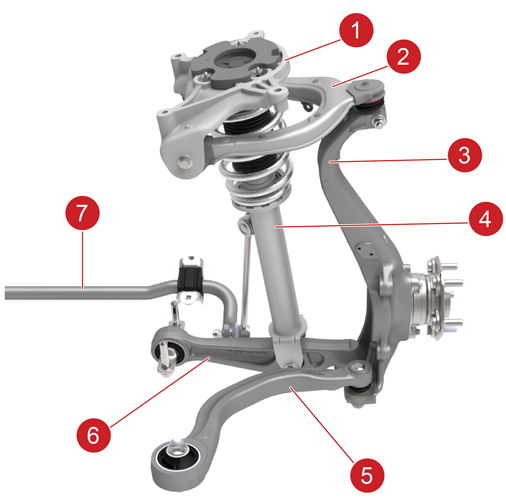
The front suspension is a variation of the double wishbone design. This geometry is widely used in higher end cars and racing because it allows for independent tuning of multiple parameters of the suspension. The double wishbone design usually consists of a short upper control arm and a longer lower control arm, however in the case of the Model 3 the lower link is actually comprised of 2 links. This variation moves the steering axis of rotation of the front tires in such a way as to make the vehicle more stable and planted. The 2 lower arms are aluminum forgings that connect to an aluminum knuckle that houses the wheel hub. The knuckle is tall in order to transfer most of the lateral loads from the tire through the two lower links, while the upper arm experiences less load. The shock absorber and the upper control arm connect to a structural reinforcement called the Front Upper Control Arm (FUCA) mount that is bolted into the body.
 |
|---|
| 1. Front Upper Control Arm (FUCA) mount 2. Upper control arm 3. Knuckle 4. Shock absorber 5. Lower compliance link 6. Lower lateral link 7. Stabilizer bar |
| Front Suspension, Overview |
The front damper and spring come together as one assembly and connect to the lower lateral link. A spring steel stabilizer bar exists in order to tune the roll stiffness of the front suspension. The upper arm and the lower lateral link are mostly responsible for the camber and camber curve of the wheel. The lower compliance link is mainly responsible for the caster, which can be adjusted by moving the FUCA mount. The steering rack connection to the knuckle is through a tie rod that is adjustable in length, allowing for adjustment of the front toe. The lower links and the steering gear are all connected to a structural member called a subframe that is made of stamped and welded steel and provides a mounting structure between the body and the suspensions.
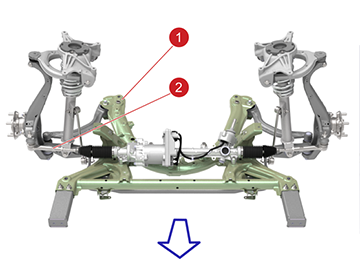 |
|---|
| 1. Subframe 2. Tie rod |
Note
The arrow points to the front of the vehicle.
The use of a subframe provides extra rigidity in the body for mounting suspension links, and is an important part of crash management. The subframe also simplifies the manufacturing process, allowing the entire front end to be built as a unit and mounted to the body. It also provides mounting points for things such as a steering rack and the front fascia.
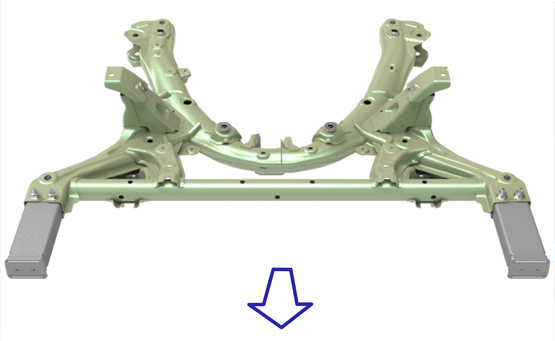 |
|---|
| Front Subframe |
Note
The arrow points to the front of the vehicle.
Rear Suspensionlink
The rear suspension is a multi-link set up comprised of 5 arms. The arms are all steel and either tubes or stamped. They connect to an aluminum knuckle which houses the wheel hub. The high strength steel arms are effective at transmitting loads while the aluminum knuckle reduces unsprung weight. The spring and damper are split but both connect to the lower aft link. The spring is a larger diameter but lower profile while the strut is thinner but longer; by splitting them up they can be packaged to allow for much more interior space in the trunk for storage.
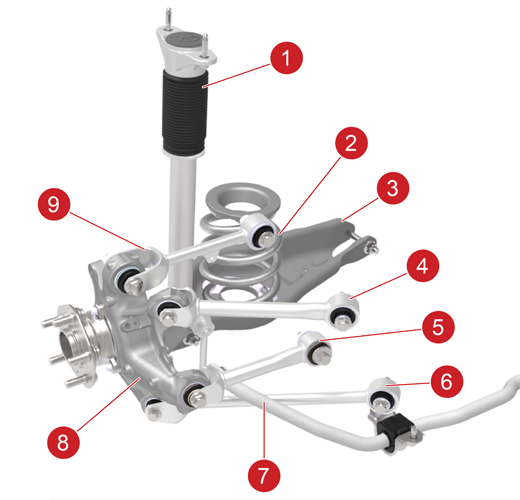 |
|---|
| 1. Damper 2. Spring 3. Lower compliance link 4. Upper fore link 5. Toe link 6. Lower lateral link 7. Stabar 8. Knuckle 9. Upper aft link |
| Rear Suspension, Overview |
The upper and lower aft links are mainly responsible for the camber and camber curve of the wheel. The fore links are responsible for the longitudinal and rotational movement of the wheel. The toe link is responsible for pointing the wheel and is the only adjustable link. There is a cam bolt on the inboard side of the toe link to allow for alignment.
The rear subframe is a stamped and welded steel structure. It provides the hard mounting points for the suspension and the rear drive unit. The subframe connects to the body in white via 4 large, main bushings. This arrangement allows the subframe to both distribute the loads from the suspension into the main structures within the unibody as well as to isolate the cabin from road inputs and drive unit vibration.
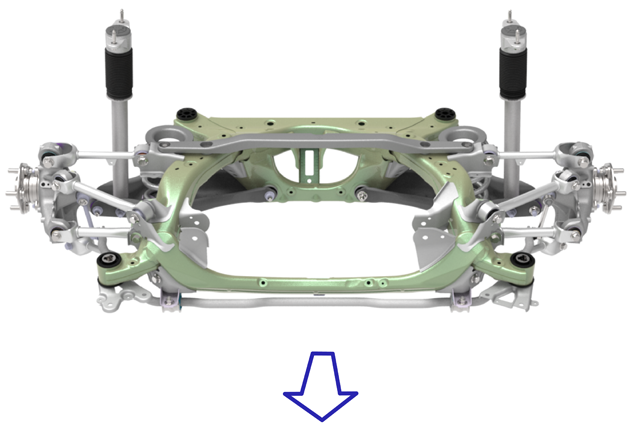 |
|---|
| View of the Rear Suspension |
Note
The arrow points to the front of the vehicle.
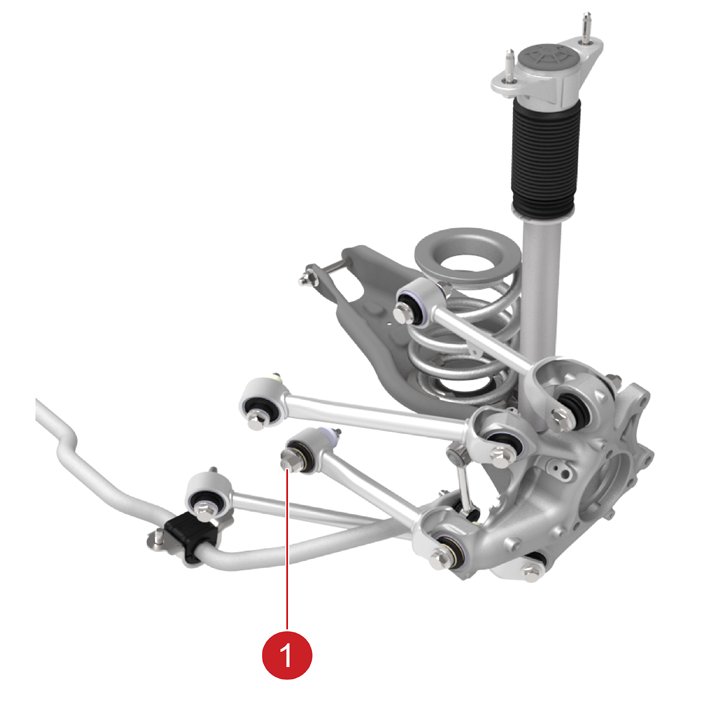 |
|---|
| 1. Cam bolt |
| Rear Suspension Toe Adjustment |
Serviceabilitylink
The suspension is serviceable by individual component replacement. If issues arise with any of the suspension links or their integrated bushings, the whole link must be replaced. The same is true with the subframes and the clevis mounting points. After suspension components are loosened, it is important to align the suspension to ensure the vehicle stability and correct tire wear.