Charge Portlink
Last updated: September 18, 2024
Overviewlink
The 2021+ Model S charge port assembly can be seen as a combination of Model S charge port inlet with Model 3 / Model Y busbar architecture. The charge port assembly is made up of 5 components:
- Charge port door
- High voltage busbars with high voltage battery connector
- Trim piece with PCB, LED ring, UHF antenna
- Charge port Electronic Control Unit (ECU)
- Charge port inlet and latch
The charge port is located next to the left-hand tail light, which hides the charge inlet when the charge port door is closed. The inlet is very similar to the Model S charge port inlet, with the exception that almost all logic has been moved from the inlet itself to an external charge port ECU and that the inlet has been modified to connect to busbars.
The charge port door is motorized and opens horizontally. The charge port ECU is located in a separate enclosure from the charge port inlet. The charge port ECU has vehicle communication with external charge equipment such as Supercharger, Wall Connector and UMC. The charge port ECU is connected to the High Voltage System (HVS) controller area network (CAN) bus. This means it can communicate with Battery Management System (BMS), Power Conversion System (PCS), and High Voltage Processor (HVP). The High Voltage (HV) charge port busbars connect to a connector on top of the HV battery enclosure in the rear left corner from where power is distributed to the PCS at the front of the HV battery for alternating current (AC) charging (single-phase Tesla charge port) and to the fast charge contactors at the rear of the HV battery for direct current (DC) charging. The HV busbars connect to the charge port inlet and the HV battery using bolted connections, and the inlet pins are temperature monitored. The charge handle should be 5 - 10 inches (15 - 25 cm) from the charge port door for effective operation of the remote open button.
Charge Port Assemblylink
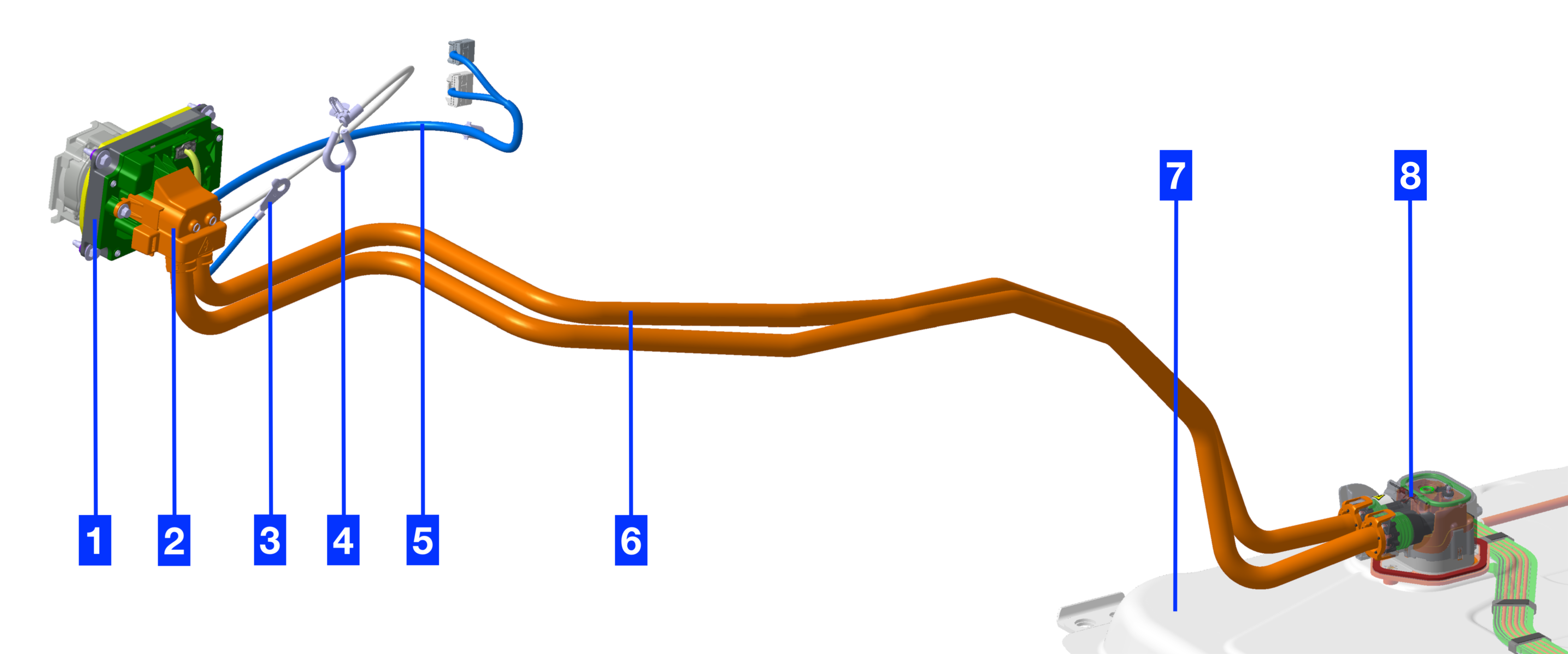 |
|---|
| 1. Inlet assembly 2. HV back cover 3. Ground strap 4. Manual release 5. LV harness to ECU 6. HV busbars 7. HV battery 8. HV battery connector |
| Charge Port Assembly, Overview |
On single-phase charge ports, the charge port HV busbars are used for AC charging (up to 48A limited by PCS) and DC charging. The HV battery connector has a charge port high voltage interlock loop (HVIL or CPIL) to make sure that the HV harness connects properly to the battery while charging. The CPIL does not prevent driving nor HV battery power switch closing if interrupted; however, charging would be prohibited. Inside the connector, the busbars are mounted to the header using bolted connections. The bolts can be accessed through a lid on top of the connector. In order to make sure high voltage cannot be exposed, an open lid causes the CPIL circuit to remain open. Therefore, the lid needs to be sensed closed in order to allow the vehicle to charge. The busbars are held in place by their connectors at both ends and are not separately mounted to the vehicle chassis. The charge port ECU mounts to the wheel arch area with two plastic hooks and a nut.
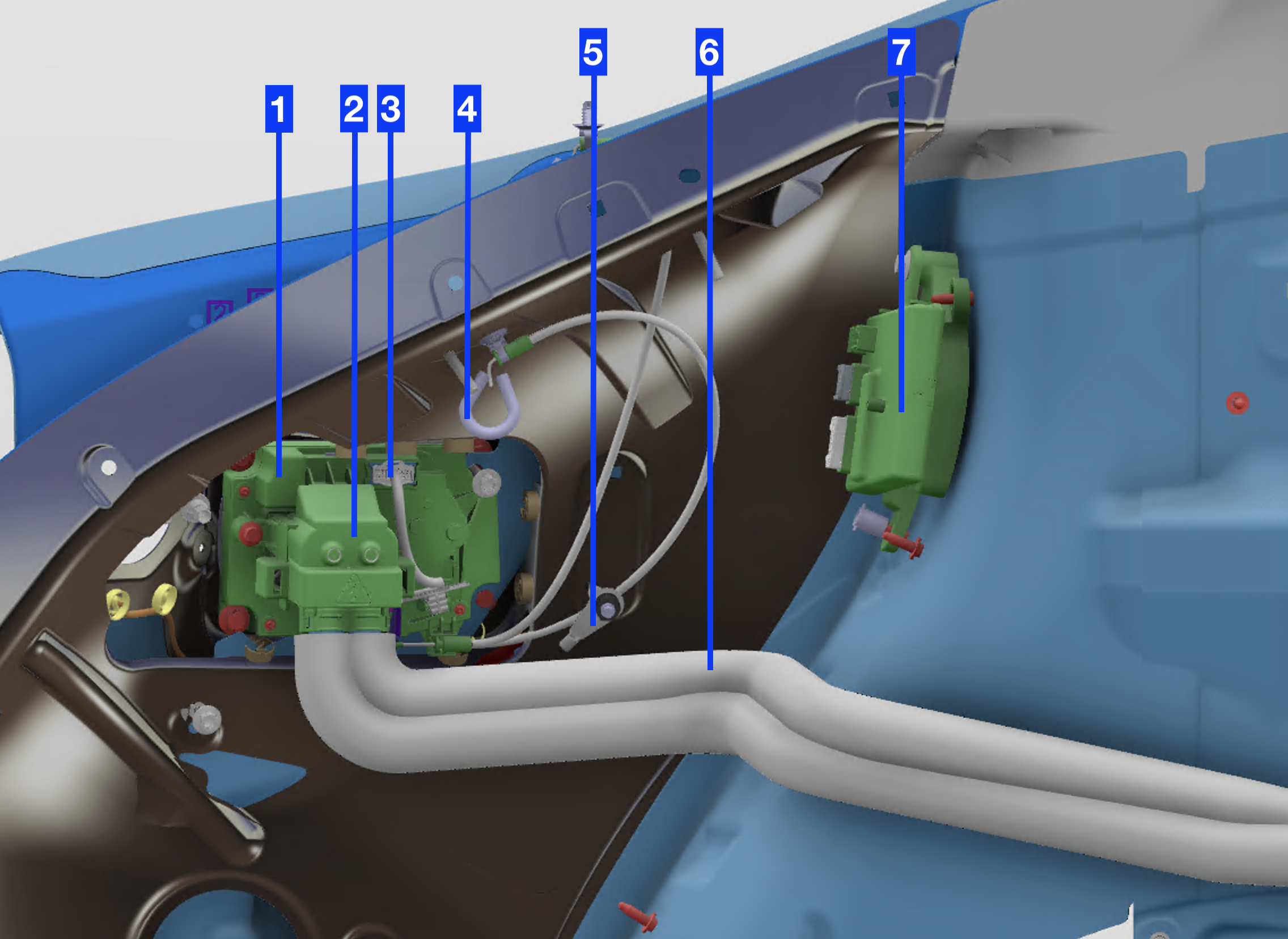 |
|---|
| 1. Inlet assembly 2. HV back cover 3. LV connector (door potentiometer, door actuator, door button, latch potentiometer, latch actuator, back cover sensing, temperature sensing, LEDs, UHF antenna) 4. Manual release 5. Ground strap 6. HV busbars 7. Charge port ECU |
| Charge Port Assembly, Overview In Vehicle |
The charge port inlet features LEDs that light up a ring around the inlet itself.
The flash speed pattern is inversely related to the State Of Charge (SOC). When the SOC is closer to 100% SOC, the flashing is slower, and when the vehicle is done charging, the charge port displays constant green. The flash speed is not related to the line current value or the charge limit setting.
The charge port LED is active when the charge port door is open and one of the following scenarios is true:
- When the vehicle is locked and charging, the green LED stops flashing 2 minutes after vehicle lockout.
- When the vehicle is unlocked and charging, the LED is illuminated during the entire charging session.
- Once the vehicle is fully charged, the charge port LED switches to solid green.
If there is no pilot signal, the LEDs turn off (for example, unplugging a UMC from the wall while connected to vehicle). Each LED color represents a separate condition that must be met as described in the table below:
| LED Color | Charge Port State | Set Conditions |
|---|---|---|
| Solid White | Charging cable can be removed or inserted | The charge port latch is disengaged. |
| Solid Amber | Cable is inserted, but not properly latched | The cable is connected, charge port latch is not engaged, vehicle is trying to engage latch, and vehicle is not charging. |
| Solid Red | Either the charger, charge port, or Electric Vehicle Supply Equipment (EVSE) is not operating as expected | One of the following:
|
| Flashing Green | Charging at expected current | Cable is connected, charge port latch is engaged, and vehicle is actively charging. |
| Flashing Amber | Charging at reduced current | Cable is connected, charge port latch is disengaged, and vehicle is actively charging. |
| Solid Green | Charging is complete | Cable is connected and vehicle is no longer charging. |
| Solid Blue | Pilot is present | Cable is connected and either a pilot signal or fast charger is present. |
The inlet assembly contains the Ultra High Frequency (UHF) antenna used to detect Radio Frequency (RF) signals from Tesla charge handles. It also includes the charge port latch whose position is sensed via a built in potentiometer. Position sensing on the motorized charge port door is achieved via a separate door potentiometer. The charge port door connects to the inlet assembly which is forwarding actuation requests and position sensing signals directly from and to the charge port ECU. A button at the bottom left of the charge port inlet assembly allows the charge port ECU to sense when the user is pushing the door to open it. The button also allows unlatching of the charge cable when the vehicle is unlocked and a cable connected.
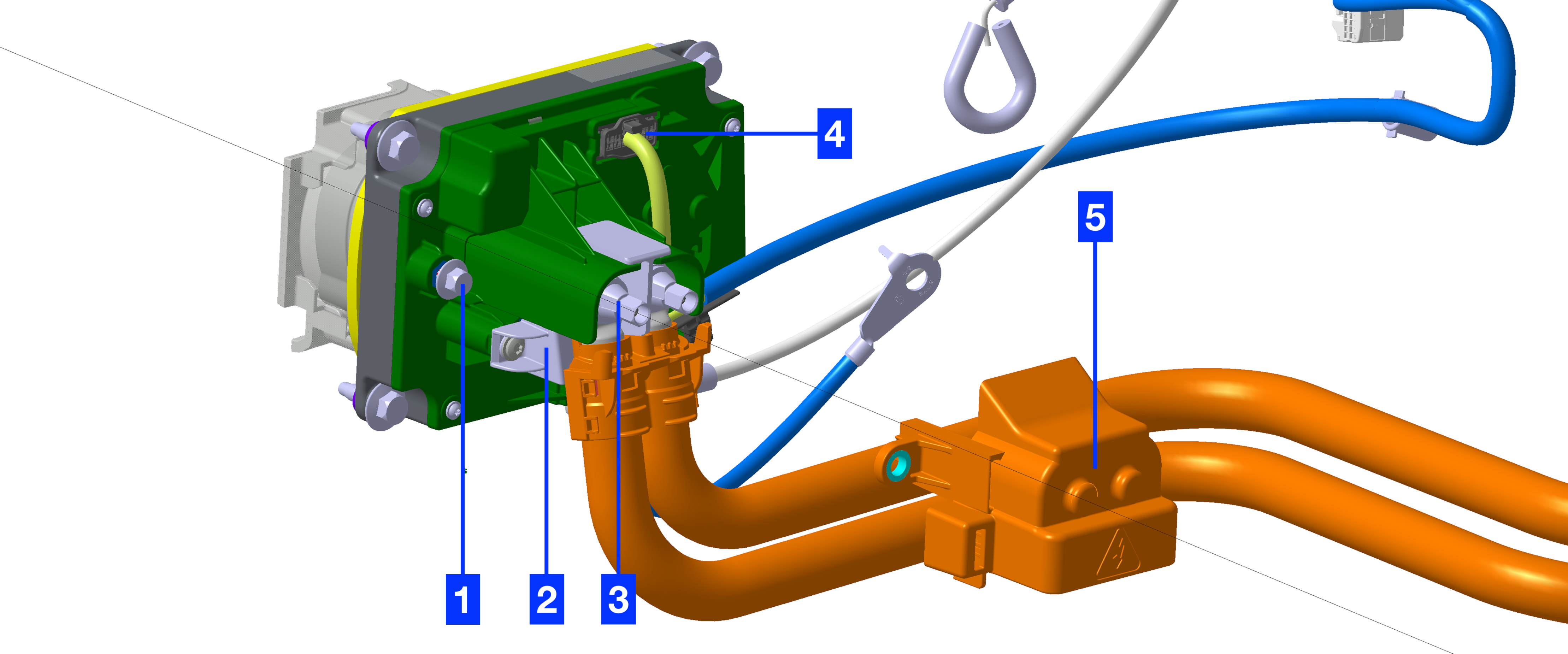 |
|---|
| 1. HV back cover bolt 2. Plastic isolator with trident connector behind 3. HV busbar fastener 4. LV connector (door potentiometer, door actuator, door button, latch potentiometer, latch actuator, back cover sensing, temperature sensing, LEDs, UHF antenna) 5. HV back cover |
| Charge Port Rear, With Busbars |
A low voltage (LV) harness connects the charge port ECU to the charge port inlet assembly. On the ECU side, the harness splits into two branches where it connects via two connectors to the ECU, at the inlet side the harness splits into two branches as well:
- One connects to the trident connector for proximity and pilot
- One connects to the inlet itself for:
- Back cover sensing
- Latch position sensing
- Latch actuation
- LED drivers
- Temperature sensing
- UHF
- Door actuation
- Door position sensing
- Door button sensing
If the back cover is removed, a circuit different from the CPIL is interrupted that signalizes this condition to the charge port ECU. In order to access the trident connector, a plastic isolator needs to be removed.
Note
The plastic isolator is not serviceable separately.
The trident connector features a separate ground strap that is connected to the vehicle chassis. Ground is established through a separate fifth screw, rather than through one of the four charge port to vehicle body mounting fasteners. Inside the trident connector, a 2.7 kOhm resistor connects proximity to ground.
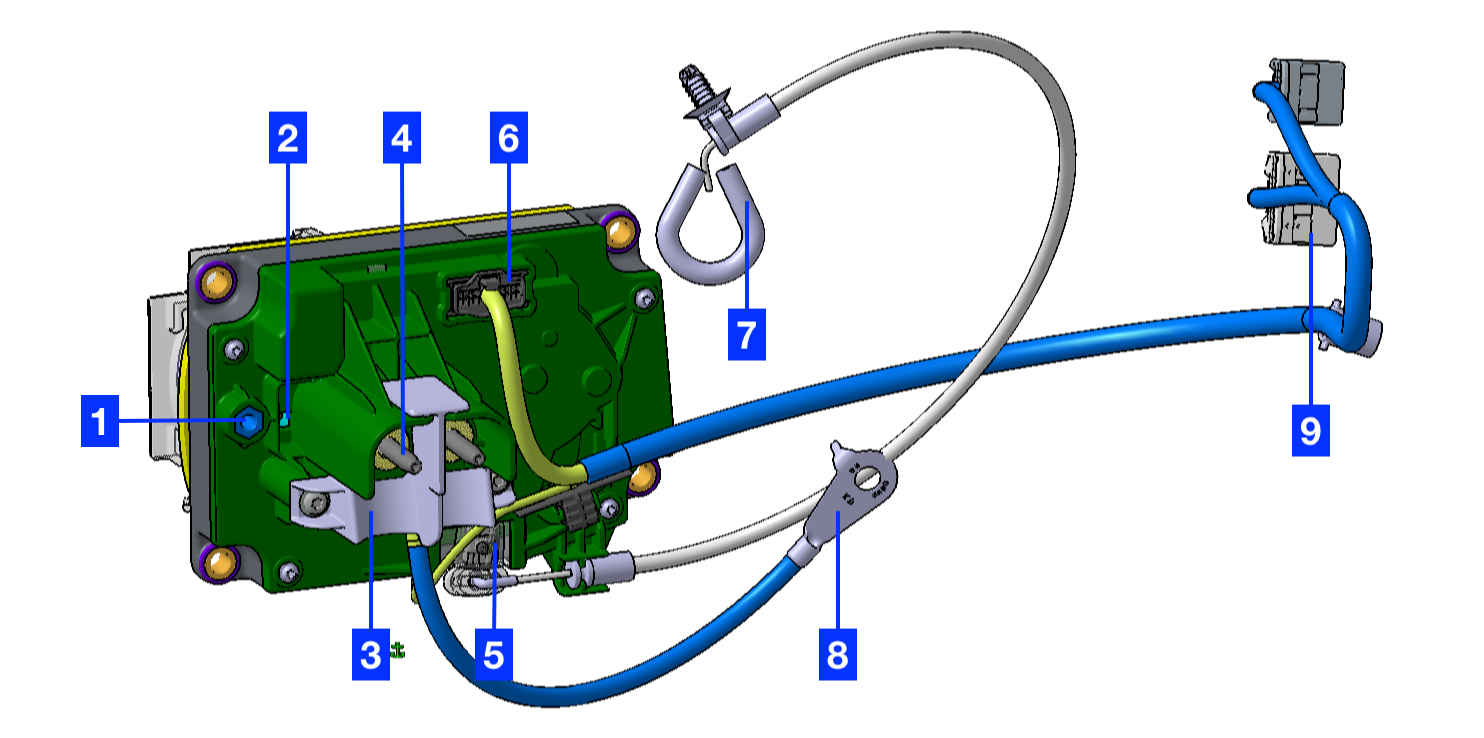 |
|---|
| 1. HV back cover nut 2. HV back cover sensing switch 3. Plastic isolator with trident connector behind 4. HV busbar studs 5. Latch actuator manual release lever with release cable mount 6. LV connector (door potentiometer, door actuator, door button, latch potentiometer, latch actuator, back cover sensing, temperature sensing, LEDs, UHF antenna) 7. Manual release cable 8. Ground strap 9. LV connectors on charge port ECU |
| Charge Port Rear, Busbars Removed |
Charge Port ECUlink
The charge port ECU controls the following sub-components:
- Charge port door motor
- Charge port door potentiometer
- Charge port latch
- Charge port latch potentiometer
- LEDs
- UHF antenna
- Door button
- Inlet thermistors
- Back cover sensor
The charge port ECU connects to external charge equipment through pilot and proximity pins in the trident connector. The charge port ECU is not connected to high voltage power. The charge port ECU enclosure is similar across multiple regions, and can house different internal hardware, resulting in different connector pinout. Therefore, in some cases it may be necessary to verify that the charge port ECU matches the vehicle it is being installed in.
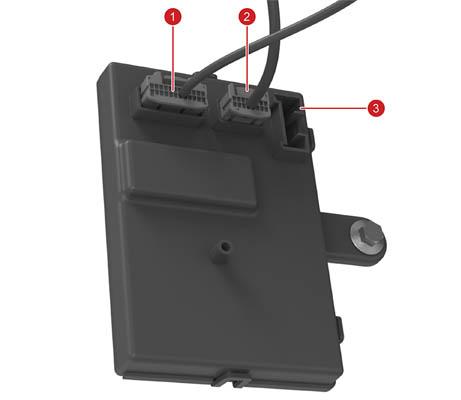 |
|---|
| 1. 24 pin male connector for LV harness (proximity, pilot, thermistors, latch drive, latch sense, inlet power, LED ring, back cover sensing) 2. 16 pin male connector for LV harness (UHF, door sense, door drive) 3. X049 vehicle interface connector (CAN, power, latch enable signal, HVP fault signal) |
| Charge Port ECU |
A 5V source connected to a 330 Ohm resistor supplies the proximity pin. This allows detecting the presence of a charge handle, and the button press state on the handle. The charge port does not generate a digital proximity signal to the drive inverter. Instead, in the unlikely event that the cable state is unknown to the front vehicle controller (VCFRONT) and drive inverter (for instance because the charge port ECU is missing on CAN), the customer can manually override and confirm on the touchscreen that there is indeed no charge cable connected before the vehicle allows them to shift into drive.
The pilot pin detects the duty cycle of a 1 kHz PWM signal sent from external charge equipment. The duty cycle indicates the max allowable current draw from the charging station. The positive amplitude of the pilot signal indicates vehicle readiness for charging (see Gen 2 UMC Theory of Operation for more details). Additionally, the charge port ECU controls single wire controller area network (SWCAN) communication, which means the charge port ECU has the SWCAN relay and transceiver to communicate with external charging products, such as Supercharger. The charge port sends relevant CAN messages from the SWCAN bus to the HVS bus where the BMS, PCS, and HVP are connected.
The charge port ECU connects to the HVP with two hardware lines:
- The charge port fault line
- Bidirectional active-low signal used by HVP to disallow charging and door opening.
- It is used to prevent HV exposure when, for instance, the fast-charge contactors are welded or assumed welded.
- The signal can also be set low by the charge port when there are risks of HV exposure.
- The fault line immediately stops charging (via hardware and software) if charging is active.
- The charge port latch enable line
- Unidirectional active high signal used by HVP to allow the charge port to drive the latch into disengaged state for cable insertion.
- The charge port cannot drive the latch in either direction if this signal is not active.
Since there is thermal sensing of the charge port inlet power pins, the charge port ECU can read temperatures while charging which allows the vehicle to monitor temperature changes and reduce the charge rate if needed.
Note
Always consult the circuit diagram and connector reference for the vehicle being diagnosed to confirm which connector is used.
Charge Port Doorlink
The charge port door can open three different ways:
- A request by the user interface (UI)
- Pressing the charge port door
- Pressing the button on a Tesla charge handle
When the charge handle is pressed, a RF signal is sent to the charge port inlet UHF antenna. A potentiometer mounted to the door driveshaft senses the door position. The charge port ECU uses this potentiometer reading to determine closed/open states. In addition, a button mounted on the bottom left corner of the inlet is used to sense when the door is pressed. The charge port ECU measures the door motor current for accurate control during door actuation, and stall current detection when reaching fully closed/open positions.
The door motor uses a gear to produce appropriate torque for door actuation. Normally, customers should not need to manually move the door since it will automatically close 6 seconds after removing a charge handle. If customer moves the door manually when a handle is not connected, the charge port door will close.
Charge Port Inlet Latchlink
The charge port latch locks the charge handle in place when charging and current is flowing to prevent live disconnect. The charge port latch is integrated into the inlet assembly and cannot be serviced separately.
The latch uses a potentiometer for position sensing, the charge port ECU interprets the analog voltage reading coming from the potentiometer and bins it into either engaged or disengaged position. The latch does not require calibration. Instead, the voltage bins for potentiometer position sensing are fixed. The latch further includes a spring mechanism that ensure that the latch moves by default into engaged position. There is no continuous latch connection check that drives the actuator at low current (which causes a quiet "ticking" noise on Model 3 and Model Y charge ports that have this implemented).
Charge Port Latch Manual Release Cablelink
The charge port latch manual release cable is used in emergency situations where the latch or 12V support is not operating as expected while a charge cable is plugged in. This is the only situation the latch release cable should be used. The latch release cable should never be used to disengage the latch to force insert a charge cable. This is because if the latch does not disengage the inlet could be live. The latch release handle is accessible by users from the left-hand trunk area through a little hole in the trunk side carpet.
Serviceabilitylink
Electrical Connectionslink
To ensure low resistance connections, all busbar connections need to be established with sufficient amount of electrical joint compound applied. Hioki resistance measurements are recommended to ensure that the resistance specifications for the joints are met.
Note
Always refer to the Service Manual for the latest instructions.
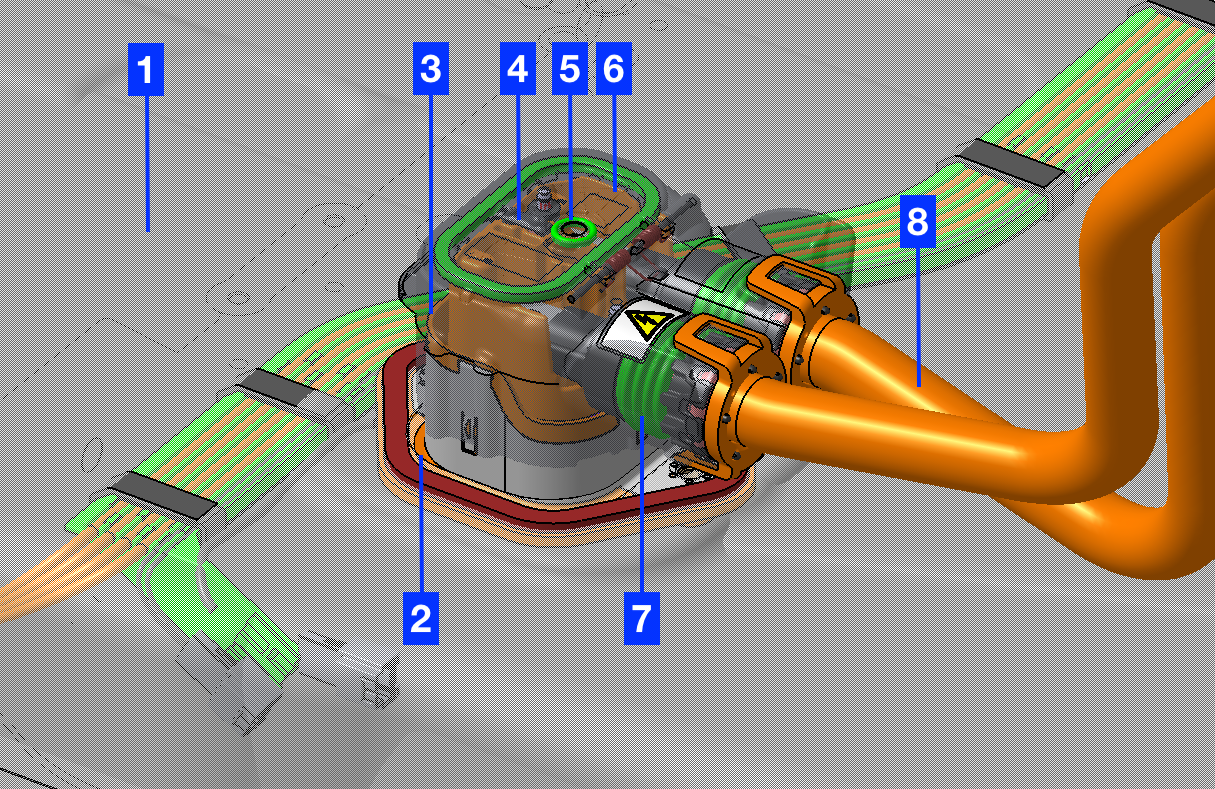 |
|---|
| 1. HV battery enclosure 2. HV connector header (sealed) 3. HV connector 4. CPIL switch (opens when connector lid is opened) 5. Lid bolt (sealed) 6. Lid (sealed) 7. HV busbar seal 8. HV busbar |
| Charge Port HV Battery Connector |
Calibrationslink
The potentiometers for sensing the position of the charge port latch and door do not require calibration.
Diagnosis Methodslink
If the charge port does not operate as expected, it is important to determine if another condition prevents the charge port from operating.
For example, the two hardware signals from HVP can prevent the latch from being driven, or the door from opening, for instance in case a fast charge (FC) contactor has welded or is assumed welded. The FC contactor can be assumed welded if the FC contactor logic harness in the HVC is disconnected or damaged. In this case, alerts from HVP will be present, so generally it is a good idea to resolve all HVP alerts prior to resolving charge port issues.
Additionally, as shown in the charge port LED state table, whenever the BMS is in a faulted state the charge port LED ring will show red LEDs, so any BMS alerts should be diagnosed before suspecting issues with charge port.
The latch has an analog continuous position sensor rather than a binary switch.
The door potentiometer gives a position value for the door which can be used for diagnosing door issues.
If the door button is not operating as expected the door may not open when pressing the door, or it may open when not pressing the door, or the charge cable may unlatch when the vehicle is unlocked. In the former case, the door could be opened by using charge handle or UI. The door will never open when the vehicle is in Drive.
- If the vehicle is in Drive gear, the door will not open using the UI, charge handle button, or press-to-open.
- If the drive rail is enabled but the vehicle is in Park, and either a UI or charge handle open request is received, the front vehicle controller (VCFRONT) will attempt to disable the drive rail. The drive rail will not be disabled with a push-to-open request.
If the latch fails to engage, the vehicle will not allow DC charging, but will be able to AC charge at up to 16A. This is usually sufficient for emergency charging so that the vehicle can drive to a Service Center. If a handle does not latch when inserted in the charge port, inspect the charge port inlet and handle for any signs of obstruction, try a different handle, or very gently wiggle the handle.
Partslink
These are the only parts that can be replaced:
- HV busbars with HV battery connector
- Inlet assembly with latch
- LV harness with trident connector and ground strap
- HV back cover
- HV back cover busbar brackets
- Charge port door
- Charge port ECU