First Rowlink
Last updated: January 06, 2025
Overviewlink
There are two generations of Model X first row seats. While both generations of seats function the same, they have different frames and different seat controllers.
Coverslink
Component Descriptionlink
Model X seats are available in cream, white, and black polyurethane (PUR). This material is a leather alternative.
Theory of Operationlink
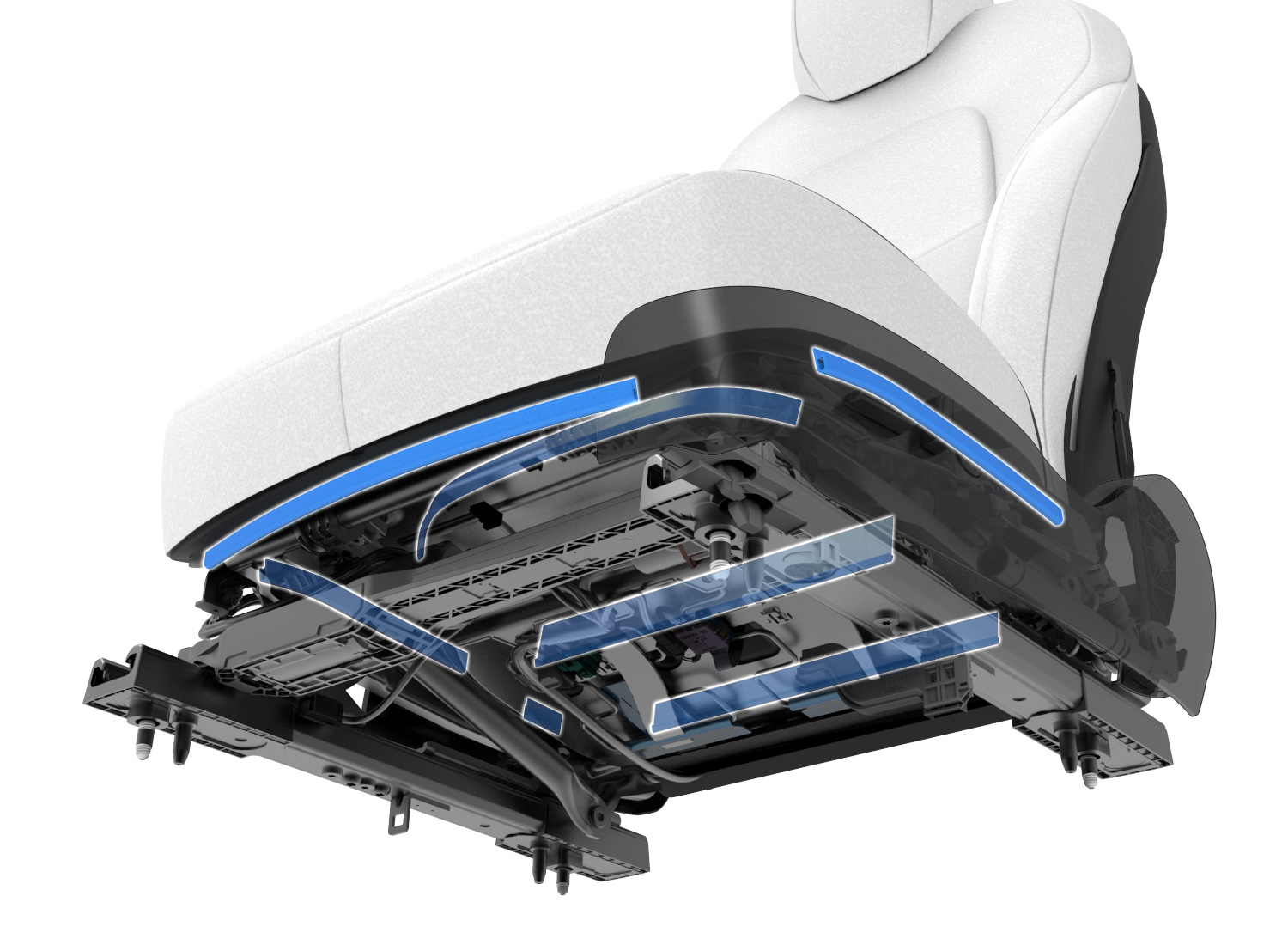
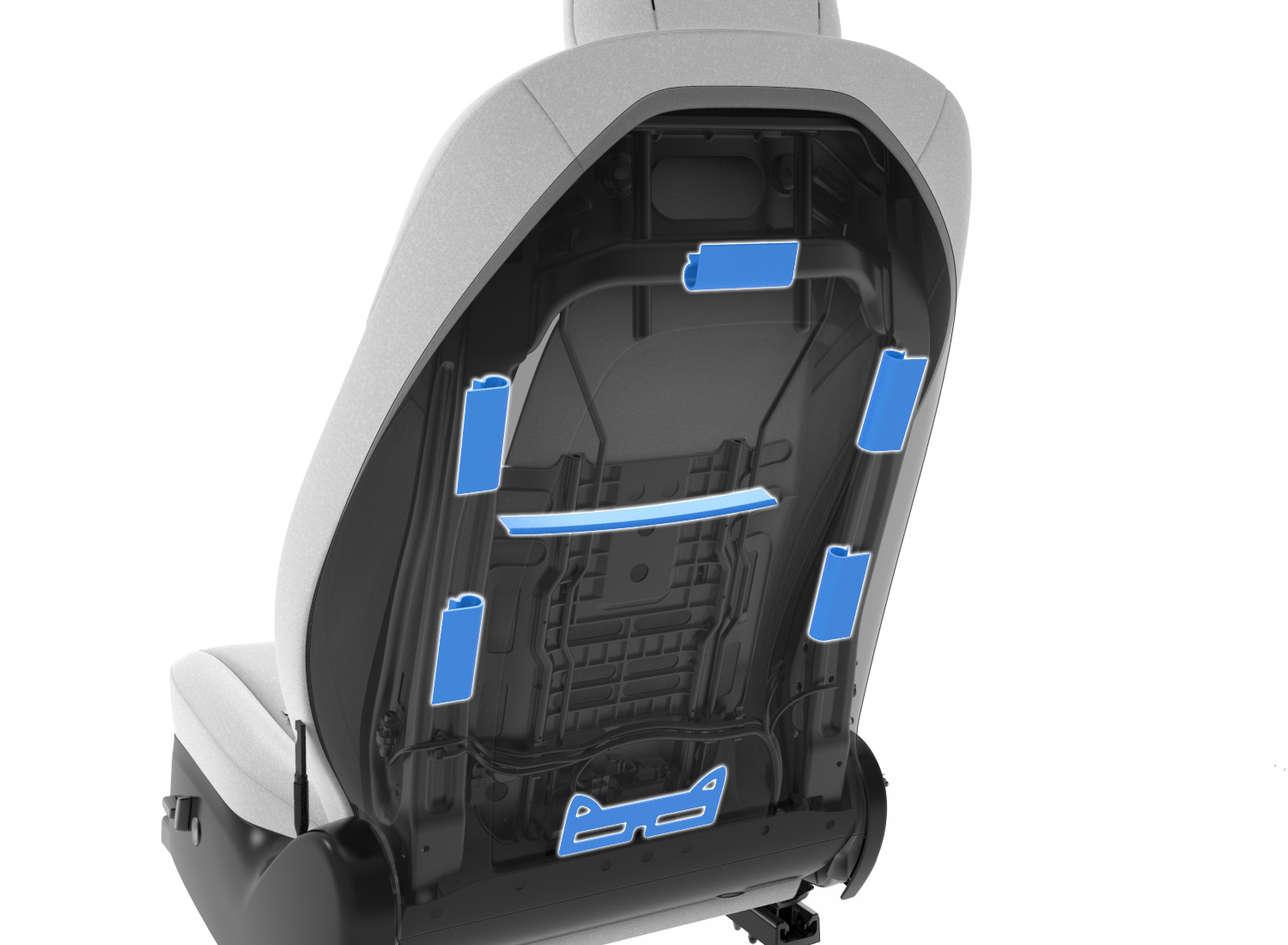
Model X first row seat covers are secured to the foam with hook-and-loop fastening strips, which helps create the different panels on both the seat cushion and seatback. The seat cover is attached to the frame, enclosing the foam with various clips that are pulled taught on the frame to maintain the seat shape. The stitch detailing within the seat is used to help form the shape around the foam.
 |
|---|
| The seat cover attaches to the frame on the outer edges and attaches to the foam on the middle panel trenches |
| First Row Seat Cushion Cover |
 |
|---|
| The seat cover attaches to the frame on the outer edges and attaches to the foam on the middle panel trenches |
| First Row Seat Back Cover |
Serviceabilitylink
Cleaninglink
It is important to steam the seat covers on a low setting, quickly going over the seat cover so as to not damage components like the microphone.
Cleaning PUR seats with some conventional cleaners (especially alcohol-based) can cause performance and appearance degradation. Do NOT use products containing bleach (sodium hypoclorite). It is therefore important to clean seats with only approved cleaners. Below is a list of approved cleaners:
- Clorox NON Bleach Disinfecting Wipes
- Formula 409
- Seventh Generation NON Bleach Disinfecting Wipes
For Cream PUR ONLY, isopropyl alcohol is the strongest solvent that can be used without damaging the seat material. Moisten a soft cloth with warm water and isopropyl alcohol and gently wipe the stain in a circular motion.
Warning
Isopropyl alcohol should not be used on Black PUR or White PUR.
Foam/Padlink
Component Descriptionlink
The seat foam, also referred to as the seat pad, provides comfort and stability to occupants.
Serviceabilitylink
If the seat foam and covers have not been properly installed it can feel or look as if the seat is missing foam or that the foam has collapsed. Because the foam is sandwiched between the cover and upholstery support, it is possible that the foam could have been misaligned during installation. In some rare cases, the way in which a user ingresses or egresses from the vehicle can apply pressure on the outmost edge of the cover and foam, causing the foam to get caught on the frame and not maintain it's full shape. This can be resolved by refitting the cover and foam.
Controllerlink
Component Descriptionlink
The first generation Model X first row seat has a Bitron Seat controller. The Bitron seat controllers communicate on the Body Fault Tolerant (BFT) bus connected to the gateway. The second generation Model X first row seat has a Tesla controller in it. VCSEATD for the driver seat and VCSEATP for the passenger seat.
Seat Heatlink
Component Descriptionlink
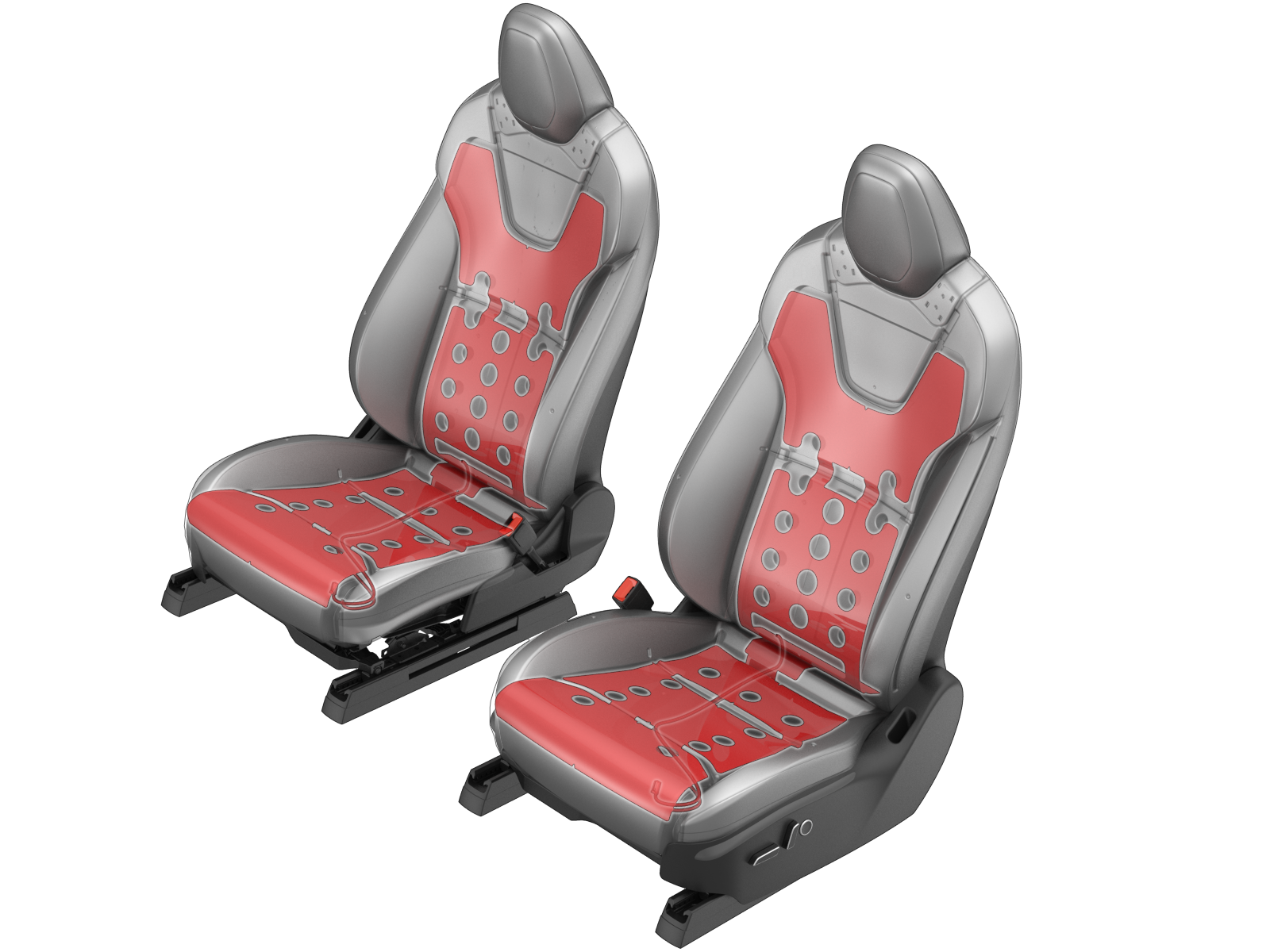
Model X first row has heating elements in both the seat cushion and seatback of the driver and passenger seats.
 |
|---|
| First Row Seat Heat |
The seat heater is made up of the following components:
- High side driver
- Pulse width modulation (PWM)
- Negative temperature coefficient (NTC) thermistors
- Resistive pad
The heating element, or resistive pad, is located only in the center panels of the seatback and seat cushion, the heating element is not located in the side bolsters.
Theory of Operationlink
There are 3 heating temperature targets for the seats (low, medium and high). Target temperatures for both the cushion and the backrest are:
- Low (Setting 1): 28°C or 82°F
- Medium (Setting 2): 44°C or 111°F
- High (Setting 3): 60°C or 140°F
The seat heaters utilize PWM at 1Hz in order to reach the desired target temperature. This means pulsing the voltage at a controlled frequency. The duty cycle (width of the pulses) will be increased if the temperature read by the NTC is below the target temperature, the duty cycle can be increased all the way up to 100%, providing up to 16V. When the temperature read by the NTC is higher than the target temperature, the duty cycle can be decreased all the way to 0% providing no voltage. Due to this PWM, the voltage at the seat heater is constantly changing and varies due to ambient temperature and heat setting level.
Current travels through the resistive pad generating the heat. This resistance remains constant with a functioning seat heater.
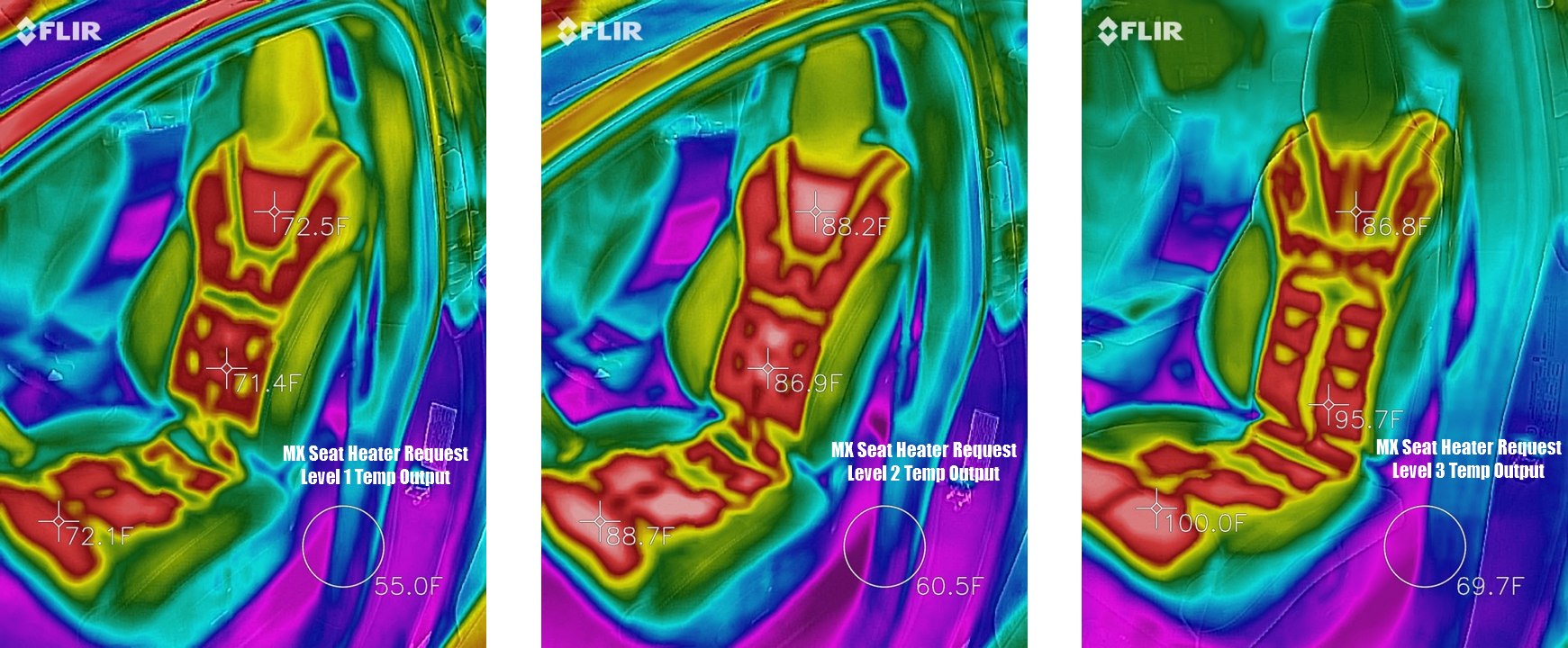
The table below provides information on testing procedures and the approximate voltage, resistance values, and surface temperatures when checking for proper seat heater operation. When testing the seat heater temperatures, several factors can affect the measurements and the time it takes for the seat to heat up and shut off.
Warning
Use the temperatures below as a guideline and not as a direct match.
Level 1
| Time elapsed in Minutes | Seat Base Temp (°F) | Seat Back Temp (°F) | Seat Heater Voltage |
|---|---|---|---|
| OFF | 54 | 54 | 12.9 |
| 1:00 | 59 | 59 | 13.4 |
| 3:00 | 76 | 64 | 13.4 |
| 5:00 | 84 | 65 | 13.4 |
| MAX DELTA | 85 | 66 | 13.4 |
Level 2
| Time elapsed in Minutes | Seat Base Temp (°F) | Seat Back Temp (°F) | Seat Heater Voltage |
|---|---|---|---|
| OFF | 60 | 60 | 13.9 |
| 1:00 | 70 | 70 | 13.4 |
| 3:00 | 86 | 73 | 13.4 |
| 5:00 | 93 | 76 | 13.4 |
| MAX DELTA | 105 | 77 | 13.4 |
Level 3
| Time elapsed in Minutes | Seat base Temp (°F) | Seat back Temp (°F) | Seat Heater Voltage |
|---|---|---|---|
| OFF | 61 | 61 | 12.9 |
| 1:00 | 69 | 69 | 12.9 |
| 3:00 | 81 | 79 | 13.4 |
| 5:00 | 93 | 79 | 13.4 |
| MAX DELTA | 111 | 82 | 13.4 |
 |
|---|
| Heating Element Location |
The NTC is located only in the seat cushion, not the seatback. It is connected to 5V through a resistor on the body controller. As the temperature of the seat increases, the resistance on the NTC lowers and the voltage read at the controller goes down. If the thermistor is disconnected, the voltmeter will read 5V or 0V depending on where the disconnect occurs. At around room temperature, the voltage at the NTC should be around 3.6V.
Communicationlink
The seat heater communicates via Vehicle bus (VEH). All communication happens on the driver seat vehicle controller (VCSEATD) or passenger seat vehicle controller (VCSEATP).
Serviceabilitylink
The seat heater resistive pad is adhered to the seat foam and is therefore not serviceable without potentially damaging the seat foam.
The temperature felt at the surface of the seat depends on an occupant sitting in the seat. Compressing the foam and trim with an occupant sitting in the seat allows for the occupant to fully feel the temperature provided by the seat. Factors such as a heat soaked interior, body heat from someone sitting in the seat, direct sunlight, and ambient air temperatures can play a big role on the temperature readings at the surface of the seat cover.
Seat Ventilationlink
Component Descriptionlink
Model X first row seats are equipped with seat ventilation in both the seat cushion and seatback. Model X first row has heating elements in both the seat cushion and seatback of the driver and passenger seats.
The seat ventilation is made up of the following components:
- Perforated seat cover PUR
- Reinforcement mesh
- Spacer mesh
- Holes within the seat heater and OCS sensor to matchup with the holes in the foam
- Foam
- Fan
For long range seat covers, the perforation only exists on the center panel. For performance seat covers, the perforation is also on the inner bolsters.
Theory of Operationlink
Seat ventilation can be activated via the UI.
There are 3 levels of cooling. The seat cover is perforated to allow air flow at the cover A surface.
Serviceabilitylink
Similar to seat heat, the temperature of the A surface of the seat cover is dependent upon the seat being compressed by an occupant's weight.
The seat fan is an indicator of Model X seats as it has been several years since Tesla offered ventilation in the seats. Model S built after October 2019 has a very similar structure to Model X first row seats, they both utilize the same frame and motors, but Model X offers seat ventilation.
Framelink
Component Descriptionlink
The front seat structure is comprised of two main assemblies, the cushion assembly and the backrest assembly. The main assemblies are each built separately then assembled together to form the full structure. Each assembly has a metal frame, electronics and harness, foam cushion, restraint components, and trim covers. The front seat frame is made out of laser welded steel alloy metal. The seat cushion frame has a cushion spring to add non-rigid support.
Serviceabilitylink
The frame is typically the source of any rocking issues that can occur. During diagnosis, the joints for heigh movements, track ball bearings or recliner joints are usually place in which rocking can originate from. The cushion spring can cause certain noise concerns if not properly seated on the cushion frame.
Trim/Plasticslink
Component Descriptionlink
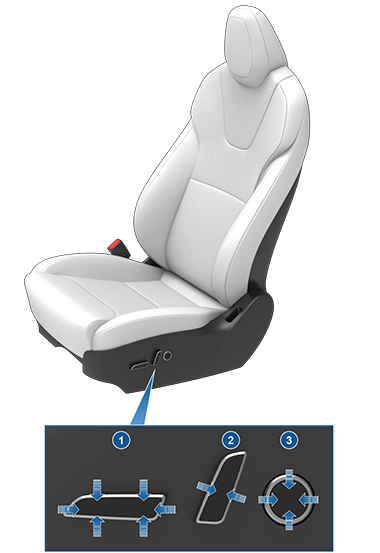 |
|---|
| 1. Seat cushion button 2. Recliner button 3. Lumbar button |
| Seat Controls, Outboard Side Shield |
Serviceabilitylink
First row seatback panel at start of production, February 2021, does NOT include a map pocket.
Both the inner and outer side shields come as two pieces. This is in order to accommodate a slight degree of rotation difference in the seat belt buckle and the seat belt pretensioner between the North America and EU variants.
Motorslink
Component Descriptionlink
The front seats have the ability to move on 4 axis:
- Track: Forwards and backwards, moves the seat closer or further away from the steering wheel.
- Height: Up and down, this allows the height of the seat to be taller or shorter.
- Tilt: Up and down, this allows the front pan of the seat cushion to be taller or shorter.
- Recliner: Forwards or backwards, moves the back rest around the pivot point of the seat.
Each front seat includes an 8-way, plus lumbar, control switch pack which is used to control the different seat adjustment functionalities. The seat heaters for all seats are activated from the touchscreen.
|
|---|
| Seat Controls for Tesla Seat First Row |
| Action | Button Combo | Resistance (Ohm) | Pin |
|---|---|---|---|
| Up | H | 886 | 1 |
| Down | G | 597 | 1 |
| Forward | F | 1011 | 2 |
| Reverse | E | 676 | 2 |
| Tilt Up | D | 499 | 1 |
| Tilt Down | C | 429 | 1 |
| Backrest Forward | B | 1179 | 2 |
| Backrest Reverse | A | 774 | 2 |
| Lumbar Up | M | 1012 | 3 |
| Lumbar Down | K | 677 | 3 |
| Lumbar Out | J | 774 | 3 |
| Lumbar In | L | 1179 | 3 |
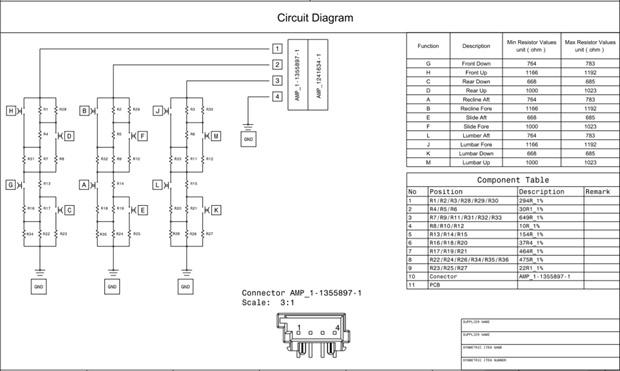 |
|---|
| **Circuit Diagram for Tesla Seat First Row ** |
Theory of Operationlink
First row seats have a total of 4 electric 12V DC brushed motors that control the different seat adjustment functionalities. This includes track, lift, tilt, and recline adjustments.
| Motor | Seat Travel | Encoder Counts per entire range | Travel Time (s) | Nominal Current (A) | Stall Current (A) | Inrush (A) |
|---|---|---|---|---|---|---|
| Track | 260mm | 1242 | 16 | 3 | 12 | 8 |
| Height | 60mm | 2060 | 12 | 6 | 14 | 10 |
| Tilt | ± 3 degrees | 551 | 6 | 3 | 10 | 7 |
| Backrest | ± 20/40 degrees | 2455 | 17 | 5 | 9 | 6 |
Communicationlink
The power functions of the seats are controlled by the left and right body controllers. The driver seat is controlled by VCSEATD and the passenger seat is controlled by VCSEATP.
Lumbar Support Systemlink
Component Descriptionlink
Model X Tesla seat lumbar system is a pneumatic 2-bladder, 4-way power system. It consists of an air pump, a valve pack, two air bladders and a lumbar flex mat.
Theory of Operationlink
The lumbar control unit is controlled via local interconnect network (LIN) communication by the corresponding left or right body controller. Depending on the user command via the 4-way lumbar control button on the seat, the control unit will pump or deflate the corresponding air bladders to provide the desired lumbar support. The body controller constantly monitors the pressure in each bladder using the pressure sensors in the valve control unit to keep the pressure within specified limits. There is also a blow-off valve for each bladder to release excess air once max pressure is reached.
The lumbar 4-way control button has the controls:
- Up = Inflate (B1), Deflate (B2)
- Down = Inflate (B2), Deflate (B1)
- Right = Deflate (B1)+(B2)
- Left = Inflate (B1)+(B2)
The following movements are a result of pressing two functions together. The switch below the circular button has 4 different switches so pressing two together result in the following:
- Up+Right = Deflate (B2)
- Up+Left = Inflate (B1)
- Down+Left = Inflate (B2)
- Down+Right = Deflate (B1)
Serviceabilitylink
The body controller monitors pressure change during operation to identify a possible leak in the system. If the bladder has a leak or cannot maintain pressure, this could result in failure to calibrate.
Driver Profilelink
Feature Descriptionlink
Model X has the ability to save the preferred seating position of the driver. When the driver's seat, steering wheel or driver's side mirror is adjusted, the touchscreen will prompt the user to create a driver profile to save these adjustments. The driver's profile can utilize the "Use Easy Entry" checkbox if the user would like the steering wheel and seat to adjust when the park gear is engaged and the driver's seat belt is unbuckled, allowing an easy exit from the vehicle. When returning to the vehicle and stepping on the brake pedal, settings automatically adjust back to the setting used by the most recent driver profile.
Model X supports up to 10 driver profiles. The driver profile can be linked to keys, including authenticated phones, key cards and up to 4 key fobs.
Theory of Operationlink
Model X Driver's profile is recalled from the UI. When a user saves a driver's profile it is associated with an index. The UI then saves the orientation of the various motors in millimeters and degrees. There is then an app layer on VCSEATD which performs inverse kinematics that translates the millimeters and degrees into encoder counts on the motor.