Doorslink
Last updated: October 20, 2023
Exterior Door Handleslink
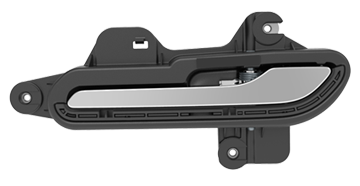
The door handles are incorporated with a hall sensor used to measure the angle of the handle and signal the latch when a pulse width modulation (PWM) threshold is met.
The door handle has two modes:
- Sleep: handle is retracted and the signal is a constant 0v, at less than 100uA.
- Awake: handle is opened beyond +2.75 / -2.25 degrees and the signal oscillates between 0v and 5v, at 13mA (PWM pulse where duty cycle is proportional to the angle).
The hall effect sensor is located on the housing at the rear of the handle. It senses a magnet located on the handle, and depending on the distance the magnet is from the sensor it will determine the angle for sleep / wake.
The handle is equipped with a return spring. When the lever is released, a damper will slow the retract speed until the handle returns to its retracted position. Handles are common front to rear and symmetrical left to right.
 |
|---|
| Door Handle |
Side Door Latchlink
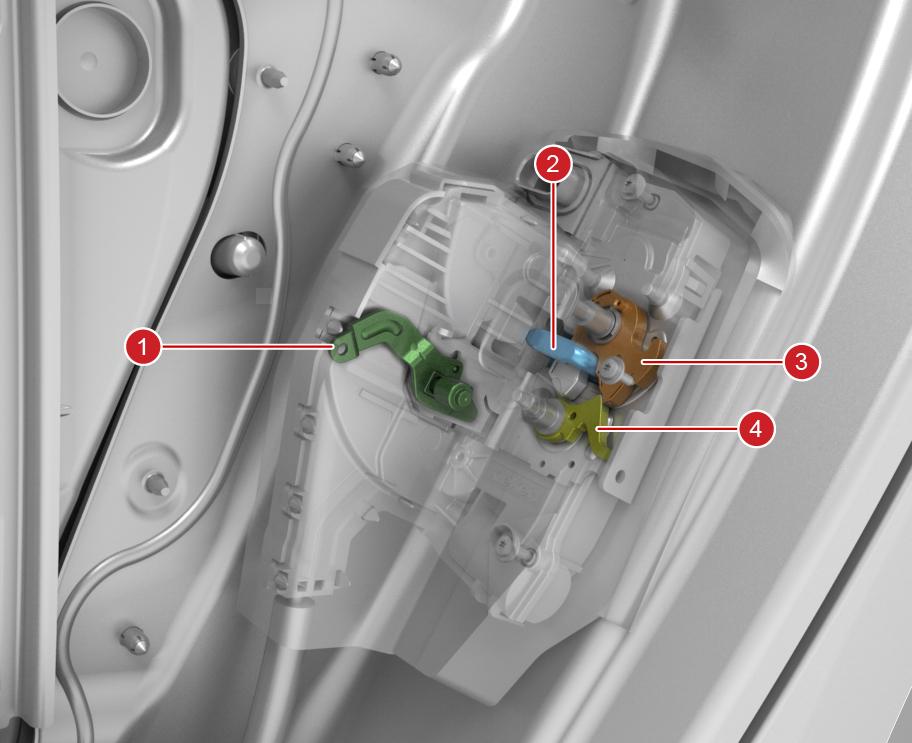
The side door latch is a standard non-cinching latch with a primary and secondary claw position. The main claw holds the striker in position and is prevented from moving by a rotating pawl internal to the latch. The mechanical body of the latch is the same for the front and rear doors, but they are not interchangeable parts because the cabling for the mechanical release is different. The latch is primarily released with an electronic signal from a body controller, but also includes a manual mechanical release cable in both the front and rear configuration. The front mechanical release can be pulled from a section of the door panel from the interior of the vehicle, but the rear latch mechanical release is only accessible through a small service panel. It is used in service to release the latch if there is no low voltage power.
 |
|---|
| 1. Mechanical inside release 2. Striker 3. Claw (or ratchet) 4. Pawl |