Electronic Park Brake (EPB)link
Last updated: September 30, 2022
Overview / Componentslink
The main purpose of the EPB is to make sure the vehicle does not roll when the vehicle is parked and powered down. The main electro-hydraulic brake system requires continuous power input to make sure brake pressure and clamp force are maintained. The EPB does not require continuous power input. The clamp force is mechanically guaranteed for as long as it is not actively released. The secondary function of the EPB is to act as a backup brake system in case of a malfunction with the main brake system.
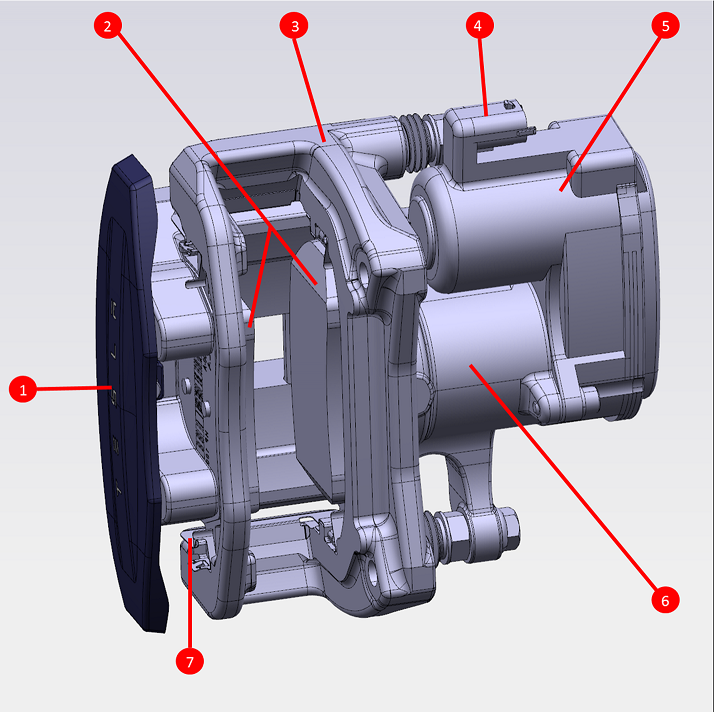
The mechanics of the EPB system are integrated into the rear foundation brake calipers and are not separately serviceable. The rear calipers comprise an EPB drive unit, brake caliper, piston assembly, and brake pad assembly. The EPB control units (EPBL and EPBR) are integrated into the left vehicle control unit (VCLEFT)'s housing and the right vehicle control unit (VCRIGHT)'s housing. EPBL and EPBR each control their corresponding (left and right) EPB motor. The EPB control units communicate with VCLEFT and VCRIGHT over Inter Processor CAN (LIPC and RIPC, respectively). EPBL and EPBR also both communicate via the Vehicle- and Party-CAN. Their CAN-nodes can be found on VCLEFT and VCRIGHT as well.
 |
|---|
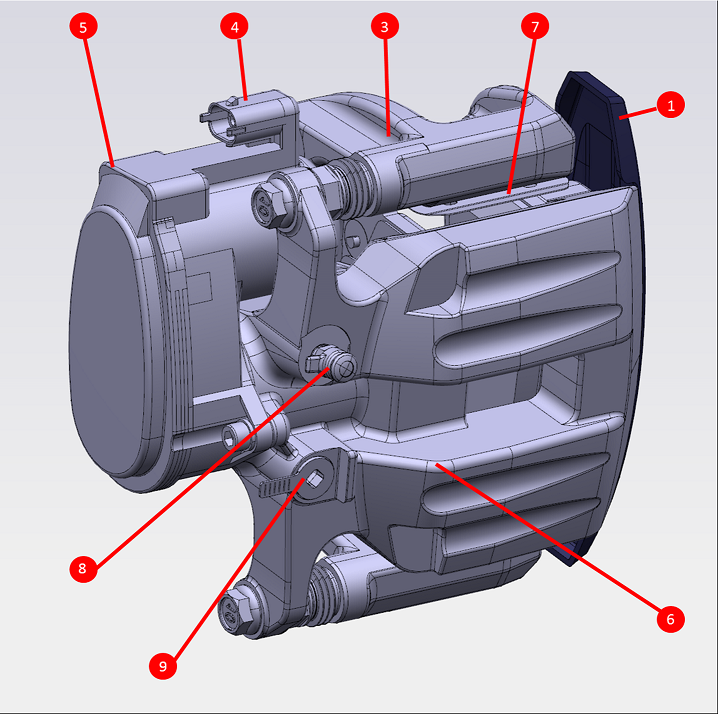 |
| 1. cover 2. brake pads 3. caliper carrier 4. EPB connector 5. EPB motor 6. caliper body 7. brake pad anti-rattle shim 8. bleed nipple 9. plug |
| EPB caliper |
Specificationslink
Operation Specificationslink
| Description | Specification | Comment |
|---|---|---|
| Supply voltage | 9-16 V | Voltage supply range in which the EPB will operate as intended |
| Operating temperature | -40 +85 °C | Ambient temperature range in which the EPB will operate as intended |
| Brake fluid | Dot 4 | Prescribed brake fluid type with which the EPB will operate as intended |
Current Specificationslink
| Description | Threshold | Comment |
|---|---|---|
| Static (parking) clamp current | 18 A | Current level at which the controls will stop engaging the EPB when the parking brake is activated, which will result in the clamping force required for parking |
| Dynamic brake clamp current | 5.2 A | Current level at which the controls will stop engaging the EPB and the dynamic/emergency brake is activated, which will result in the clamping force required for dynamic/emergency braking |
| Endstop max current | 10 A | Current level at which the controls will stop releasing the EPB when a service release is active and the piston reaches the endstop |
| Max no-load current | 3.5 A | Maximum allowable current when piston is moving freely. A higher current suggests the piston is in clamping phase or running at its endstop |
Piston Position Specifications (Voltage Counts)link
| Description | Threshold | Comment |
|---|---|---|
| EPB release counts | 1100 | Number of counts (distance) the EPB will release when the park brake is released |
| EPB clamping counts high | 600 | Max number of counts during clamping phase (current higher than no-load) before static clamp current is reached |
| EPB releasing counts high | 250 | Max number of counts during release phase (current higher than no-load) before a current lower than no-load current is reached |
| EPB service release counts | 16000 | Number of counts the EPB will release when service release is active. This value is higher than the endstop distance in a normal release. The endstop current is what first detects hitting of the endstop during service release |
EPB Performance Specificationslink
| Description | Specification | Comment |
|---|---|---|
| Healthy brakes grade warning slope | 27 % | Slope gradient to which the vehicle is able to hold when the brakes are healthy; both EPBs operable, and descent rotors and pads |
| Degraded brakes grade warning slope | 15 % | Slope gradient to which the vehicle is able to hold when the brakes are degraded. Only 1 EPB operable with worn rotors and pads |
| Dynamic brake deceleration | 0.2 g | Minimum deceleration when applying the dynamic/emergency brake with healthy brakes |
Theory of Operationlink
The Electronic Park Brake (EPB) system is able to apply the rear brakes without the use of hydraulic pressure. It electro-mechanically actuates the pistons of the rear calipers. An electric motor through a reduction gear rotates a spindle on which the piston of the brake caliper sits. In this mechanism, the rotational motion is translated into a lateral motion. During EPB apply, the system detects sufficient clamping force by measuring the current through the EPB drive motor (clamp current). When the clamp current is reached, the actuation of the drive motor is stopped. For EPB release, the EPB will release a fixed amount of counts or distance (EPB release counts). Within a specified number of counts (EPB releasing counts high), the current should drop below the no-load current. If not, an alert will be set. When the EPB is not engaged, the piston can move by hydraulic power pressing against the piston. When the EPB is engaged, it can only be disengaged by rotating the spindle compared to the piston. The EPB system has two functions in the vehicle: the parking brake and the emergency brake.
Parking Brakelink
As a parking brake, the EPB performs two functions: the Park (gear) function and the Park Brake (hand brake) function.
Park (gear): When the driver shifts into Park, the parking brake automatically engages to the static clamping force. The gear shows P. This same function happens when the driver exits the vehicle when it is still in Reverse, Neutral, or Drive.
Park Brake (hand brake): When the P button is pressed for more than 800 ms, or when the Park Brake is selected on the touchscreen, the parking brake also engages to the static clamping force. In addition to the gear showing P, the Park Brake indicator light will light up on the touchscreen. If the vehicle was already in P before activating the Park Brake, the parking brake will re-engage. The EPB motors will be shortly activated.
For both functions, the parking brake will clamp to the static clamp force. The parking brake, whether being in P or on Park Brake, will release when the driver shifts into any other gear.

When the parking brake is applied, the RED Park Brake indicator lights up on the touchscreen.

In case of malfunction of the EPB system or if for some reason the EPBs fail to reach the target current, the YELLOW Park Brake indicator lights up on the touchscreen accompanied by a fault message.
Dynamic / Emergency Brakinglink
Holding the parking brake button on the center console for more than 500 ms while the vehicle is still moving can result in different behavior depending on vehicle speed:
- When the vehicle speed is between 0 and 0.5 mph, the parking brakes will clamp with the static clamping force.
- When vehicle speed is between 0.5 and 5 mph, EPB performs dynamic apply, with the parking brakes clamping to the dynamic clamp force for 3 seconds, or until the vehicle speed is below 0.5 mph. Once below 0.5 mph, the parking brakes will clamp to the static force.
- When the vehicle speed is above 5 mph, EPB performs dynamic apply without using the EPB calipers, but instead using the ESP (hydraulic brakes) to reach a target deceleration of 0.6 g.
In case there is a malfunction of the ESP system, the EPB calipers always will be activated when a dynamic brake request is made, regardless of the vehicle speed.
In case of a complete loss of hydraulic pressure in the brake system, the emergency braking function can be used. The emergency brake can be actuated in the same way as dynamic apply by holding the parking brake button on the center console for more than 500 ms at a vehicle speed greater than 8kph/5mph. The touchscreen displays a visual warning and a chime sounds.
An emergency brake request will cause the EPB to apply while the vehicle is moving and decelerate the vehicle with at least 0.2 g.
Only EPBL_a180_dynamicActive will be recorded in log data, although the sytem will always enter dynamic / emergeny apply with both calipers at the same time. If one of the EPBs malfunctions the system will not enter dynamic / emergency apply.
Servicabilitylink
EPB service releaselink
Retraction of the piston for brake service purposes is called EPB service release. This can be done in 3 different ways:
-
When the vehicle is fully operational, this can be done using Toolbox as described in the Service Manual. A request is sent to the controller to fully retract the piston. This is done per side separately.
-
When the vehicle is not operational, the EPB can be released using a special park brake release tool. This tool connects to the connector on the caliper and powers the EPB drive motor. By manually providing electric power to the caliper, it can be retracted or closed.
-
If the special EPB release tool is not available or the piston does not retract (piston is stuck, motor is broken), the EPB can be released by removing the electric motor and manually rotating the shaft inside the caliper. Because the EPB drive needs to be opened for this, the caliper needs to be discarded and a new caliper shall be installed.