Alarm System (With Interior Cabin Ultrasonics)link
Last updated: October 20, 2023
Summarylink
The Model 3 is equipped with an alarm system, which monitors for any unwanted entry into the vehicle and alerts the user if any such instance is detected. This system is activated 60 seconds after the vehicle is locked, and checks the status of the door and front/rear trunk latches. If any intrusion is detected, the alarm system is activated, causing the horn to sound once every second and turn signals to flash.
For European (EU) vehicles, the alarm system is also equipped with tilt/intrusion sensors, and certain vehicles also have a Battery Backup Siren (BBUS).
Specificationslink
General Alarm Functionalitylink
The alarm functionality can be disabled by the user by going to Settings > Safety and Security > Security Alarm.
The alarm is partially armed when the vehicle is parked and locked using the key card, key fob, phone or Walk Away Lock. The alarm will then transition to fully armed after 1 minute if no unlocking request is received.
The alarm is disarmed when the vehicle is unlocked (with key card, key fob or phone) or when the vehicle enters Drive Mode.
If armed, the alarm is triggered when any door or trunk is opened.
Note
The alarm is not triggered if the front or rear trunk get opened by an authorized entry (e.g from Tesla phone application). See Trunk Theory of Operation for more information.
If the alarm is triggered, the horn will sound once every second and the turn signals will flash (except for EU vehicles equipped with a battery back-up siren, where the siren will sound instead of the horn).
If triggered, the alarm can be disabled by unlocking the vehicle via an authenticated device. If none are detected, the alarm will be disabled after being activated for 30 seconds and will re-activate after 1 minute, for a maximum of 10 activation cycles.
Tilt And Intrusion Detection (EU vehicles only)link
The Tilt / Intrusion detection system can be disabled by the user when the alarm is not armed by going to Settings > Safety and Security > Tilt / Intrusion. The alarm feature needs to be enabled for the Tilt / Intrusion detection to be ON. After each unlock event and if the vehicle drive rails are powered, the Tilt / Intrusion setting is reset by default to ON.
If any motion is detected in the vehicle when the alarm is enabled, intrusion detection is triggered and the alarm is activated.
If the vehicle is tilted or moved while the alarm is enabled, tilt detection is triggered and the alarm will be activated.
Vehicles built without a Li-Ion battery are also equipped with a battery back-up siren (BBUS), which has internal battery acting as a backup power supply.
The Tilt/Intrusion sensor is available in the following vehicle modes:
- Normal
- Valet
- Diagnostic
- Service
- Showroom
The Tilt/Intrusion sensor is disabled in Transport mode.
Warning
The ultrasonic sensors are designed to reliably detect motion inside the cabin. Therefore, it is possible that that small flying insects, like flies, are detected by the intrusion sensors, especially in summer. This is expected and the customer can be informed about this.
Component Descriptionslink
Component Locationslink
The following components make up the Alarm system:
- Rear Overhead Console (ROHC)
- Vehicle Control Security (VCSEC)
- Vehicle Control Left (VCLEFT)
- Battery Backup Siren (BBUS) (EU vehicles without Li-Ion battery only)
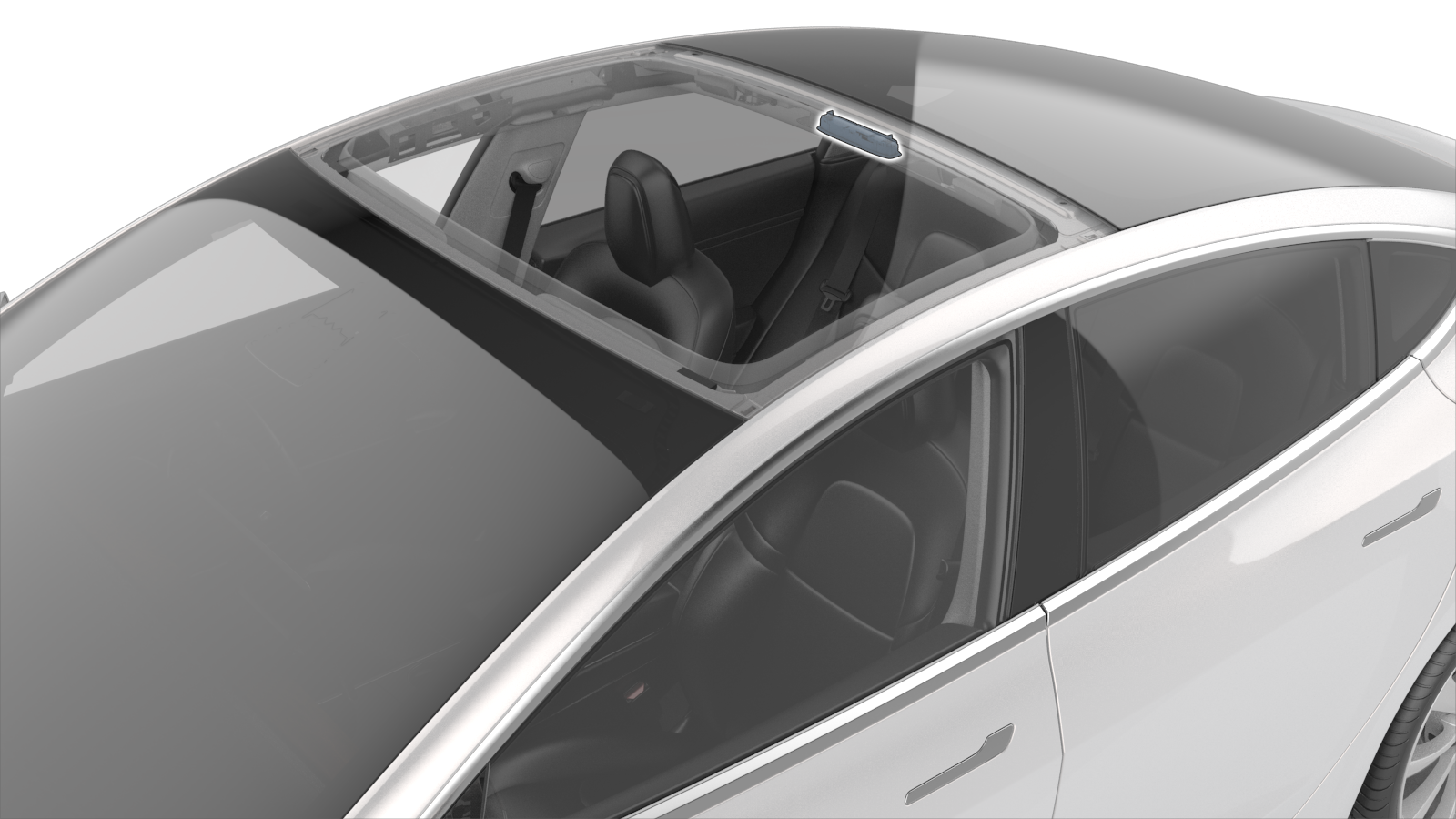 |
|---|
| Rear Overhead Console (ROHC) location (Equipped with intrusion sensors on EU vehicles only) |
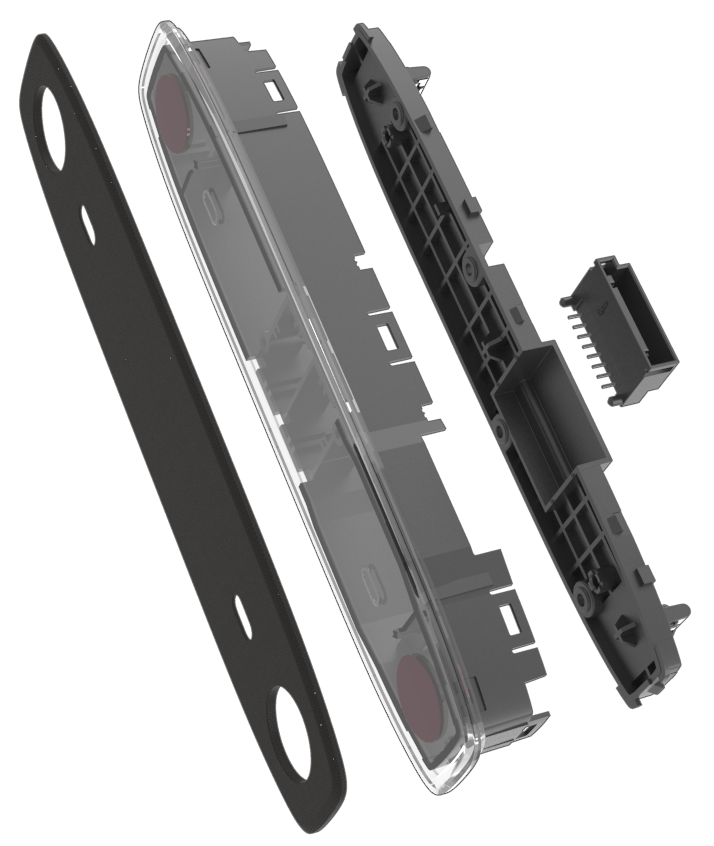 |
|---|
| Rear Overhead Console (ROHC) |
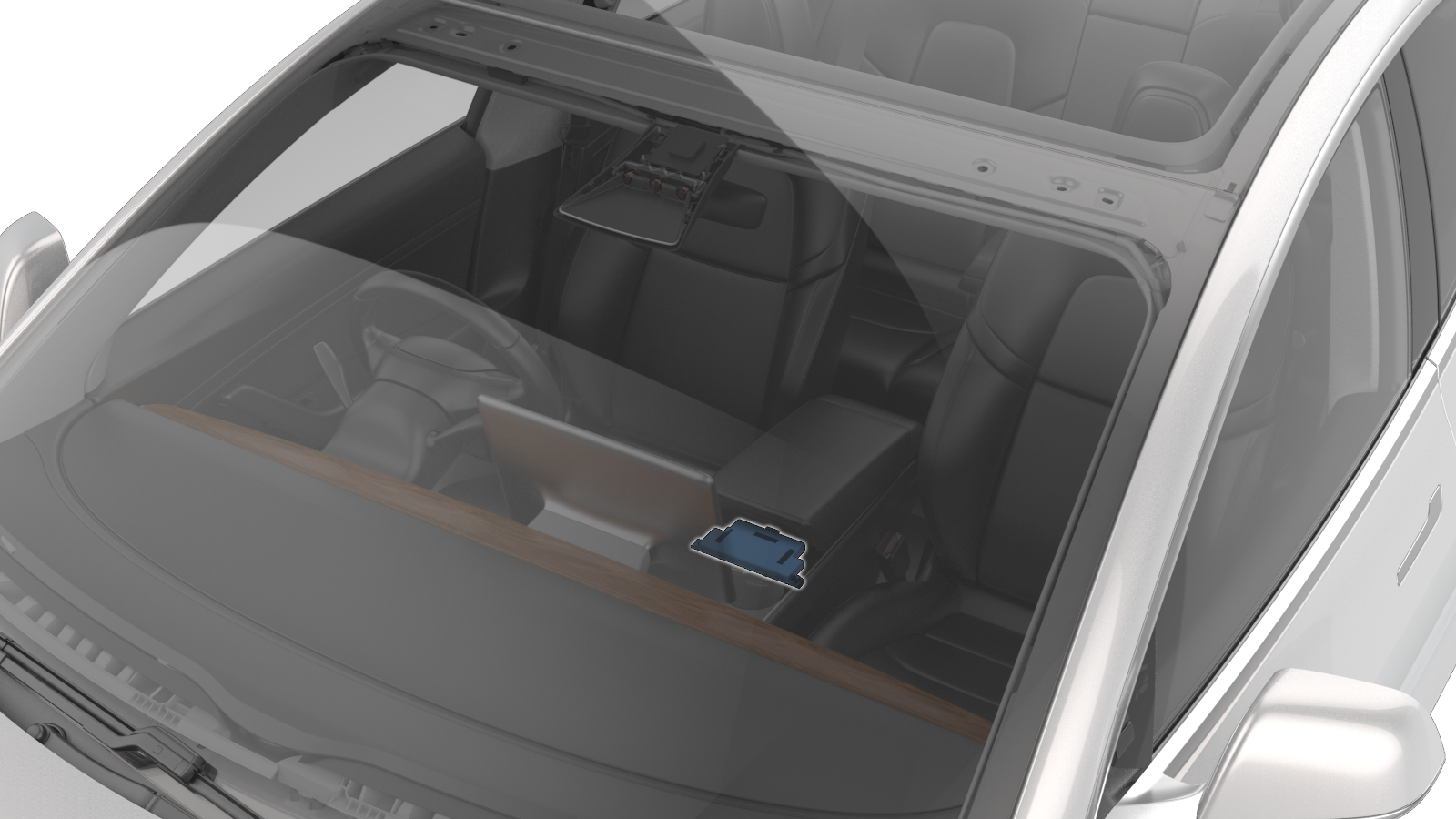 |
|---|
| Vehicle Control Security (VCSEC) location |
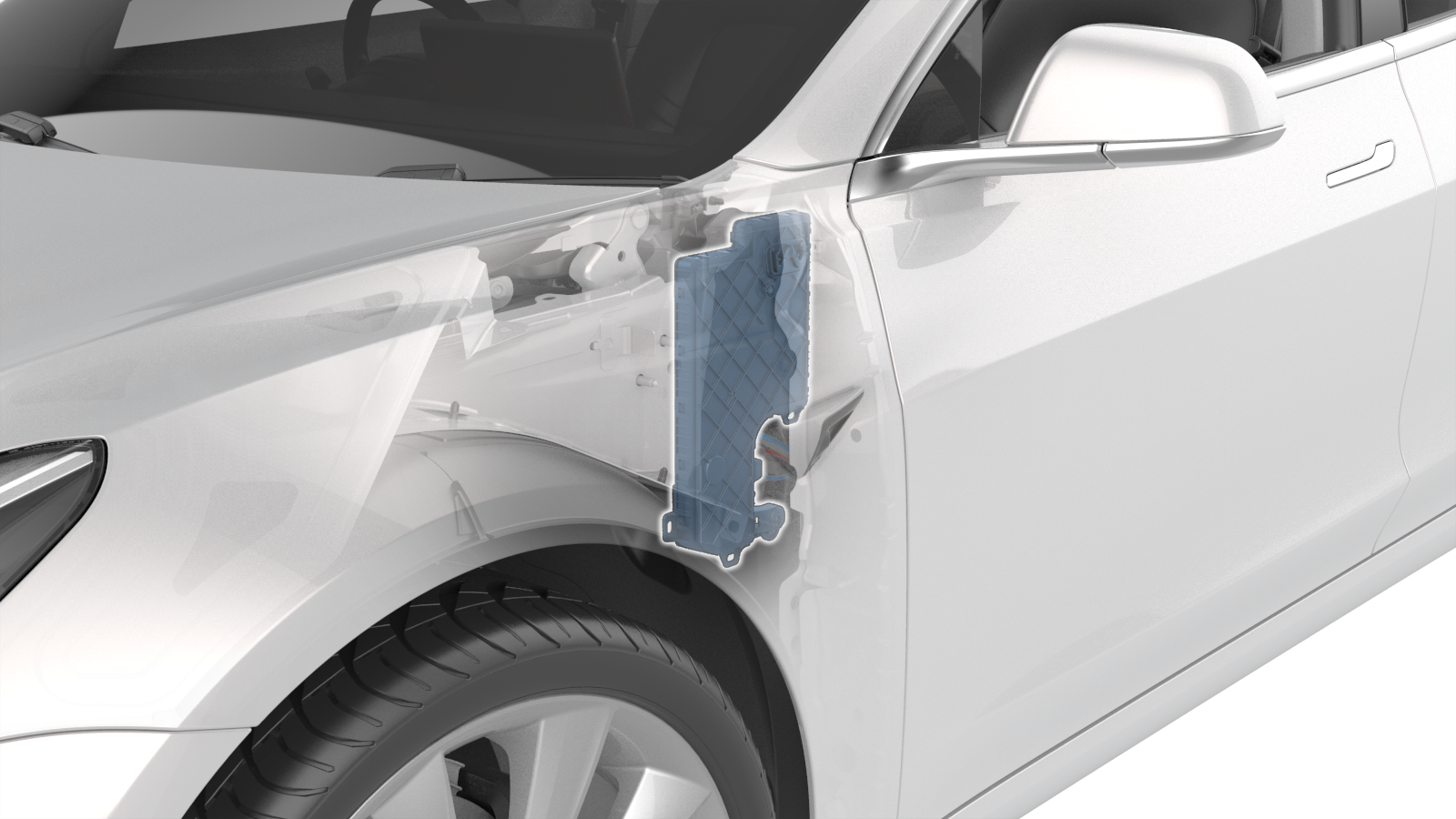 |
|---|
| Vehicle Control Left (VCLEFT) Location |
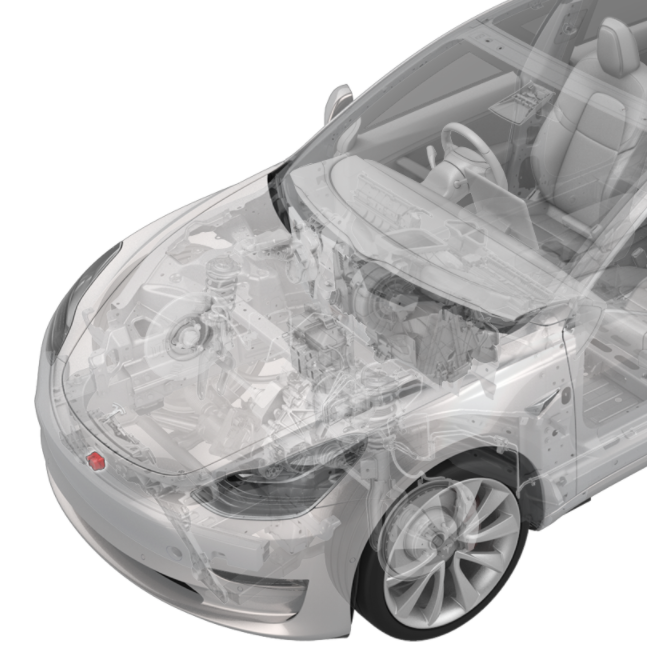 |
|---|
| Battery Backup Siren (BBUS) location |
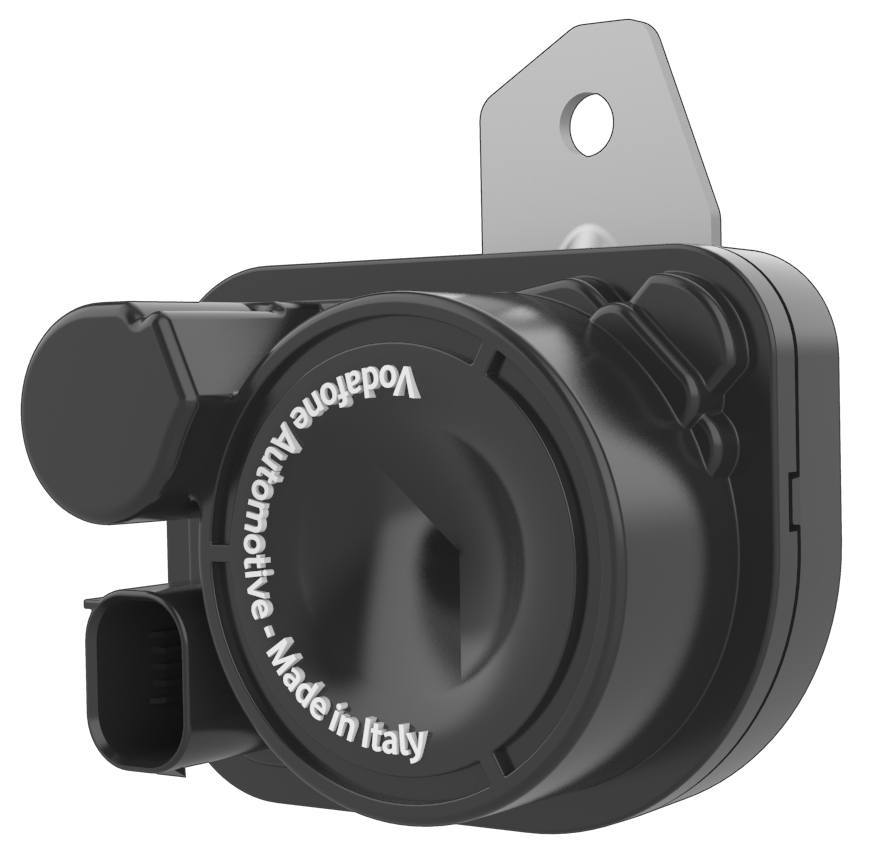 |
|---|
| Battery Backup Siren (BBUS) |
Alarm Operationlink
All Marketslink
The Security Vehicle Controller (VCSEC) continuously monitors the status of all latches (front/rear doors and front/rear trunks). When any of the latches are opened while the vehicle is supposed to be locked, the alarm is triggered. While activated, the horn sounds once every second and the turn signals will flash.
EU vehicles onlylink
Vehicles sold in Europe are equipped with additional components:
- Tilt/Intrusion sensors
- Battery Backup Siren (BBUS) (only for vehicles built without Li-Ion battery)
The Tilt/Intrusion sensors are located inside the Rear Overhead Consol (ROHC). When the alarm is active, the siren will sound instead of the horn and turn signals will flash.
For vehicles equipped with a BBUS, if the alarm system is enabled and 12V power/communication to the BBUS get disconnected, the siren turns on (sound only).
Tips
If the alarm is triggered for the above reason, headlamps and turn signals will not flash. The left vehicle controller (VCLEFT) will also not report this as an alarm trigger and so no alarm trigger event will be recorded on the vehicle CAN buses.
APAC vehicles onlylink
Starting from Nov 2022, Superhorn PWS speaker is introduced to integrate the functionalities of a trumpet horn, a pedestrian warning speaker (PWS), and a security alarm (siren) into one single component that saves weight and reduces the complexity of assembly.
For more information, see the Pedestrian Warning System section of the Safety and Restraints Theory of Operation.
Intrusion Detection Operation (EU Vehicles)link
Model 3 vehicles sold in Europe are equipped with Tilt/Intrusion sensors that are located inside the rear overhead console. VCLEFT acts as a master on the ROHC, which is controlled via a LIN bus. ROHC power, ground and LIN pass through the Front Overhead Console (FOHC) and come from VCLEFT. The ROHC also has a private LIN connection passing through VCLEFT to the BBUS.
The intrusion detection is based on the Doppler effect. One sensor generates sound waves (emitter sensor) that are inaudible to the human ear (ultrasonic frequency). A second sensor monitors the sound in the vehicle (receiver sensor) and transmits the recorded sound waves to an ECU which compares the frequency of emitted and received sound waves to determine if there was any movement in the vehicle.
If there is no movement, the emitted and received signals have the same frequency. Otherwise, the emitted and received frequencies will be different because of the Doppler effect: if the wave reflects on a moving object, its frequency will be modified. Hence any motion inside the vehicle will cause the ECU to detect a frequency shift.
If any motion inside the vehicle is detected, it causes the ROHC to send an alarm message to the VCLEFT over a LIN bus (Pin ROHC X288-6). VCLEFT will then communicate to VCSEC to trigger the alarm.
For vehicles that are equipped with a BBUS, ROHC also sends an alarm message to the BBUS over the private LIN (Pin ROHC X288-5) to make the siren sound.
Tilt Detection (EU Vehicles)link
Model 3 vehicles sold in Europe are equipped with a tilt detection sensor that is located inside the ROHC.
The tilt sensor is an Inertial Measurement Unit (IMU) that monitors the vehicle movement and inclination. If the vehicle is tilted (e.g for steeling a wheel) or towed, the IMU would measure an acceleration and trigger the alarm. The behavior and triggering of the alarm is the same as for the intrusion detection.
Battery Back-Up Siren (BBUS) (EU Vehicles Without Li-Ion Battery)link
Model 3 vehicles sold in Europe are equipped with a Battery Backup Siren (BBUS) required by local regulation. This component is supplied with power by the Front Vehicle Controller (VCFRONT) but can also supply itself with a built-in battery if needed.
The siren is triggered by the ROHC intrusion sensors over LIN, and will sounds until requested to stop. While the alarm is armed, if the communication between the ROHC and the BBUS is cut or if the BBUS power from VCFRONT is removed, the siren will sound.
Wiring and Communicationlink
Alarm systemlink
VCSEC is the master control unit of the alarm, it requests door and front/rear trunk statuses (via latch position) from VCLEFT (left side doors and rear trunk), VCRIGHT (right side doors) and VCFRONT (front trunk). If any latch signals report that a closure is open while the alarm is armed, VCSEC sends an alarm message to VCFRONT to sound the horn and flash the turn signals.
For EU vehicles, role of the VCSEC is identical except that it only sends an alarm message to VCFRONT to flash the turn signals. Instead of activating the horn, VCSEC will send an alarm message to VCLEFT that will flag the ROHC through LIN. The ROHC will then activate the siren (BBUS) through a dedicated private LIN channel.
Intrusion sensors system - ROHC (EU Vehicles Only)link
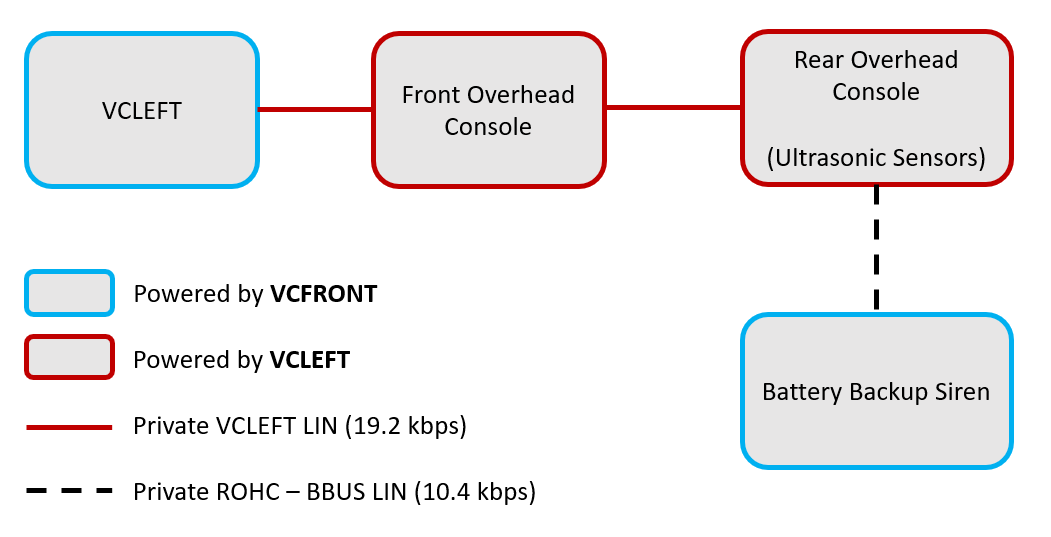 |
|---|
| Intrusion sensors and siren wiring architecture |
For EU vehicles, the ROHC shares the power and the ground with the FOHC, which is supplied by VCLEFT. It communicates with VCLEFT via a LIN channel shared with FOHC and with the BBUS via a private LIN passing through VCLEFT.
For EU vehicles, the BBUS is powered by VCFRONT and is connected to the Chassis ground. It communicates only with the ROHC via a private LIN passing through VCLEFT.
PIN MAP for the ROHC:
| No. | Description | Type |
|---|---|---|
| 1 | Ground | Ground |
| 2 | Rear Map lamp switch output | Analog Out |
| 3 | Rear map lamp Left PWM input | PWM In |
| 4 | Rear map lamp Left PWM input | PWM In |
| 5 | Private LIN to BBUS | Out |
| 6 | LIN from FOHC | In |
| 7 | Not connected | n/a |
| 8 | Power Always | 12 VDC |
Behaviorslink
Alarm Stateslink
The alarm state can be determined from the signal
VCSEC_alarmStatus routed on the VEH CAN bus. The signal value is determined
by VCSEC according to the table below.
| Signal value | Description |
|---|---|
15 ALARM_STATUS_SNA |
When VEH Can bus is asleep. |
7 ALARM_STATUS_DEFAULT |
|
6 ALARM_STATUS_IMMINENT |
If the alarm is armed and triggered, it will wait 1 second in this status to receive an authentication request. If none is received within the time window, the alarm status will change to ALARM_STATUS_TRIGGERED_FLASH_ACTIVE. |
5 ALARM_STATUS_TRIGGERED_FLASH_INACTIVE |
The alarm will wait 60 seconds in this state before entering ALARM_TRIGGERED_FLASH_ACTIVE again. If an unlock request is received while in this state, the alarm goes to ALARM_STATUS_DISARMEDEvery time the alarm enters this state due to an Ultrasonic or Tilt trigger, the alarm trigger count is increased. If it reaches 10, the alarm will stays in this state until an authentication is received by the vehicle. This counter is reset when the vehicle is unlocked. |
4 ALARM_STATUS_ERROR |
|
3 ALARM_STATUS_TRIGGERED_FLASH_ACTIVE |
The alarm is active, horn/siren (depending on the market region) sounding and turn signals flashing. If the alarm remains active for 30 seconds, its status will change to ALARM_TRIGGERED_FLASH_INACTIVE. |
2 ALARM_STATUS_PARTIAL_ARMED |
The vehicle is locked and the alarm initializes. After 1 minute the alarm status will change to ALARM_STATUS_ARMED. |
1 ALARM_STATUS_ARMED |
The alarm is enabled and monitoring the vehicle environment. |
0 ALARM_STATUS_DISARMED |
The alarm is disabled. Either the vehicle is unlocked or the alarm functionality is disabled by the user. |
Trunk Openinglink
With the vehicle locked and the alarm armed, opening the rear trunk using the mobile app or by double-clicking the rear of the key fob temporarily disarms the alarm and causes the vehicle locking status to transition to selective unlock.
After the trunk is closed, the vehicle locks again and the alarm changes to partially-armed before entering the armed status after 60 seconds (refer to the Alarm States section above for state details).
Opening the front trunk via the mobile app or the key fob does not change the alarm status nor the vehicle locking status. The reason for this is that the front trunk is not part of the vehicle cabin.
Diagnosticslink
Alarm systemlink
There are different signals used by VCSEC to control the alarm behavior. The following tables present the signals received by VCSEC from the different ECUs involved in the alarm system. They can be used to determine alarm trigger reason and status.
VCSEClink
Signals for the current state of the vehicle alarm and lock status.
| Signal | Description | Values |
|---|---|---|
VCSEC_alarmStatus |
Status of the alarm system | 15 ALARM_STATUS_SNA 7 ALARM_STATUS_DEFAULT 6 ALARM_STATUS_IMMINENT 5 ALARM_STATUS_TRIGGERED_FLASH_INACTIVE 4 ALARM_STATUS_ERROR 3 ALARM_STATUS_TRIGGERED_FLASH_ACTIVE 2 ALARM_STATUS_PARTIAL_ARMED 1 ALARM_STATUS_ARMED 0 ALARM_STATUS_DISARMED |
VCSEC_vehicleLockStatus |
Lock status of the vehicle | 15 LOCK_STATUS_PASSIVE_INTERNAL_LOCKED14 LOCK_STATUS_PASSIVE_INTERNAL_UNLOCKED13 LOCK_STATUS_CRASH_UNLOCKED 12 LOCK_STATUS_ACTIVE_REMOTE_LOCKED11 LOCK_STATUS_ACTIVE_REMOTE_UNLOCKED 10 LOCK_STATUS_ACTIVE_UI_LOCKED 9 LOCK_STATUS_ACTIVE_UI_UNLOCKED 8 LOCK_STATUS_ACTIVE_BLE_LOCKED 7 LOCK_STATUS_ACTIVE_BLE_UNLOCKED 6 LOCK_STATUS_ACTIVE_SELECTIVE_UNLOCKED 5 LOCK_STATUS_PASSIVE_BLE_LOCKED4 LOCK_STATUS_PASSIVE_BLE_UNLOCKED 3 LOCK_STATUS_PASSIVE_SELECTIVE_UNLOCKED2 LOCK_STATUS_ACTIVE_NFC_LOCKED 1 LOCK_STATUS_ACTIVE_NFC_UNLOCKED0 LOCK_STATUS_SNA |
VCLEFTlink
Signals report the status of left side door handles, interior release buttons, and latches.
| Signal | Description | Values |
|---|---|---|
VCLEFT_frontLatchStatus |
Status of the front door latch | 8 LATCH_FAULT 7 LATCH_DEFAULT 6 LATCH_TIMEOUT 5 LATCH_AJAR 4 LATCH_OPENING 3 LATCH_CLOSING 2 LATCH_CLOSED 1 LATCH_OPENED 0 LATCH_SNA |
VCLEFT_rearLatchStatus |
Status of the rear left door latch | 8 LATCH_FAULT 7 LATCH_DEFAULT 6 LATCH_TIMEOUT 5 LATCH_AJAR 4 LATCH_OPENING 3 LATCH_CLOSING 2 LATCH_CLOSED 1 LATCH_OPENED 0 LATCH_SNA |
VCRIGHTlink
Has the same signals as for VCLEFT but for the right side doors plus two additional signals for the rear trunk:
| Signal | Description | Values |
|---|---|---|
VCRIGHT_trunkExtReleasePressed |
Status of the exterior trunk release button | 1 = pressed 0 = not pressed |
VCRIGHT_trunkLatchStatus |
Status of the rear trunk latch | 8 LATCH_FAULT 7 LATCH_DEFAULT 6 LATCH_TIMEOUT 5 LATCH_AJAR 4 LATCH_OPENING 3 LATCH_CLOSING 2 LATCH_CLOSED 1 LATCH_OPENED 0 LATCH_SNA |
VCRIGHT_frontLatchStatus |
Status of the front right door latch | 8 LATCH_FAULT 7 LATCH_DEFAULT 6 LATCH_TIMEOUT 5 LATCH_AJAR 4 LATCH_OPENING 3 LATCH_CLOSING 2 LATCH_CLOSED 1 LATCH_OPENED 0 LATCH_SNA |
VCRIGHT_rearLatchStatus |
Status of the rear right door latch | 8 LATCH_FAULT 7 LATCH_DEFAULT 6 LATCH_TIMEOUT 5 LATCH_AJAR 4 LATCH_OPENING 3 LATCH_CLOSING 2 LATCH_CLOSED 1 LATCH_OPENED 0 LATCH_SNA |
VCFRONTlink
Signal report status of the front trunk (frunk).
| Signal | Description | Values |
|---|---|---|
VCFRONT_frunkLatchStatus |
Status of the front trunk latch | 8 LATCH_FAULT 7 LATCH_DEFAULT 6 LATCH_TIMEOUT 5 LATCH_AJAR 4 LATCH_OPENING 3 LATCH_CLOSING 2 LATCH_CLOSED 1 LATCH_OPENED 0 LATCH_SNA |
Alertlink
Whenever an alarm is triggered, VCSEC_a133_alarmTriggered is logged which has a payload of the alarm trigger reason.
The different trigger reasons are:
| Alarm trigger reason | Description |
|---|---|
FRONT_DRIVER_DOOR |
Front driver door was unlatched |
FRONT_PASSENGER_DOOR |
Front passenger door was unlatched |
REAR_DRIVER_DOOR |
Rear driver door was unlatched |
REAR_PASSENGER_DOOR |
Rear passenger door was unlatched |
FRONT_TRUNK |
Front trunk was unlatched |
REAR_TRUNK |
Rear trunk was unlatched |
ULTRASONIC |
Ultrasonic sensor was triggered |
TILT_SENSOR |
Tilt sensor was triggered |
Intrusion sensors and siren signalslink
There are different signals reporting VCLEFT messages control intrusion sensors and BBUS. They can be used for monitoring the state of the intrusion sensors and advanced diagnosis. These CAN messages are routed through the VEH CAN bus.
VCLEFTlink
| Signal | Description | Values |
|---|---|---|
VCLEFT_DBG_Siren_ST_Status |
Self test result of the Siren. | 1 = passed 0 = failed |
VCLEFT_DBG_Siren_is_sounding |
Battery Back Up Siren activation status. | 1 = sounding (activated) 0 = silent (deactivated) |
Alertlink
There are several alerts related to the Intrusion sensors system. Front Overhead Console (FOHC) alerts are also relevant, given that the LIN communication and power/ground of the Intrusion sensors go through it.
| Signal | Description | Set Condition | Clear Condition | Potential Impact | Payload |
|---|---|---|---|---|---|
VCLEFT_a308_sirenMIA |
The siren is detected as missing while the alarm is armed | The Siren self test reports that the siren is KO for some time (self test reports failed) | The siren self test pass with success | Siren is not working/installed and will not sound if an alarm is triggered. Note the horn will sound instead. | tamperDetected |
VCLEFT_a332_intrusionSensorMIA |
The intrusion sensor is not communicating over LIN | The communication between ROHC and VCLEFT can't be established | Rear Overhead Console is responding over LIN | ROHC may not be functional | none |
VCLEFT_a333_overheadConsoleMIA |
The Front Overhead Console is not communicating over LIN | The communication between FOHC and VCLEFT can't be established | Front Overhead Console is responding over LIN | FOHC may not be functional | none |
VCLEFT_a334_overheadConsoleInternalFault |
The Front Overhead Console has detected an internal fault | The FOHC is responding over LIN but has reported an internal fault | The FOHC fault is cleared | Overhead console may not operate as intended | none |
VCLEFT_a335_intrusionSensorInternalFault |
The intrusion sensor has detected an internal fault, detailed in the payload(Refer to corresponding signal description in previous section) | The intrusion sensor is responding over LIN but has reported an internal fault | The intrusion sensor fault is cleared | Intrusion sensor may not operate as intended | USSSelfTestResult EEPROMSelfTestResult LMSelfTestResult SystemError SelfTestStatus |