Rear Trunklink
Last updated: October 20, 2023
Trunk Latchlink
Specificationslink
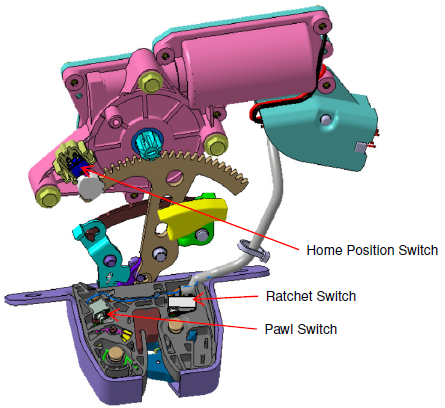
The trunk latch is a 2 position cinching latch on the underside of the trunk, with the striker on the body of vehicle. The striker can be adjusted for trunk to body alignment. The latch has a mechanical switch that will determine if the claw is in the fully closed/latched position. A mechanical release lever rotates the pawl and disengages it from the claw to allow the latch to open. The latch also allows electrical actuation with a single DC motor that drives a worm gear to rotate the same lever as the mechanical release. The DC motor and switch line are controlled by the right body controller.
Note
The trunk cannot be opened when the vehicle is moving. If an attempt is made to open the trunk, a warning message appears on the display.
 |
|---|
| Trunk Latch |
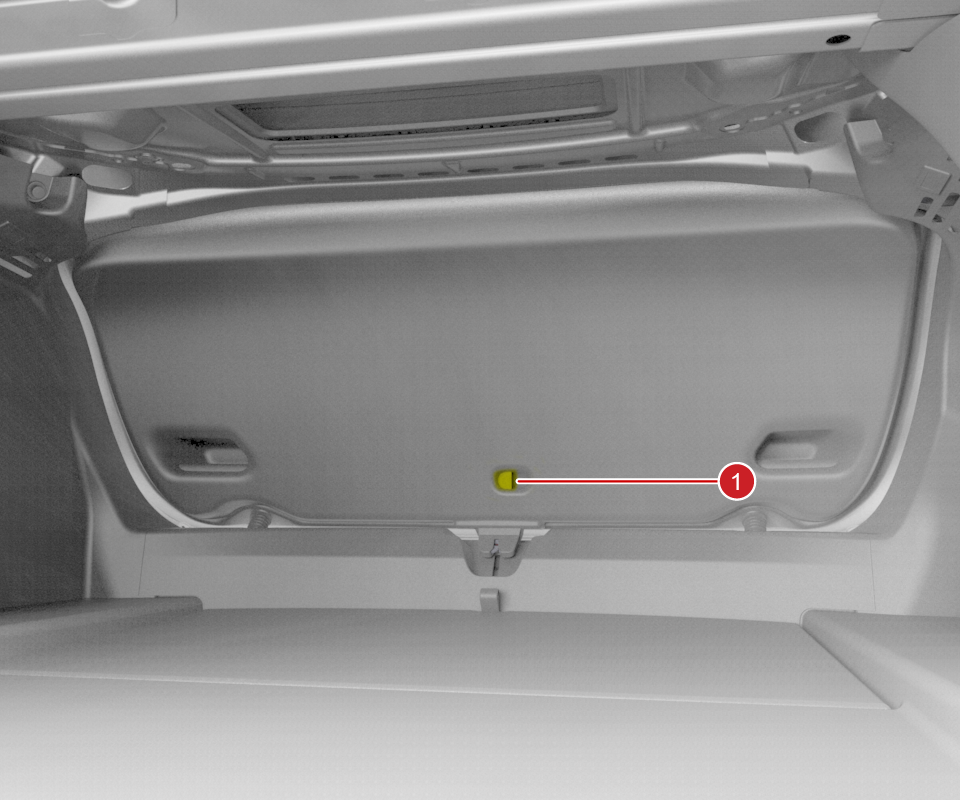
The phosphorescent emergency mechanical release lever for the trunk is visible in the recessed extrusion in the center of the trunk hard trim.
 |
|---|
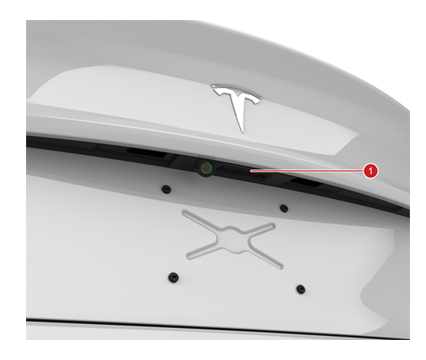
| 1. Electrical Release Switch |
| Electrical Release Switch |
 |
|---|
| 1. Trunk mechanical release lever |
| Mechanical Release |
Operationlink
The rear trunk latch integrates a motor to enable the automatic operation of the liftgate. This motor can spin in both directions to cinch or release.
There is one switch detecting the home position of the motor and its status is classified as followed:
| Latch Motor | Home Switch |
|---|---|
| "Home" Position | Not Pressed |
| "Unhomed" Position | Pressed |
There are two switches detecting the position of the latch and their status are classified as followed:
| Trunk Latch | Pawl Switch | Ratchet/Claw Switch |
|---|---|---|
| Primary Position (Closed) | Not Pressed | Not Pressed |
| Secondary Position (AJAR) | Not Pressed | Pressed |
| Open Position | Pressed | Pressed |
| Open Position | Pressed | Not Pressed |
If a release request is received by the right controller:
- The latch motor actuates and spins in the release direction, performing a release actuation, for a maximum of 6 seconds.
- The release actuation stops when the ratchet and pawl switches are pressed for 20ms, classifying the latch as opened, or if the motor stalls for 100ms.
- The latch waits 500ms.
- The latch motor actuates and spins in the cinching direction, performing a reset actuation, for a maximum of 3 seconds.
- The reset actuation stops when the home switch is not pressed, classifying the latch motor at the home position, or if the motor stalls for 100ms.
With the liftgate is open, the right controller cinches close the latch if the pawl switch is not pressed, indicating that the liftgate is being closed as the secondary position is engaged.
- The latch motor actuates and spins in the cinching direction, performing a cinching actuation, for a maximum of 6 seconds.
- The release actuation stops when the ratchet and pawl switches are not pressed for 50ms, classifying the latch as closed, or if the motor stalls for 100ms.
- The latch motor actuates and spins in the release direction, performing a reset actuation, for a maximum of 3 seconds.
- The reset actuation stops when the home switch is not pressed, classifying the latch motor at the home position, or if the motor stalls for 100ms
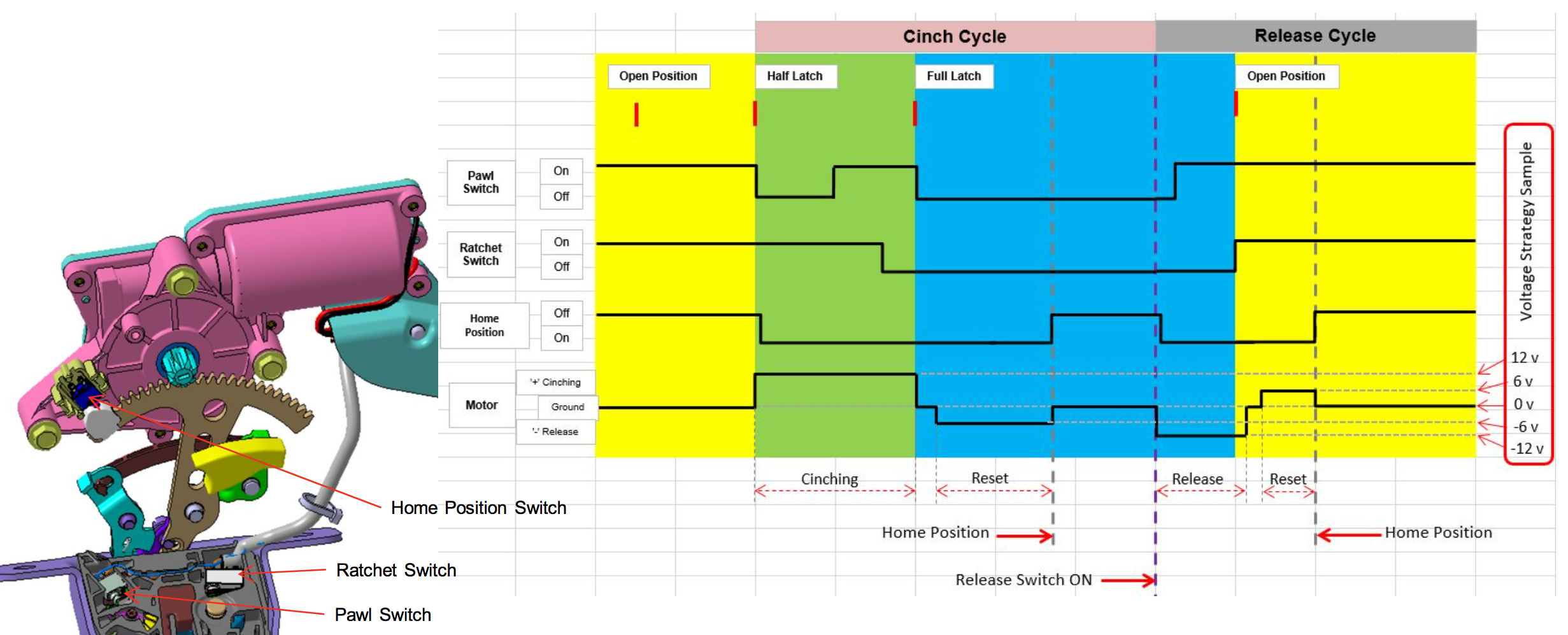
The below diagram describes the different switches as well as the motor states during a cinching actuation:
 |
|---|
| Switch Logic Diagram |
Serviceabilitylink
The rear trunk latch status is reported by VCRIGHT signal VCRIGHT_trunkLatchStatus and can be monitored to diagnose rear trunk latch related issue. The latch status is mainly determined by the value of the latch switch(es) but also rely on different conditions to detect potential malfunction in the system operation.
VCRIGHT_trunkLatchStatus |
Description |
|---|---|
8 LATCH_FAULT |
The trunk latch detected a stalling condition or timed out from its previous state. |
7 LATCH_DEFAULT |
Default trunk latch status when initializing the latch state machine. |
6 LATCH_TIMEOUT |
|
5 LATCH_AJAR |
The trunk latch is in AJAR position (primary unlatched but not secondary). |
4 LATCH_OPENING |
The trunk latch is performing a release actuation. |
3 LATCH_CLOSING |
The trunk latch is performing a cinching actuation. |
2 LATCH_CLOSED |
The trunk latch is closed. |
1 LATCH_OPENED |
The trunk latch is opened. |
0 LATCH_SNA |
Dual Power Strutslink
Specificationslink
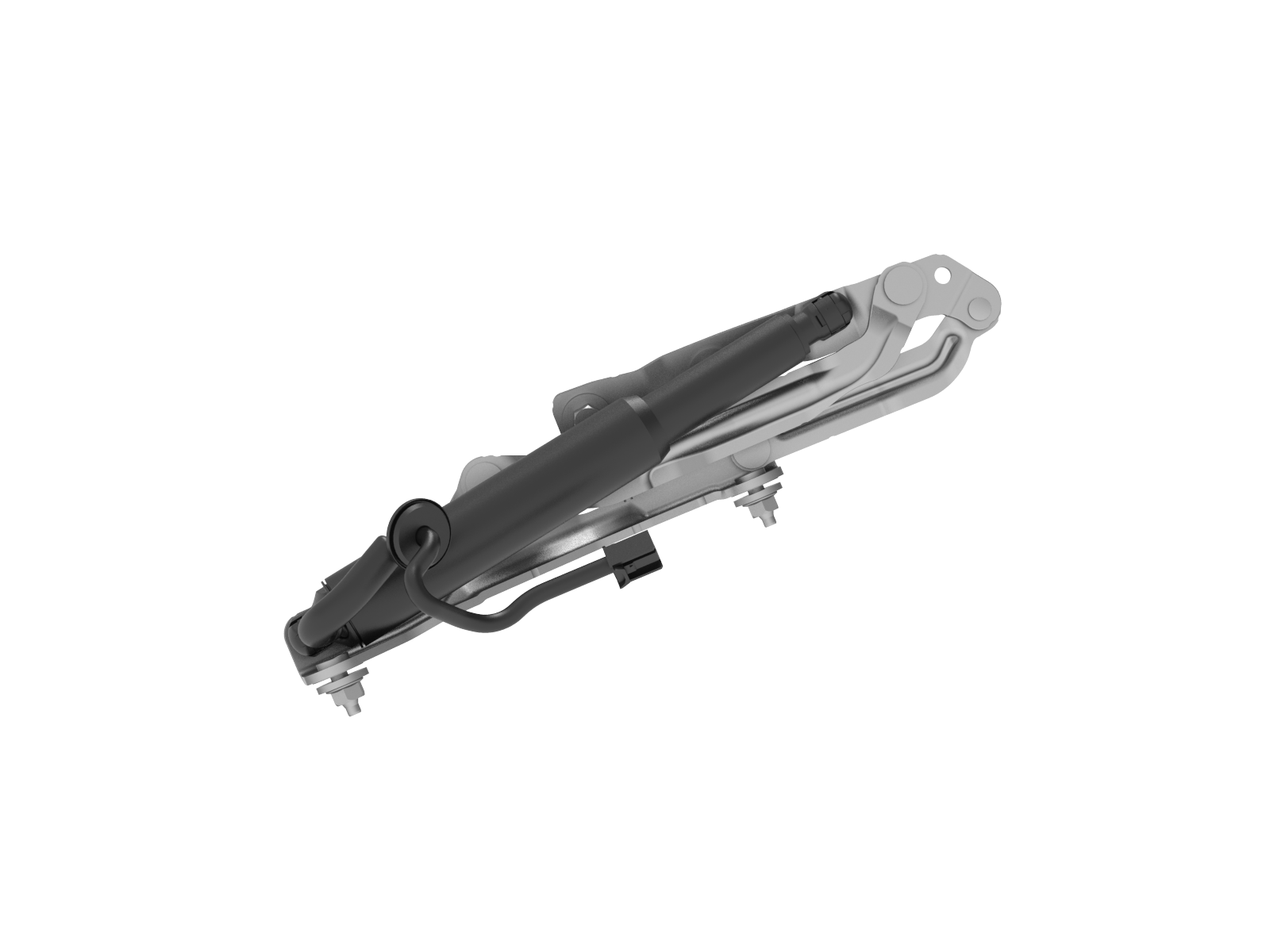
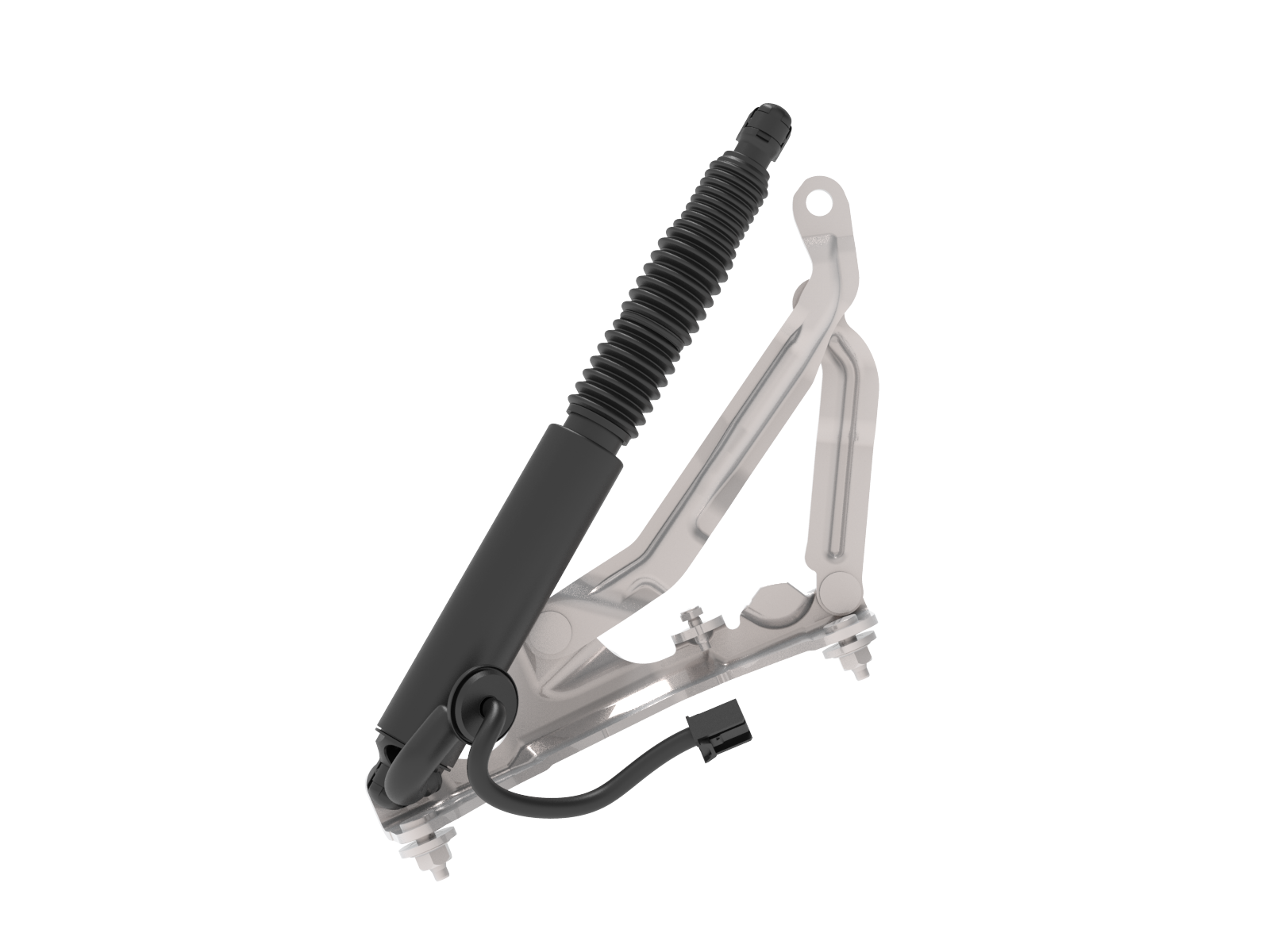
Dual power struts raise the liftgate. The left and right power struts are controlled by the left vehicle controller (VCLEFT) and the right vehicle controller (VCRIGHT). Each controller contains two hall sensors to track the position of the liftgate. The dual power struts provide equal force at the left and right side to hold the lift gate and make open process smoother.
The dual power strut diameter is reduced and spring is removed to avoid power strut interface with the lift gate seal.
 |
 |
|---|---|
| Power Strut Closed Position | Power Strut Open Position |
Operationlink
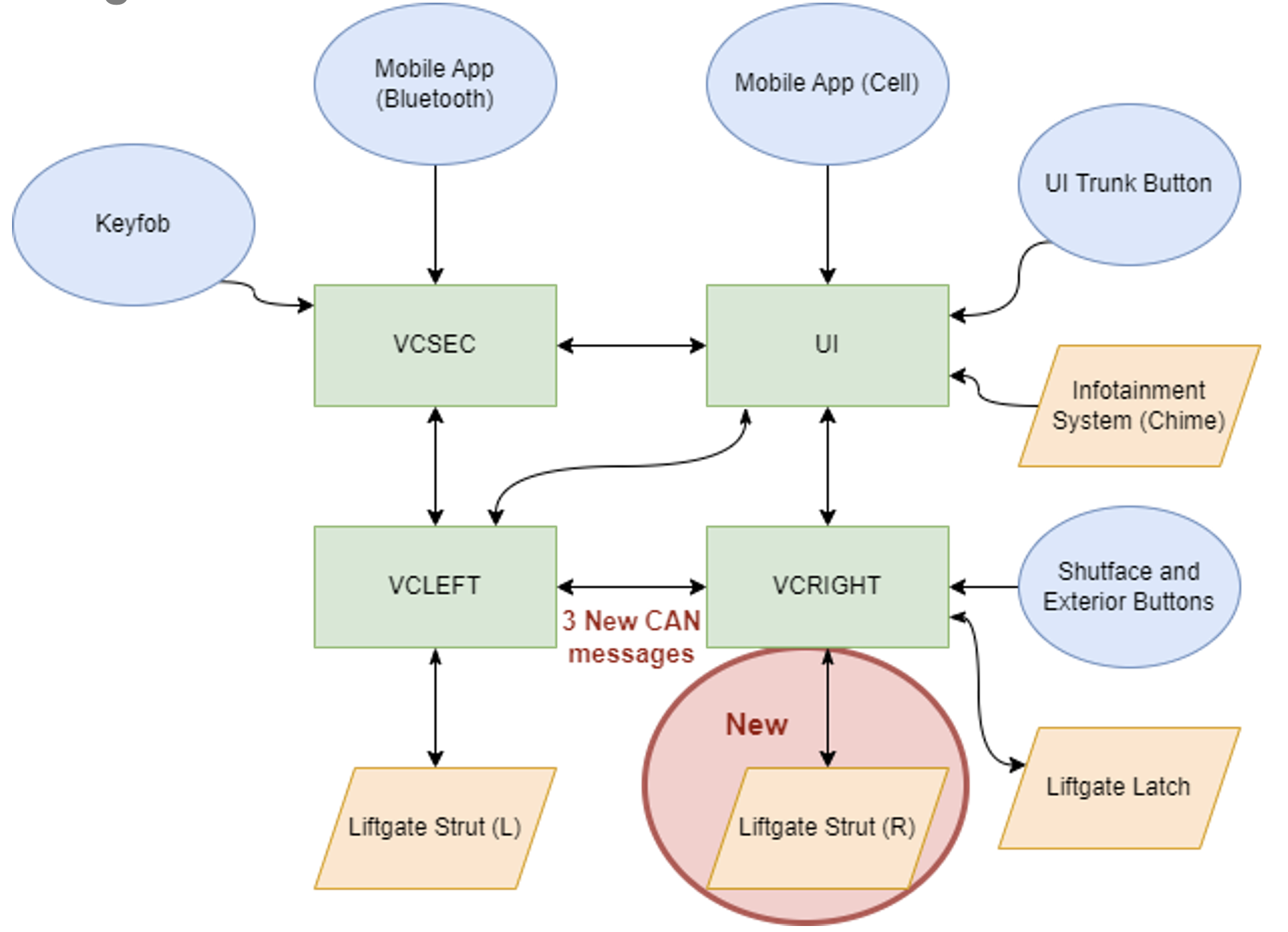
Because the left and right power struts are controlled by VCLEFT and VCRIGHT separately, exact synchronization of two power struts is not possible. To mitigate this, VCLEFT messages are selected as leader messages and VCRIGHT messages are follower messages. This means that VCRIGHT copies the commands from VCLEFT to control the right power strut. During operation, VCLEFT decides motion profiles but must react quickly to strut signals generated by VCRIGHT.
To make these two power struts cooperate smoothly, the obstacle detection of the left and right power struts is same. Different work modes for each power strut are assigned to them, including:
- Brake mode
- Normal mode
- Coast mode
- Dynamic braking mode.
The leader can determine whether to switch the mode and tell the follower to brake or coast. The follower can send dynamic braking request.
The synchronization (angle difference) between left and right power strut is reported on controller area network (CAN). The follower response message and leader request message operate at 2Hz and burst on change. Expect no more than 5-10 bursts per liftgate cycle.
The performance of this power strut is sensitive to temperature. To avoid an overheat event to power strut and in-operation of power trunk, a thermal limit for the power liftgate actuators is implied. Initial condition to trigger and exit over temperature status is when strut temperature is ≥ 80º C and ≤ 60º C. Over temperature status will not pause liftgate actuation.
Following is control diagram of dual power struts.
 |
|---|
| Rear Trunk Operation Diagram |
User Interactionslink
Opening and Closing the Rear Trunklink
The trunk can only be opened or closed when the vehicle is stationary. There are 4 methods of operating the trunk:
- Press the trunk release button on the mobile application.
- The mobile application transmits a trunk open request via Bluetooth Low Energy (BLE) to the security controller (VCSEC), and it passes the trunk open command to VCLEFT, which sends a command to VCRIGHT to release that latch as part of the opening action.
- From the touchscreen, touch Control > Trunk.
- The UI would send trunk request message on the vehicle controller area network (CAN), and VCLEFT or VCRIGHT would command power struts and latch to execute the desired action.
- With the vehicle unlocked, press the exterior release button.
- The exterior release switch is a simple momentary contact switch and is a direct input to VCRIGHT. Pressing the switch completes a path to ground.
- Pull the mechanical release lever located in a recess on the hard trim on the underside of the trunk.
- This is an mechanical release and the egress method from inside the enclosed trunk area
Trunk Releaselink
The trunk has a release actuator to mechanically pull to the pawl holding the trunk claw away, which allows the claw to rotate freely to the open position. When the pawl is released, the spring holds the pawl and claw open. Pushing the striker into the claw again forces the components apart as the claw rotates around the striker. Once the latch enters the closed position the pawl will fall into the indent on the claw, latching the assembly in the closed position. In the closed position the claw presses on the latch switch bus pulling it away from the ground stud, opening the circuit. When the latch is in the open position the switch bar is allowed to connect to ground, closing the latch status circuit.
Trunk Cinchlink
When trunk is moving down to close, the striker on vehicle body contacts claw firstly and pull it into half latch status, with pawl switch and ratchet switch change. After VCRIGHT detects pawl switch changes to off position, it will command motor to rotate and cinch trunk latch. Trunk is fully closed here.
Adjusting the Opening Heightlink
The liftgate opening height is adjustable and can be set by following these three steps:
- Open the liftgate, and then manually lower the trunk to the desired opening height that is between 30-82 degrees.
- Press and hold the liftgate shutface close button for 3 seconds until a confirmation chime is heard.
- Confirm the liftgate is set it to the desired height by closing the liftgate and then reopening it.