Electronic Toll Controllerlink
Last updated: January 25, 2024
Overviewlink
The Electric Toll Collection initiative in China is a government-led effort to implement a system that enables toll payment through electronic means by equipping an Electronic Toll Controller to vehicles sold in China.
Note
The Electronic Toll Controller (ETC) is only available on or can be added to vehicles that are sold in China.
The ETC is an electronic on-board equipment that has bi-directional communication with Roadside Equipments (RSU). Electronic toll collector is a wireless system that uses information and communication technology to automatically collect the usage fee or toll charged to the vehicle without requiring any action or stopping by the driver.
On the vehicle side, electronic toll collector is installed inside of the front instrument panel (IP). ETC is powered by left vehicle controller (VCLEFT) and communicates with VCLEFT via Controller Area Network (CAN) over the On-board Diagnostics (OBD) CAN bus. Electronic toll collector is also able to communicate with a user's device (3rd party mobile phone) by connecting to the Bluetooth on the device.
Specificationslink
PCB Layoutlink
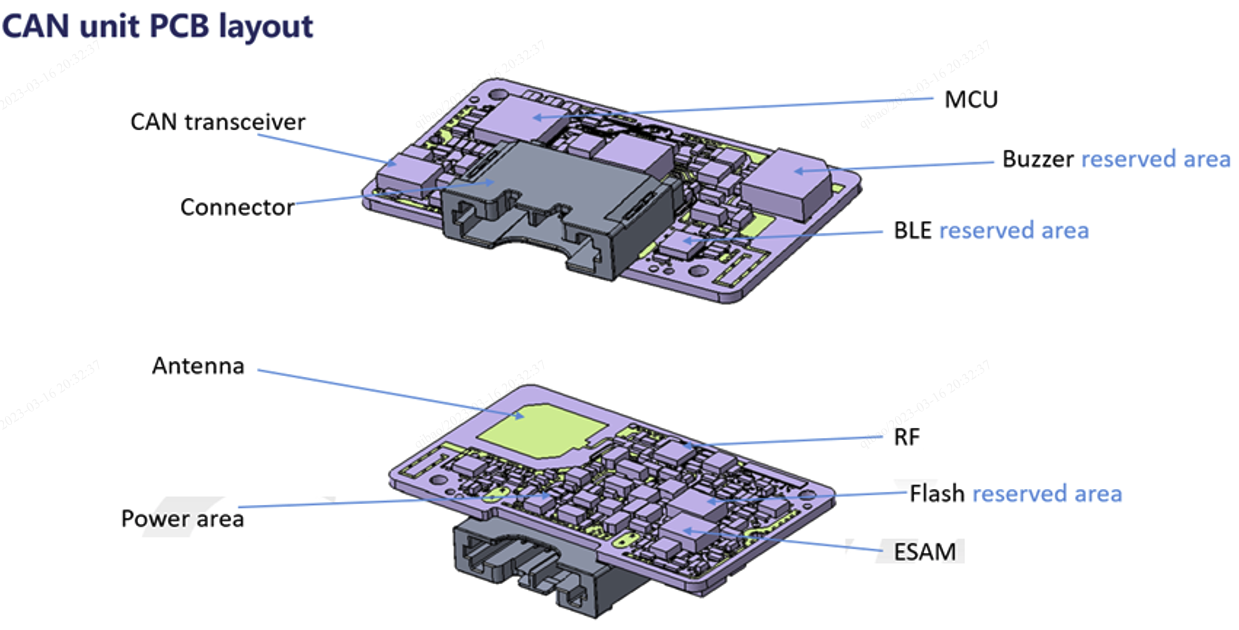
The electronic toll collector unit consists of a CAN transceiver, a microcontroller, a main connector, as well as modules of BLE (Bluetooth Low Energy), Buzzer, Antenna, Power Area, Embedded Secure Access Module (ESAM), Flash, and Radio Frequency (RF).
 |
|---|
| Electronic Toll Collector PCB Layout |
Power, Ground, and Communicationlink
The electronic toll collector unit is mounted in IP and is directly powered by VCLEFT. VCLEFT will turn on the high side drive after the power state is ACCESSORY.
Electronic toll collector communicates with VCLEFT via CAN protocol over the On-board Diagnostics (OBD) CAN bus. Different from other backbone vehicle CAN networks, the OBD CAN is a private CAN bus that is connected to the VCLEFT controller only. The purpose is to provide a CAN interface to external parties and auxiliary equipments such as electronic toll collectors and taxi meters.
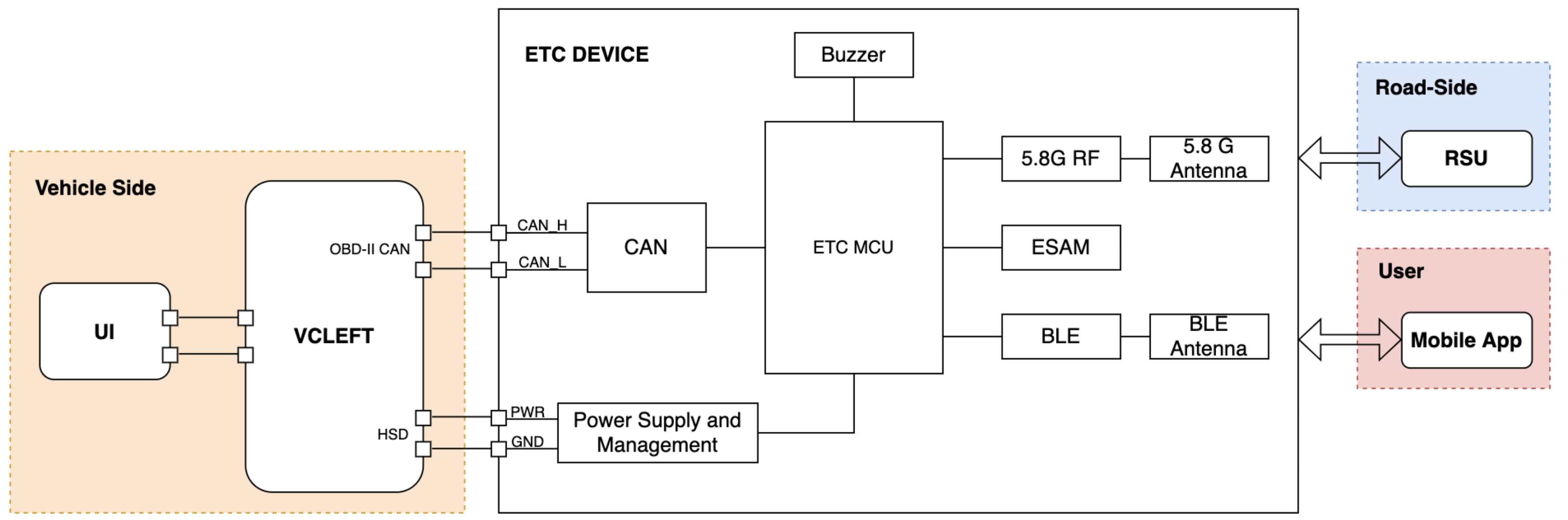
The following diagram illustrates how electronic toll collector interacts with vehicle side, road side, and user side:
- Vehicle side
- Electronic toll collector communicates with the left vehicle controller on OBD CAN and gets powered on directly from left vehicle controller high side drive for power supply and management. The left vehicle controller then communicates with the car computer user interface (UI) to display ETC information on the center display.
- Road side
- Electronic toll collector communicates with road side units (RSU) via 5.8G antenna.
- User side
- Electronic toll collector communicates with user's mobile phone via Bluetooth Low Energy (BLE).
 |
|---|
| Electronic Toll Collector Block Diagram |
Featureslink
The following table summarizes key features of electronic toll collector:
| Feature | Description |
|---|---|
| Activation/De-activation | Users can activate and de-activate the ETC by establising connection of the mobile phone to the ETC bluetooth. The activation/de-activation process can be done via mobile phone. |
| Anti-takeoff | Anti-takeoff is VIN-based bi-directional authentication for ETC and vehicle controller that is communicated over CAN bus. |
| Diagnostics | Diagnostics over CAN (UDS) |
| Human-Machine Interaction | Reminds users by the sound from ETC bell buzzer. On the touchscreen, customer-facing alerts and a toggle button for ECT bluetooth functionality (used for device activation and deactivation) are displayed. |
| Information Exchange (if needed) | CAN messages can be customized if needed. ETC sends the transaction and road side information to vehicle. |
| OTA | ETC has bootloader that is capable of software update Over The Air (OTA). |
| Power shutdown data protection | ETC can save the data when the device is powered off. |
| Query | Users can query the ETC status and transaction history via mobile phone with bluetooth connection. |
| Self test | ETC is able to perform self test during initialization and the test result will be reported to the vehicle if there is any failure. |
| Transaction | Relevant regulatory requirements, such as No.13 announcement from the Ministry of Transport and GB/T 20851 transaction functions with RSU, are met. |
Self Test Electronic toll collector is able to test and ensure the Embedded Secure Access Module (ESAM), Bluetooth Low Energy endpoint module, and VIN-based authentication functions are working properly after powered on. Electronic toll collector sends the self test result to VCLEFT over OBD CAN.
Electrical Anti-Takeoff Electronic toll collector features Anti-Takeoff. ETC Anti-Takeoff is a VIN-based bi-directional authentication for the ETC and vehicle controller via CAN bus. See the following steps for details:
- VCLEFT writes VIN to electronic toll collector via CAN on the production line.
- Electronic toll collector generates a random number for authentication.
- Electronic toll collector sends the random number to VCLEFT via CAN.
- VCLEFT encrypts the random number by the agreed encryption algorithm.
- VCLEFT sends the encrypted data to electronic toll collector via CAN.
- VCLFET decrypts the random number by the agreed decryption algorithm.
- Electronic toll collector compares the decrypted data with the random number generated in step 2.
- If the comparison results are consistent, electronic toll collector considers that the authentication has passed. If the results are inconsistent, the ETC will re-authenticate within an interval of 100ms. If the authentication fails 3 times continuously, electronic toll collector considers that the authentication has failed.
- VCLEFT reports anti-takeoff check failure on the touchscreen.
Bluetooth and Activation/De-activation Bluetooth endpoint on electronic toll collector is able to command on and off via CAN messages from VCLEFT. Users can turn on electronic toll collector bluetooth functionality on the touchscreen. The ETC ID automatically pops up when the ETC bluetooth is turned on and ETC ID is received by vehicle.
Bluetooth endpoint on electronic toll collector is disabled by default. After receiving a Bluetooth command through CAN, Bluetooth endpoint on electronic toll collector reverts to disabled state when no connection of any of its advertised BLE services is detected. Electronic toll collector transmits the following bluetooth statuses to VCLEFT over CAN:
- ON with bluetooth device connection
- ON without bluetooth device connection
- OFF
Serviceabilitylink
2024+ Model 3 is able to be retrofitted with electronic toll collector as a service add-on. This is per homologation requirement for new vehicle model to have direct power electronic toll collector as an option. This feature is China unique.
Electronic toll collector unit can be replaced at service.